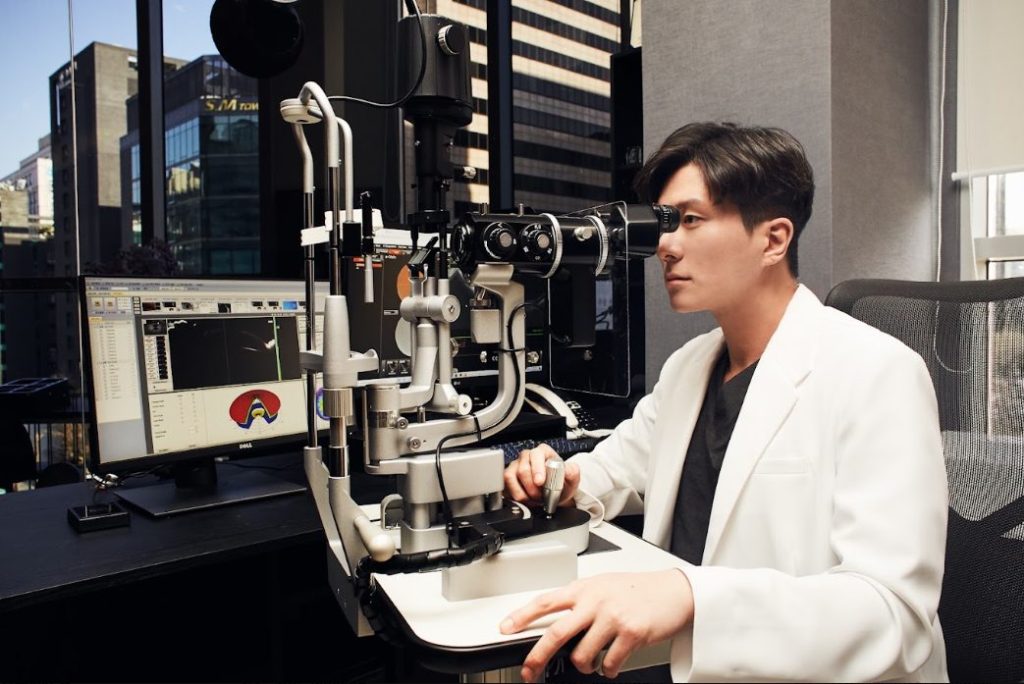
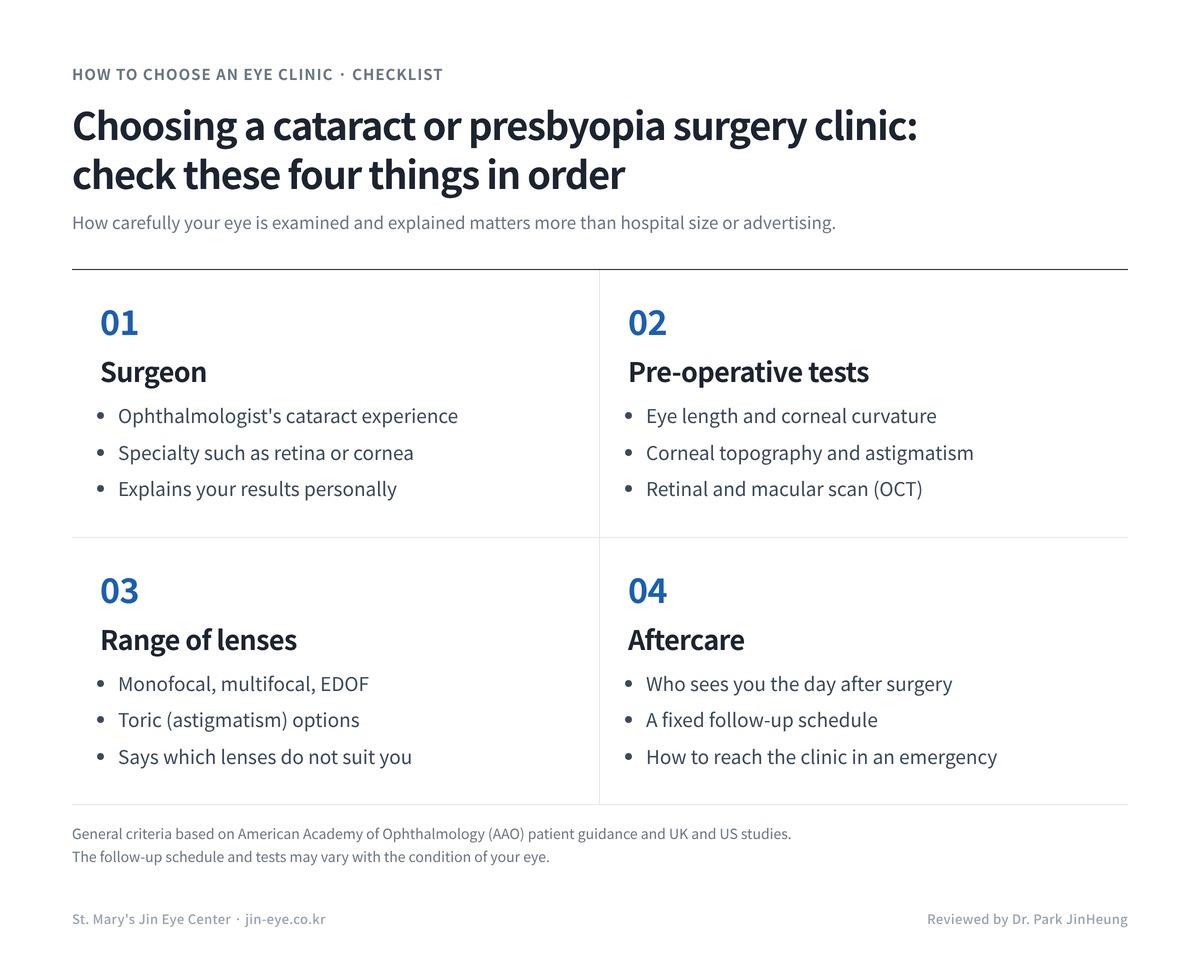
To choose an eye clinic in Korea for cataract surgery or lens replacement for presbyopia, check four things in order: the surgeon’s experience and specialty, the pre-operative tests (eye length, corneal curvature and topography, and a macular OCT scan), the range of intraocular lens options, and the aftercare system. How carefully your eye is examined, and whether the results are explained to you before a lens is chosen, matters more than the size of the hospital or its advertising.
Medically reviewed by Dr. Park JinHeung, Director, St. Mary’s Jin Eye Center (Ophthalmologist, PhD; Adjunct Professor, Seoul St. Mary’s Hospital) · Last updated 2026-11-27
Ask who will see you the day after surgery and whom to contact if pain or blurred vision appears. As an international patient, also confirm the interpreter, your surgery and check-up schedule and what the fee includes before you book flights. Below, the ophthalmologists of St. Mary’s Jin Eye Center, an eye clinic near Gangnam Station in Seoul, set out the checks and the questions to ask, based on American Academy of Ophthalmology (AAO) guidance and published studies.
- Surgeon: an ophthalmologist who states their cataract experience and specialty, and explains your test results personally.
- Tests: eye length, corneal curvature and topography, plus a macular OCT scan and a dilated retinal examination. In one study, OCT found macular problems missed on routine examination.
- Lenses: monofocal, multifocal, EDOF and toric (astigmatism) lenses explained with their pros and cons for your eye and lifestyle.
- Aftercare: a check-up the day after surgery, a fixed follow-up schedule and a clear way to reach the clinic in an emergency.
- Be cautious with any clinic that guarantees results or chooses your lens before the examination.
- International patients: confirm interpreter availability, whether each eye will be operated on a separate day, the recommended length of stay and what the fee includes.
How do I choose an eye clinic in Korea for cataract surgery?
Look first at how carefully your eye is examined and whether the surgical plan is explained from the results, not at hospital size or advertising. Checking the surgeon, the pre-operative tests, the lens options and the aftercare in that order makes clinics easier to compare.
Cataract surgery was the most frequently performed of the 35 major operations tracked by Korea’s National Health Insurance Service (NHIS): its 2025 Major Surgery Statistics counted about 692,000 in a year (Digital Daily report, NHIS statistics).
Because it is so common, it is easy to think it is the same everywhere. But an intraocular lens usually stays in the eye for life, and every eye differs in coexisting disease, astigmatism and lifestyle, so the preparation makes a difference.
The AAO advises patients to ask the surgeon directly about their experience, lens options and costs, who provides care after surgery, whether further correction is possible, and the infection-control record of the surgical facility (AAO, How to Choose a Cataract Surgeon). The table below turns this into checks you can make at consultation.
| What to check | Why it matters | How to check at consultation |
|---|---|---|
| Surgeon | Eyes differ in difficulty, and retinal or corneal disease changes the plan | The surgeon’s specialty and cataract experience; who explains your results |
| Pre-operative tests | The basis for the lens power and lens type | Whether eye length, corneal curvature, topography and retinal OCT are measured |
| Range of lenses | Different eyes and lifestyles suit different lenses | Whether several types are explained, including those that do not suit you |
| Aftercare | Even rare complications must be found early to protect vision | Check-up the day after surgery, follow-up schedule, emergency contact |
What should I check about the cataract surgeon?
Check that an ophthalmologist performs the surgery, how much cataract surgery they have done, and whether they have a specialty — such as retina or cornea — that covers other problems in your eye. Whether the surgeon explains your results and answers your questions personally is also an important sign.
The AAO suggests asking how many cataract operations the surgeon has performed and how much experience they have with the lens they recommend (AAO).
In a UK national audit of more than 55,000 cataract operations, posterior capsule rupture and/or vitreous loss occurred in 1.92% (Jaycock et al., Eye 2009). A study of 4,322 operations by 19 UK trainees found posterior capsule rupture in 2.3%, falling significantly as experience grew (Buchan and Cassels-Brown, Eye 2008).
Experience can affect outcomes, but rather than judging by a single number, see how specifically the surgeon explains the risk factors in your eye. Eyes whose pupils dilate poorly, dense cataracts, high myopia and retinal disease such as diabetic retinopathy or macular degeneration may need a different plan.
If you take prostate medicines (such as tamsulosin) or blood thinners, tell the clinic and ask how they prepare for it. Do not stop any medicine without your prescribing doctor’s advice. Preparation for medicines is covered in medications before cataract surgery, and planning with retinal disease in cataract surgery with retinal disease.
Which tests should be done before cataract surgery?
The key tests are eye length and corneal curvature to calculate the lens power, corneal topography for astigmatism and corneal shape, and a macular OCT scan to detect macular abnormalities that may not be visible on routine examination, together with a dilated retinal examination. Careful testing reduces refractive surprises after surgery and shows whether lenses that depend heavily on eye health, such as multifocal lenses, are suitable.
The AAO explains that eye length and corneal curvature are the most important measurements for lens power, and that although the calculation is very accurate, errors can occur (AAO, Ask an Ophthalmologist).
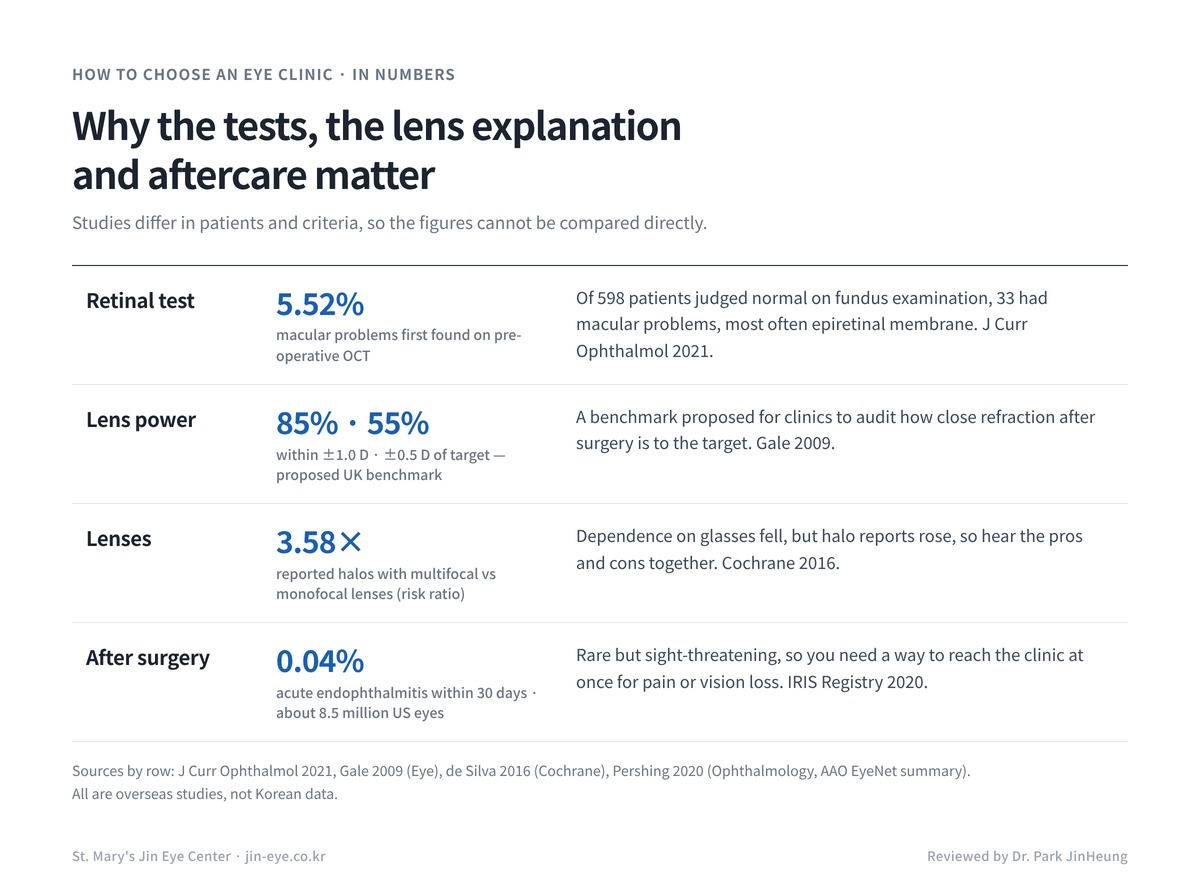
In the UK, a benchmark was proposed for clinics to audit themselves: 85% of patients within ±1.0 dioptre and 55% within ±0.5 dioptre of the predicted refraction (Gale et al., Eye 2009). This is an audit benchmark for clinics, not a promise for an individual, so ask how the lens power is calculated and what is done if there is an error.
In a study of 598 patients judged normal on fundus examination before cataract surgery, macular OCT found abnormalities missed on examination in 33 (5.52%); epiretinal membrane was the most common, and the risk was higher over age 70 (J Curr Ophthalmol 2021). Only 0.83% actually had their surgical plan changed, but knowing in advance explains why vision may be lower than expected after surgery. With retinal disease, a monofocal lens may be better than a multifocal one, so the retinal test is linked directly to lens choice.
| Test | What it measures | Why it is needed |
|---|---|---|
| Optical biometry | Eye length, anterior chamber depth and more | Lens power calculation |
| Keratometry and corneal topography | Corneal shape, amount and type of astigmatism | Need for a toric lens; multifocal suitability |
| Retinal and macular OCT | Cross-sectional structure of the macula | Hidden epiretinal membrane, macular degeneration and more |
| Dilated fundus examination | The retina, including the periphery | Retinal tears, diabetic retinopathy and more |
| Endothelial cell count and eye pressure | Corneal health, glaucoma risk | Surgical safety and aftercare plan |
The tests may vary with the condition of your eye.
Why does the range of lens options matter?
Intraocular lenses differ in the range of vision they provide and the likelihood of halos and similar visual disturbances, so a wider choice makes it easier to match a lens to your eye and lifestyle. More important than the number of lenses, though, is whether the clinic honestly tells you which lenses do not suit you.
Intraocular lenses are grouped by focus into monofocal (one primary focal distance), multifocal (several distances) and extended depth of focus (EDOF), and toric lenses also correct corneal astigmatism (AAO, IOL Implants).
The AAO notes that presbyopia-correcting lenses can cause halos and glare, reduced contrast and less sharp vision in dim light, and that the risk of a poor result is higher if you already have another eye disease (AAO, Presbyopia-correcting IOLs).
In a Cochrane review of 20 randomised trials, multifocal lenses reduced dependence on glasses compared with monofocal lenses (risk ratio 0.63), but the risk ratio for reported halos was 3.58 and for glare 1.41 (de Silva et al., Cochrane 2016). The analysis reflects the lenses studied at the time; newer lenses differ by product. So choose a lens by your driving, reading and computer time, night activities and retinal and corneal condition, not by price or trend.
| Lens | Often suits | Be cautious when |
|---|---|---|
| Monofocal | Life focused mainly on one distance; eyes with retinal or macular disease | You want to see near without glasses |
| Multifocal (trifocal etc.) | You want less dependence on glasses and have a healthy retina and cornea | You drive at night a lot or are sensitive to halos; retinal disease, glaucoma etc. |
| EDOF (extended depth of focus) | You want a continuous range of vision from distance to intermediate, such as a computer screen | Reading glasses may be needed for long periods of small print |
| Toric (astigmatism) — available as monofocal, multifocal and EDOF | Corneal astigmatism above a certain level | Irregular astigmatism or an uneven cornea |
Products of the same type also differ; the final choice is made from your tests and consultation.
Lens differences are covered in multifocal vs monofocal lenses and trifocal vs EDOF lenses, and Alcon’s new monofocal plus lens in the Clareon TruPlus IOL guide. If you are in your 40s or 50s and considering lens replacement for presbyopia, see presbyopia surgery and refractive lens exchange for the risk of retinal detachment and the loss of natural focusing.
How do I check the aftercare after cataract surgery?
Before surgery, confirm who will see you the day after surgery, the follow-up schedule, and whom to contact if emergency symptoms such as pain or blurred vision appear. Even rare complications can threaten vision, so early detection matters; choose a clinic with a clear contact system.
The US National Eye Institute (NEI) says most people feel comfortable within a day or two, full recovery can take about 8 weeks, and you should contact your doctor right away for vision loss, severe pain that continues despite medicine, intense redness, or flashes or new floaters (NEI, Cataract Surgery).
In a US registry study of about 8.5 million eyes from 2013 to 2017, acute endophthalmitis within 30 days of surgery was rare at 0.04%, but it can threaten sight, so prompt care matters (Pershing et al., Ophthalmology 2020 — AAO EyeNet summary).
Recovery routines are covered in how long to stay in Korea for cataract surgery, and warning signs in retinal detachment warning signs after cataract surgery.
| Symptom after surgery | What to do |
|---|---|
| Mild grittiness and glare that gradually fade | Check at the scheduled visit |
| A red patch on the white of the eye without pain or vision loss | Usually clears by itself; check at the visit |
| Increasing pain or falling vision, intense redness or discharge | Contact the clinic at once for a same-day eye examination |
| New or suddenly increased floaters or flashes of light | Seek urgent eye assessment and a dilated retinal examination the same day |
| A curtain over part of your vision, sudden vision loss | Do not wait for the next visit — see an eye doctor at once, or go to an emergency room |
| You have any urgent symptom above and cannot reach the clinic | Go at once to the nearest emergency department, preferably at a hospital with an ophthalmology service. In Korea, call 119 for emergency medical help |
What questions should I ask at a cataract surgery consultation?
Ask about the condition of your eye shown by the tests, the recommended lens and why, the discomfort to expect after surgery, and the day-after check-up and emergency contact. Writing your questions down beforehand helps you cover everything in the consultation time.
| Question | What it checks |
|---|---|
| Do I have any other eye disease besides cataract (retina, cornea, glaucoma)? | Coexisting disease that affects the plan and lens choice |
| Why do you recommend this lens, and which lenses do not suit me? | Whether the recommendation is based on your test results |
| Might I still need glasses or reading glasses after surgery? | Realistic expectations |
| What happens if I have halos or a refractive error? | How it is handled, including further correction |
| Who performs the surgery, and who sees me the day after? | The surgeon and post-operative care |
| When will each eye be operated on? | Interval between the eyes and the schedule |
| What does surgery cost with my lens, and what is included? | The fee structure and any extra costs |
| How is infection controlled in the operating room? | Infection-prevention system |
| Whom do I contact if emergency symptoms appear after surgery? | The post-operative contact system |

The AAO advises avoiding a doctor who guarantees your vision after surgery (AAO). Check again any explanation that chooses your lens before the examination or insists you will never need glasses after surgery. It is also worth asking more questions if a multifocal lens is recommended without a retinal test, or if limits such as halos and refractive error are not explained.
What should international patients confirm before choosing an eye clinic in Korea?
Beyond the four checks, confirm the interpreter, how the two eyes are scheduled, how long to stay, and what the fee includes before you book flights. The final schedule and lens are decided after the examination in Korea.
| Item | At St. Mary’s Jin Eye Center |
|---|---|
| Interpreter | Complimentary English and Mongolian interpreting is always available. Other languages can be arranged if requested at least 3 days ahead: free on the day of surgery, ₩100,000 per day on days with only examinations or outpatient visits |
| Examination and consultation | About 1 hour of tests and about 1 hour of consultation and consent; if you are confirmed suitable and the schedule allows, surgery can be done on the day of the examination |
| Two eyes | As a rule, the two eyes are operated on different days, to reduce the risk of a complication such as infection affecting both eyes, and so that the first eye can be checked before the second |
| Stay in Korea | Your surgeon confirms when it is safe to fly, based on your check-ups; we usually recommend staying about one week |
| Cost | The examination fee is included in the surgery price if you have surgery on the same day; examination only is ₩80,000. Follow-up visits after surgery may cost up to ₩50,000 each. Lens prices are listed on our price page |
| After you return home | If warning signs appear, see a local eye doctor at once rather than waiting for an e-mail reply |
Lens prices and what determines the final quote are in cataract surgery cost in Korea and St. Mary’s Jin Eye Center — facts and 2026 prices. Prices are confirmed after the examination.
What does St. Mary’s Jin Eye Center check before cataract surgery?
Our pre-operative examination assesses the retina together with the lens power, and the lens and treatment plan are decided from the results. Same-day surgery in our Zero Cataract programme also goes ahead only after the results, medicines and general health have been checked.
Our two directors, Dr. Park JinHeung and Dr. Park Jae-hyun, are ophthalmologists formerly on the faculty of Seoul St. Mary’s Hospital, specialising in the retina and the anterior segment respectively, and both are regular members of the Korean Retina Society.
With experience of more than 21,000 presbyopia and cataract operations, we use equipment including the Alcon Centurion Vision System and ZEISS OPMI Lumera, and choose with you from 14 intraocular lenses the one that suits your eye and lifestyle. When retinal treatment is needed first, as in diabetic retinopathy or macular disease, we plan retinal care and cataract surgery together. The whole process is described in cataract surgery in Korea — Zero Cataract.
Cataract surgery is well established and generally safe, but complications can occur, including infection (endophthalmitis), bleeding, posterior capsule rupture, macular oedema, retinal detachment and raised eye pressure, and posterior capsule opacification can develop later (NEI). Multifocal and EDOF lenses can cause halos, glare or reduced contrast, and the lens power calculation can have errors, so glasses may still be needed after surgery. Hearing these limits before choosing a clinic is the first step to being satisfied after surgery.
Frequently asked questions
How do I choose an eye clinic in Korea for cataract surgery?
Check four things in order: the surgeon’s experience and specialty, the pre-operative tests (eye length, corneal curvature, topography and retinal OCT), the range of lens options and the aftercare system. How carefully your eye is examined and whether the plan is explained from the results matters more than hospital size or advertising.
Should I judge a cataract surgeon by the number of operations?
Experience is an important factor; in UK studies, posterior capsule rupture fell as surgical experience grew. But rather than a single number, see whether the surgeon explains the risk factors and other diseases in your eye and tells you which lenses suit you and which do not.
Why does the examination before cataract surgery take so long?
It includes eye length and corneal curvature for the lens power, corneal topography for astigmatism, a retinal and macular OCT scan for hidden disease and a dilated fundus examination. In a pre-operative OCT study of patients judged normal on examination, macular problems were found in 5.52%, which helps with lens choice and predicting vision after surgery.
Is a clinic with more lens types better?
A wider choice makes it easier to match a lens to your eye and lifestyle, but honesty about which lenses do not suit you matters more than the number of types. Multifocal lenses reduce dependence on glasses but can increase halos and glare, and with retinal disease a monofocal lens may be better.
What should I check about aftercare after cataract surgery?
Before surgery, confirm who sees you the day after, the follow-up schedule and how to reach the clinic in an emergency. If pain increases, vision falls, or floaters or flashes are new or suddenly increase, seek a same-day eye examination at once. If a curtain covers part of your vision, see an eye doctor at once, or go to an emergency room.
How long should I stay in Korea for cataract surgery?
The two eyes are usually operated on different days, and your surgeon confirms when it is safe to fly based on your check-ups. We usually recommend staying about one week. Your exact schedule is confirmed after the examination.
Where is St. Mary’s Jin Eye Center, an eye clinic in Gangnam, Seoul?
St. Mary’s Jin Eye Center is at 337 Gangnam-daero, Seocho-gu, Seoul (1F, 4F, 5F), about 5 minutes on foot from Gangnam Station Exit 5. Hours are Mon–Fri 09:00–18:00 (lunch 13:00–14:00) and Sat 09:00–15:00 (KST). English and Mongolian interpreting is free.
- 337 Gangnam-daero, Seocho-gu, Seoul (1F, 4F, 5F) — about 5 minutes on foot from Gangnam Station Exit 5
- Hours (KST): Mon–Fri 09:00–18:00 (lunch 13:00–14:00), Sat 09:00–15:00
- Phone +82-2-577-7782 · E-mail jin.eye.center@gmail.com
- Registered medical institution for international patients in Korea
- Clinic facts and prices: St. Mary’s Jin Eye Center — facts and 2026 prices
References
- American Academy of Ophthalmology. How to Choose a Cataract Surgeon. Source
- American Academy of Ophthalmology. Ask an Ophthalmologist: How is artificial lens power determined for cataract surgery? Source
- American Academy of Ophthalmology. IOL Implants: Lens Replacement After Cataracts. Source
- American Academy of Ophthalmology. Presbyopia-Correcting IOLs. Source
- National Eye Institute. Cataract Surgery. Source
- Macular optical coherence tomography before cataract surgery. J Curr Ophthalmol 2021;33(3):317-322. Source
- Gale RP, et al. Benchmark standards for refractive outcomes after NHS cataract surgery. Eye 2009;23:149-152. Source
- de Silva SR, et al. Multifocal versus monofocal intraocular lenses after cataract extraction. Cochrane Database Syst Rev 2016;CD003169. Source
- Pershing S, et al. Endophthalmitis after cataract surgery in the United States (IRIS Registry). Ophthalmology 2020 (AAO EyeNet summary). Source
- Jaycock P, et al. The Cataract National Dataset electronic multi-centre audit of 55,567 operations. Eye 2009;23:38-49. Source
- Buchan JC, Cassels-Brown A. Determinants of cataract surgical opportunities and complication rates in UK higher specialist training. Eye 2008;22:1425-1429. Source
- Digital Daily (Korean). Report on the National Health Insurance Service 2025 Major Surgery Statistics (31 August 2026). Source
This article is general medical information about choosing a clinic for cataract or presbyopia surgery and does not replace individual diagnosis or treatment. Suitability, lens choice and schedule depend on your examination, and every operation can have side effects. Clinical study figures cited here are from international research and do not represent Korean complication rates or our clinic’s own outcomes. Prices are confirmed after the examination. Zero Cataract is the name of St. Mary’s Jin Eye Center’s cataract surgery programme. Written 27 November 2026.