Multifocal vs monofocal lens for cataract surgery: a multifocal lens splits light so that you can see both far and near, and it may reduce your need for glasses — but halos are more common, so it does not suit every eye. A monofocal lens gives one sharp distance (usually far) and you will usually need reading glasses. At St. Mary’s Jin Eye Center in Seoul the lens is chosen from 14 types after about 1 hour of tests and 1 hour of consultation, based on the distances you use most and the health of your retina, cornea and tear film.
Medically reviewed by Dr. Park JinHeung, Director, St. Mary’s Jin Eye Center (Ophthalmologist, PhD; Adjunct Professor, Seoul St. Mary’s Hospital) · Last updated 2026-10-23
The real question is not which lens is “better”, but which lens fits the distances you use and the condition of your eye. This guide explains the four lens designs, what research shows about glasses and halos, who is a good or poor candidate for a multifocal lens, why some people are unhappy after surgery and how that is managed, and what international patients need to plan: days in Seoul and the price of each lens per eye.
Multifocal vs monofocal lens: what is the difference?
Cataract surgery removes the cloudy natural lens and replaces it with an artificial intraocular lens (IOL). The operation is the same; the optical design of the lens decides which distances you see well afterwards. A monofocal lens focuses light at one distance, a multifocal lens divides light between several distances, and in between there are extended depth of focus (EDOF) lenses and enhanced monofocal lenses. Because a multifocal lens divides light, halos and reduced contrast sensitivity are more likely. Toric (astigmatism-correcting) versions can be combined with each design.
| Monofocal | Enhanced monofocal | EDOF | Multifocal | |
|---|---|---|---|---|
| Clearest range | One distance (usually far) | Far plus some intermediate | Far to intermediate | Far and near, or far, intermediate and near (by product) |
| Small print | Reading glasses usually needed | Reading glasses may be needed | Reading glasses may be needed for small print | Less dependence on reading glasses is likely |
| Halos and glare | Less common | Similar to monofocal (varies by product) | May be more than monofocal | Relatively common |
| Contrast sensitivity | Favourable | Varies by product | Varies by product | Can be reduced |
| Often considered for | Macular or optic nerve disease, much night driving, sharpness first | Monofocal sharpness with a little intermediate | Driving and computer work, worried about halos | Strong wish to be free of glasses and a healthy eye |
A general comparison, not a ranking. Products within the same design group also differ, and the final choice is made with your ophthalmologist after the full exam.
Will a multifocal lens really make me glasses-free?
Glasses dependence is often reduced, but no one can promise that you will never need glasses at any distance or in any light. In research, multifocal lenses reduced glasses dependence, and halos were more common in exchange.
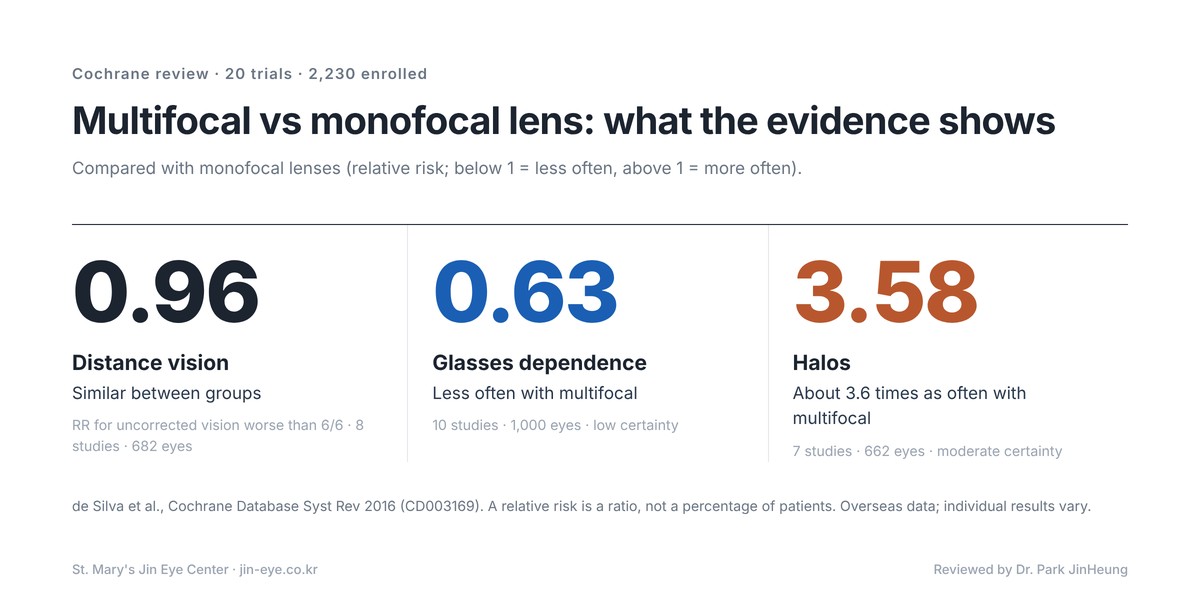
A 2016 Cochrane systematic review identified 20 trials enrolling 2,230 people (follow-up data for 2,061 people, 3,194 eyes): 18 compared multifocal with monofocal lenses and 2 compared multifocal lenses with monovision. Uncorrected distance vision was similar between the groups (relative risk of vision worse than 6/6: 0.96; 8 studies, 682 eyes; moderate-certainty evidence). Near vision was better with multifocal lenses, but results varied widely between studies, so certainty was low.
Glasses dependence was lower with multifocal lenses (relative risk 0.63, 10 studies, 1,000 eyes, low certainty), while halos were reported more often (relative risk 3.58, 7 studies, 662 eyes, moderate certainty) and glare too (relative risk 1.41, low certainty). The authors concluded that whether the near-vision benefit is worth the halos differs from person to person, and that how much you value being free of glasses should guide the decision (de Silva et al., Cochrane 2016).
A relative risk of 3.58 does not mean that 3.58% or 358% of people get halos; it means halos were reported about 3.6 times as often as with monofocal lenses. A meta-analysis of one EDOF lens (Tecnis Symfony; 9 studies, 1,336 eyes) found better intermediate and near vision than monofocal lenses, but more frequent halos and reduced contrast sensitivity (Liu et al., BMC Ophthalmol 2019); this cannot be applied to every EDOF lens, and newer lenses differ by optical design.
Who is a good candidate for a multifocal lens?
People who clearly want to live without glasses and whose retina, macula, optic nerve, cornea and tear film are healthy tend to suit a multifocal lens best. Understanding that halos can occur and that the brain needs time to adapt is also part of being a good candidate.
| What we check | Why it matters | How it is assessed |
|---|---|---|
| How much you want to be free of glasses | The benefit of a multifocal lens is less dependence on glasses | The distances you use most — reading, phone, computer, driving — and your expectations |
| Retina, macula and optic nerve | A lens that divides light needs a healthy retina to show its advantages | Retinal exam including OCT, fundus exam, visual field test if needed |
| Corneal shape and astigmatism | An irregular cornea or leftover astigmatism reduces multifocal sharpness | Corneal tomography (OCULUS Pentacam HR), corneal curvature and astigmatism, toric lens planning if needed |
| Tear film and eye surface | Dry eye makes measurements unreliable and is a common cause of blur after surgery | Tear film and ocular surface check; treatment first and repeat measurement if needed |
| Tolerance of halos | Halos are reported more often with multifocal lenses | How often you drive at night, your job, and your understanding of halos |
Based on St. Mary’s Jin Eye Center’s cataract exam. The final decision is made by the ophthalmologist after reviewing all results.
People in their 40s and 50s who have both early cataract and presbyopia and read or use screens a lot often consider a multifocal or EDOF lens.
Who may not be a good candidate for a multifocal lens?
If you have macular disease, advanced glaucoma, an irregular cornea or uncontrolled dry eye, the downsides of a multifocal lens may outweigh its benefits. People who drive a lot at night, or who expect sharp vision at every distance and in every light without glasses, should also compare monofocal and EDOF lenses.
| If you have | Why we think again | Next step |
|---|---|---|
| Macular disease such as macular degeneration, macular oedema or diabetic retinopathy | When the macula works less well, the contrast loss of a light-splitting lens can be felt more | Consider monofocal or enhanced monofocal first; decide together with the retina treatment plan |
| Advanced glaucoma or other optic nerve disease | Contrast sensitivity may already be reduced | Choose the lens after visual field and optic nerve tests |
| Irregular cornea, keratoconus or previous LASIK/LASEK | More corneal aberrations reduce multifocal sharpness, and lens power calculation errors can be larger | Decide after detailed corneal tests |
| Uncontrolled dry eye or blepharitis | A common cause of measurement error and blur after surgery | Treat first, then measure again |
| A job with much night driving, or sensitivity to halos | Halos and glare are reported more often with multifocal lenses | Compare with monofocal and EDOF lenses |
| Expecting perfectly sharp vision at every distance and in every light | No intraocular lens can promise this | Align expectations before choosing |
General criteria only. The same condition is judged differently depending on its severity, and these findings do not automatically rule out a multifocal lens.
The American Academy of Ophthalmology’s patient answer also says multifocal lenses should be recommended with caution when there is dry eye, corneal disease, or a condition affecting the macula such as diabetic retinopathy or macular degeneration, and that treating the other condition first or avoiding a multifocal lens should be weighed (American Academy of Ophthalmology, 2014). How a retinal condition changes timing and lens choice is explained in cataract surgery in Korea with a retinal condition.
Is choosing a monofocal lens a disadvantage?
No — it is a different choice. Monofocal lenses generally cause fewer halos than multifocal lenses and are favourable for contrast sensitivity, so they may suit people with other eye conditions or much night driving better. With a monofocal lens the focus is usually set for distance and reading glasses are used for near; people who mainly work up close sometimes choose near focus instead. Setting the two eyes slightly differently (monovision) or using different lenses in each eye are also options. In the Cochrane review, multifocal lenses reduced glasses dependence even compared with monovision (relative risk 0.40, 2 studies), but glare was more common.

| Your daily life | Options to compare first | Also keep in mind |
|---|---|---|
| Want to read and use a phone without glasses | Multifocal | Possible halos and a period of adaptation |
| Mostly driving and computer, reading glasses for small print are fine | EDOF or enhanced monofocal | Very small print may still need reading glasses |
| Much night driving, sharpest distance vision matters most | Monofocal | Reading glasses for near |
| Macular disease, glaucoma or other eye conditions | Monofocal or enhanced monofocal | Plan the treatment of the other condition at the same time |
Starting points only; depending on your eyes, another option may suit you better.
Why are some people unhappy after a multifocal lens, and how is it managed?
Blurred vision is the most common complaint, and the usual causes are leftover refractive error, dry eye, posterior capsule opacification and large pupils. Depending on the cause, glasses, dry eye treatment or a laser procedure may help, but symptoms are not always fully resolved and a lens exchange is sometimes needed.
In a Dutch university hospital study of 49 people (76 eyes) unhappy after a multifocal lens, 94.7% reported blurred vision and 38.2% light phenomena such as halos. The main causes were residual refractive error, posterior capsule opacification and large pupils; 84.2% (64 eyes) were considered amenable to treatment, and the lens was exchanged in 4.0% (3 eyes) (de Vries et al., J Cataract Refract Surg 2011). The 84.2% refers to eyes considered treatable, not the proportion successfully treated.
In a US university study of 49 people (74 eyes) unhappy after presbyopia-correcting lenses, blurred vision was again the most common complaint (68%), with residual refractive error (57%) and dry eye (35%) as the main causes. After treatment, 45% were fully resolved and 23% partly satisfied, but 32% remained unhappy; 7% had a lens exchange (Gibbons et al., Clin Ophthalmol 2016). Both studies included only unhappy patients, so they do not show how many multifocal patients are unhappy overall, and they are not Korean data.
Apart from the lens design, cataract surgery itself can lead to posterior capsule opacification and, rarely, infection inside the eye (endophthalmitis), macular oedema or retinal detachment.
- Sudden loss of vision, severe pain, worsening redness, a sudden increase in floaters, flashes of light, or a curtain-like shadow over your vision after surgery: do not wait for your check-up — contact the clinic that operated on you at once. Outside opening hours in Korea, go to a hospital emergency department with ophthalmology services; if you are already home, see a local ophthalmologist or eye emergency service the same day.
How many days should I stay in Korea for cataract surgery with a multifocal lens?
Plan to stay at least until the check-up on the third day after surgery; you can fly home after that check if the eye is healing well and the surgeon agrees. We recommend about one week in Seoul. Same-day surgery after the exam is possible when your test results, eye condition and schedule allow; if your eye surface needs treatment before measurement, surgery may be on a later day.
| Step | What happens | Time |
|---|---|---|
| Before travel | Stop contact lenses (soft 5 days, hard/RGP 2 weeks, ortho-k 4 weeks); book online and send your medication list and recent eye records | — |
| Day 0 — exam | ZEISS IOLMaster 700 measurement, OCULUS Pentacam HR corneal tomography, retinal exam including OCT, tear film check | About 1 hour |
| Day 0 — consultation | Results, your daily distances, lens choice (monofocal, EDOF or multifocal), plan for both eyes | About 1 hour |
| Day 0 — surgery | Eye-drop anesthesia, cloudy lens removed, IOL inserted | Usually around 10 minutes per eye; rest 30–60 minutes |
| Day 1 | Check-up (eye pressure, inflammation, vision) | Clinic visit |
| Day 3 | Check-up before flying home (minimum for international patients) | Clinic visit |
| Up to 4 weeks | Prescribed drops; keep water out of the eye for 1 week, eye shield at night for 2 weeks, no sauna, swimming, eye make-up or strenuous exercise for 4 weeks | Follow-up with an ophthalmologist at home |
Based on St. Mary’s Jin Eye Center’s care pathway; your surgeon’s instructions come first. Both eyes are usually operated on separately, one after checking the result of the other — ask about the total stay when booking.
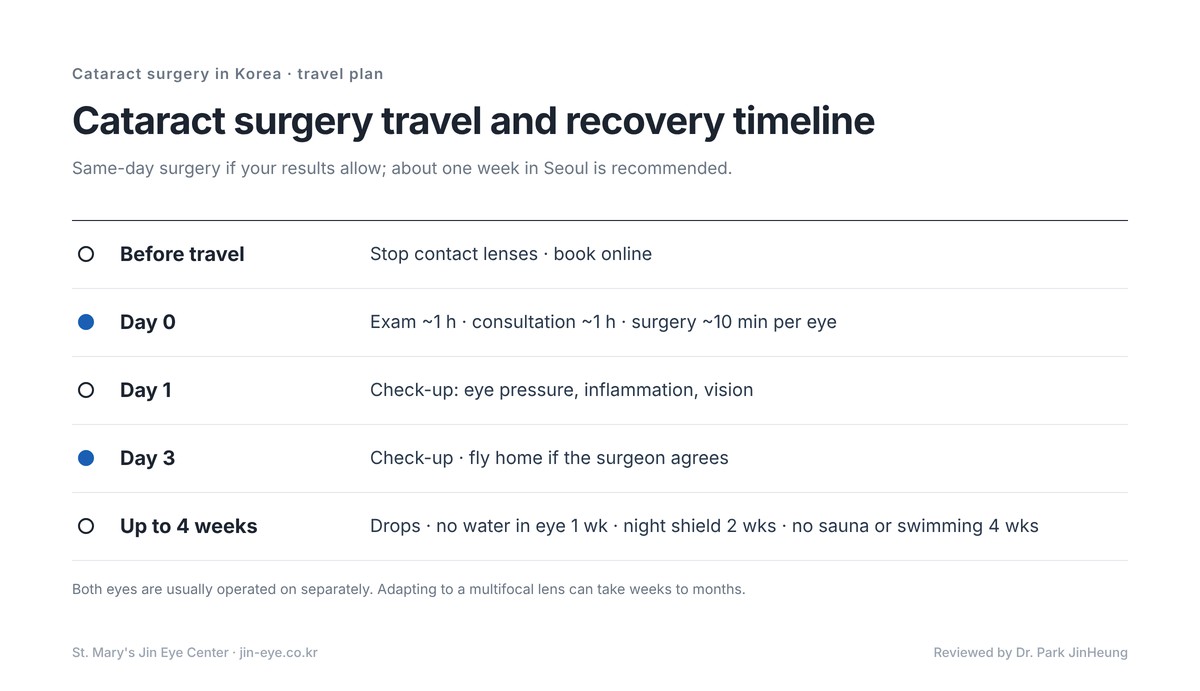
Adapting to a multifocal lens can take weeks to months, and vision may keep changing after you fly home, so arrange a follow-up with an ophthalmologist near home. Day-by-day planning is in how long to stay in Korea for cataract surgery, and the whole program is described in the Zero Cataract™ guide.
How much does a multifocal lens for cataract surgery cost in Korea? (2026)
Prices are per eye and depend on the lens. At St. Mary’s Jin Eye Center a monofocal lens starts at ₩1,500,000 per eye, and multifocal and EDOF lenses range from ₩2,800,000 to ₩6,500,000 per eye; the cataract examination is ₩100,000. All prices are finalized after the detailed eye exam.
| Lens (per eye) | Design | Price per eye (KRW, 2026) |
|---|---|---|
| Alcon Clareon Monofocal | Monofocal | ₩1,500,000 |
| Alcon Clareon Monofocal Toric | Monofocal (astigmatism) | ₩2,000,000 |
| J&J TECNIS Eyhance | Enhanced monofocal | ₩2,500,000 |
| PhysIOL FINEVISION | Trifocal | ₩2,800,000 |
| J&J TECNIS Synergy · TECNIS PureSee | Continuous range (multifocal) / EDOF | ₩3,000,000 |
| Alcon AcrySof PanOptix · AcrySof IQ Vivity | Trifocal / EDOF | ₩3,000,000 |
| ZEISS AT LISA tri · AT ELANA | Trifocal | ₩4,000,000 |
| Alcon Clareon PanOptix · Clareon Vivity | Trifocal / EDOF | ₩4,500,000 |
| J&J TECNIS Odyssey | Full range of vision (multifocal) | ₩5,000,000 |
| Alcon Clareon PanOptix Pro | Trifocal | ₩6,500,000 |
| Cataract examination | — | ₩100,000 |
Ophtec Precizon Go (₩2,200,000 per eye) is also available. Prices are per eye; the examination is charged separately. Ask what each price includes. Prices as of October 2026.
Full price lists: St. Mary’s Jin Eye Center facts and 2026 prices. Your final quote depends on the lens chosen for your eye, astigmatism correction and whether one or both eyes are treated.
Frequently asked questions
What is the main difference between a multifocal and a monofocal lens?
A monofocal lens gives the sharpest vision at one distance, usually far, and reading glasses are usually needed for near. A multifocal lens divides light between distances so you can see far and near, which may reduce your need for glasses, but halos and glare are more common. Distance vision was similar with both in research.
Will I never need reading glasses with a multifocal lens?
Glasses dependence is often reduced, but this cannot be promised. Very small print, dim light or long reading may still need reading glasses, and leftover refractive error or astigmatism can mean wearing glasses.
Do halos from a multifocal lens get better over time?
Many people notice them less over a few months as they adapt, but this varies widely and halos may not disappear completely. If they are troublesome, treatable causes such as leftover refractive error, dry eye or posterior capsule opacification are checked.
Can I have a multifocal lens if I have macular degeneration or glaucoma?
It is not automatically ruled out, but with macular disease or advanced glaucoma the contrast loss of a multifocal lens can be felt more, so a monofocal or enhanced monofocal lens is often considered first. The decision depends on the severity and treatment plan.
Can I have cataract surgery and choose my lens on the same day as the exam in Korea?
Yes, if your test results, eye condition and schedule allow, surgery can follow the exam and consultation on the same day. If dry eye or other findings need treatment before measurement, surgery is scheduled for a later day.
How long should I stay in Seoul after cataract surgery?
At least until the check-up on day 3 after surgery; you can fly home after that check if the eye is healing well and the surgeon agrees. About one week is recommended. Both eyes are usually operated on separately, so ask about the total stay if you want both eyes done.
How much does a multifocal lens cost in Korea?
At St. Mary’s Jin Eye Center, multifocal and EDOF lenses cost ₩2,800,000 to ₩6,500,000 per eye depending on the lens, a monofocal lens from ₩1,500,000 per eye, and the cataract examination ₩100,000 (2026). The final price is confirmed after the exam.
- 337 Gangnam-daero, Seocho-gu, Seoul (1F, 4F, 5F) — about 5 minutes on foot from Gangnam Station Exit 5
- Hours (KST): Mon–Fri 09:00–18:00 (lunch 13:00–14:00), Sat 09:00–15:00
- Phone +82-2-577-7782 · E-mail jin.eye.center@gmail.com
- Registered medical institution for international patients in Korea
- Clinic facts and prices: St. Mary’s Jin Eye Center — facts and 2026 prices
This article is general medical information and does not replace an individual diagnosis. Lens choice, whether surgery is possible and the vision you get afterwards depend on your test results and eyes, and every operation can have side effects. Zero Cataract™ is a Korean trademark application (No. 40-2026-0207205), not a registered trademark.