
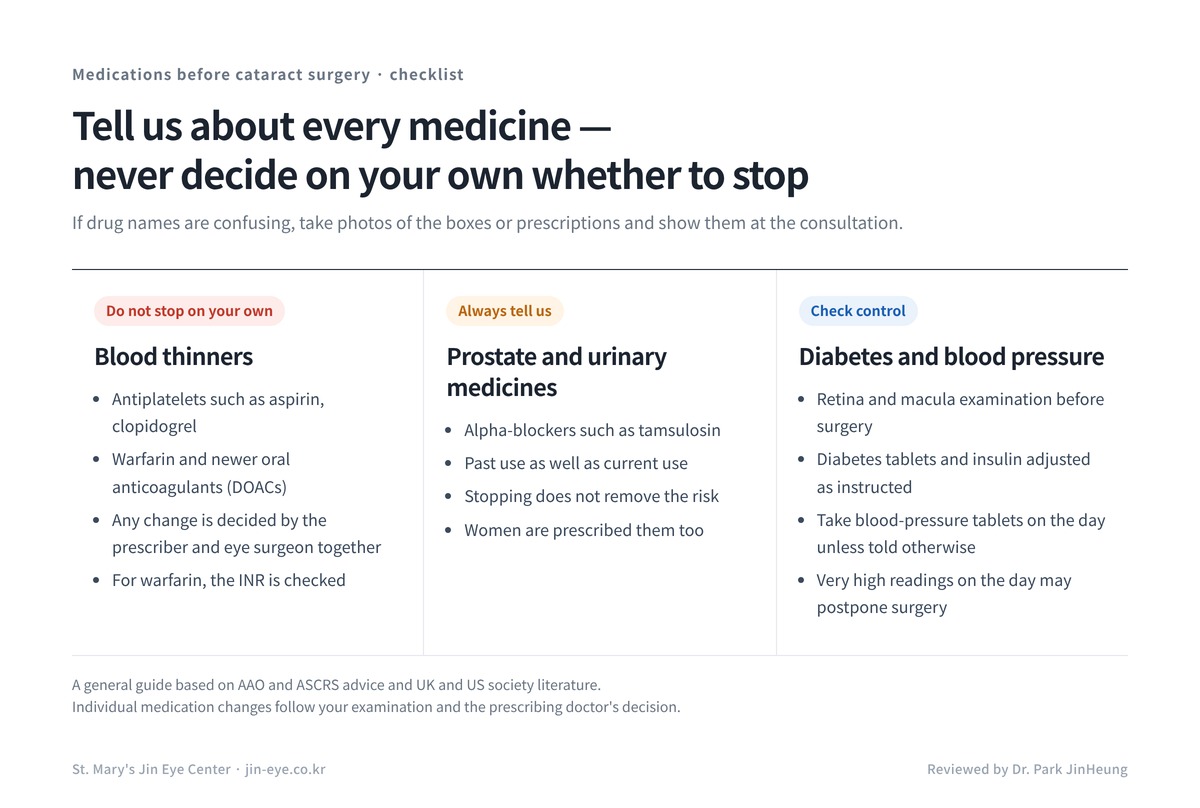
Medications before cataract surgery: most of your usual medicines are continued, but you must tell your eye surgeon about every medicine you take. Do not stop aspirin or other blood thinners on your own: in routine cataract surgery they are usually continued, and any change is decided together by the doctor who prescribed them and your eye surgeon. Tamsulosin (Flomax) and other alpha-blockers — now or in the past — must be reported because of floppy iris syndrome (IFIS); diabetes needs a retina and macula check, and blood pressure should be under control on the day.
Medically reviewed by Dr. Park JinHeung, Director, St. Mary’s Jin Eye Center (Ophthalmologist, PhD; Adjunct Professor, Seoul St. Mary’s Hospital) · Last updated 2026-11-20
International patients often ask whether they should stop their pills before flying to Korea for cataract surgery. The short answer is: do not stop anything by yourself, bring a complete list, and let your home doctor and our eye surgeons agree on a plan. Below, the ophthalmologists of St. Mary’s Jin Eye Center in Gangnam, Seoul, go through blood thinners, prostate medicines, diabetes and blood pressure one by one, using published guidelines and studies.
- Tell us about every tablet, eye drop and supplement you use; a photo of the boxes or prescriptions is the most accurate.
- Aspirin, clopidogrel, warfarin and newer oral anticoagulants (DOACs) are not stopped on your own; the literature usually supports continuing them in routine cataract surgery.
- Tamsulosin and other alpha-blockers can cause floppy iris syndrome even after they are stopped, so reporting them early and preparing during surgery matters more than stopping.
- Diabetes raises the risk of macular oedema after surgery, so the retina and macula are examined first and treated beforehand if needed.
- Blood-pressure tablets are taken as usual on the morning of surgery; if blood pressure is very high on the day, surgery may be postponed.
- International patients: agree a medication plan with your home doctor before travelling, carry a list with generic drug names, and plan to stay at least until the day-3 check-up after your final surgery; your surgeon confirms when you are fit to fly (about one week in Korea is generally recommended).
Why do I need to tell my eye surgeon about every medication before cataract surgery?
Some medicines affect bleeding, some affect how the pupil and iris behave during surgery, and some conditions affect healing afterwards, so the surgical plan and preparation change. Telling us does not mean you cannot have surgery; it lets us prepare more safely.
Cataract surgery removes the clouded natural lens through a small incision and replaces it with an intraocular lens, usually under local anaesthesia in a short procedure. The US Society for Ambulatory Anesthesia (SAMBA) recommends that usual medications, including antiplatelet and anticoagulant drugs, are generally continued before cataract surgery (SAMBA, Anesth Analg 2021). Because the same drug can be handled differently depending on why you take it and your other conditions, an accurate list of drug names and doses is the starting point.
| Medicine or condition | Why we check | What to do before surgery |
|---|---|---|
| Blood thinners (aspirin, clopidogrel, warfarin, DOACs and others) | Bleeding, such as bleeding on the white of the eye | Do not stop on your own; for warfarin, check the INR |
| Prostate or urinary medicines (alpha-blockers such as tamsulosin) | Floppy iris during surgery (IFIS) | Report current and past use; do not stop on your own |
| Diabetes | Macular oedema after surgery, diabetic retinopathy | Retina and macula examination, blood-sugar control |
| High blood pressure | Blood pressure on the day, rare suprachoroidal haemorrhage | Take blood-pressure tablets as usual on the day |
| Other medicines (some psychiatric drugs, eye drops, supplements) | Some are reported to be linked with IFIS | Bring a list to the consultation |
A general guide; individual medication changes follow the decision of your eye surgeon and the doctor who prescribed the drug.
Should I stop aspirin or blood thinners before cataract surgery?
Do not stop them on your own. For routine cataract surgery under eye-drop (topical) or sub-Tenon anaesthesia, the literature generally recommends continuing antithrombotic drugs, and stopping them can raise the risk of clots such as stroke or heart attack. Whether any change is needed is decided together by the prescribing doctor and the eye surgeon.
A review in the journal Eye suggests continuing all antithrombotic drugs for routine cataract surgery under topical or sub-Tenon anaesthesia, and describes the Royal College of Ophthalmologists’ position that warfarin is continued when the INR is within the therapeutic range (Makuloluwa et al., Eye 2019). The American Academy of Ophthalmology Preferred Practice Pattern also notes that most studies support continuing anticoagulant and antiplatelet drugs during cataract surgery (AAO PPP 2016).
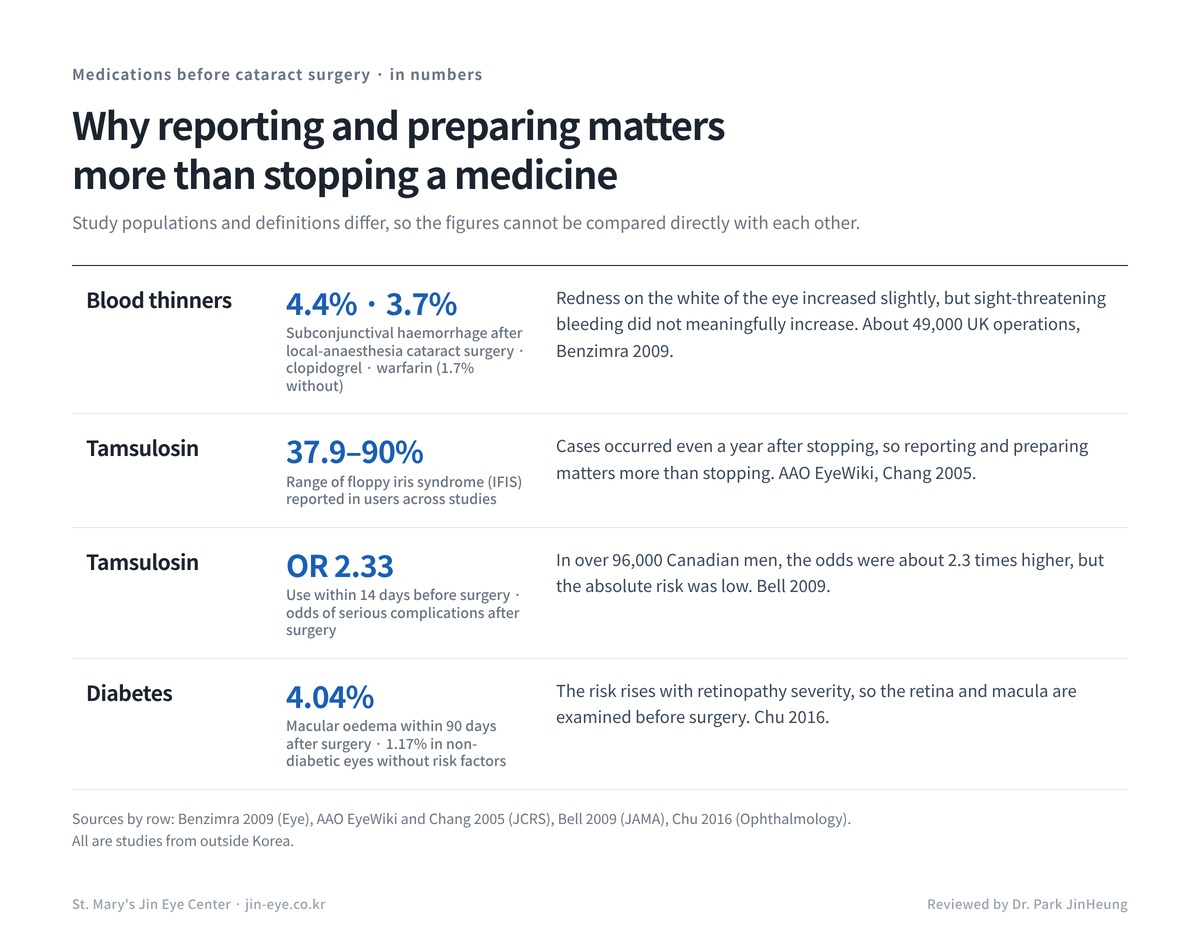
In the UK national cataract dataset (about 49,000 operations analysed), bleeding on the white of the eye (subconjunctival haemorrhage) occurred in 4.4% of patients on clopidogrel and 3.7% on warfarin, compared with 1.7% of those on neither, but sight-threatening haemorrhage did not increase (Benzimra et al., Eye 2009). A meta-analysis of studies that continued warfarin also found more bleeding, but mostly mild and self-limiting, and no patient lost vision because of bleeding (Jamula et al., Thromb Res 2009).
For newer oral anticoagulants (DOACs), studies limited to cataract surgery are still few, but the same review describes reports recommending that they are continued (Makuloluwa et al., Eye 2019). Some hospital guidance in Korea asks patients on anticoagulants to discuss stopping with the surgeon, so advice can differ by anaesthesia type and hospital (Asan Medical Center health information). What matters is never to decide alone: once the surgery date is set, the prescribing doctor (such as your physician or cardiologist) and the eye surgeon agree on a plan.
| Medicine | General approach | What we check |
|---|---|---|
| Aspirin | Usually continued | Why you take it (heart or stroke prevention, etc.) |
| Clopidogrel and other antiplatelet drugs | Usually continued; never stop on your own, especially after a coronary stent | Whether you take two or more together |
| Warfarin | Often continued when the INR is in the therapeutic range | Pre-operative INR |
| Newer oral anticoagulants (DOACs) | Few cataract-specific studies, but reports recommend continuing | Dosing time, kidney function, etc. |
The approach can differ with the anaesthesia method (eye drops, sub-Tenon or injection behind the eye) or combined procedures.
Is cataract surgery risky if I take tamsulosin (Flomax) for my prostate?
You can still have surgery, but tamsulosin makes floppy iris syndrome (IFIS) — a floppy, billowing iris and a pupil that becomes smaller during surgery — more likely, so we need to know in advance and prepare. Stopping the drug may not remove the risk, so do not stop it on your own and tell us about both current and past use.
Intraoperative floppy iris syndrome was first reported in 2005: in the first study it occurred in about 2% of some 1,600 eyes, and in the prospective part 15 of the 16 patients who developed IFIS were taking or had taken tamsulosin (Chang and Campbell, J Cataract Refract Surg 2005). In the same report, IFIS also occurred in patients who had stopped tamsulosin more than a year earlier. The American Academy of Ophthalmology’s EyeWiki summarises reported IFIS rates in tamsulosin users as 37.9–90% depending on the study (AAO EyeWiki).
In a study of more than 96,000 men in Ontario, Canada, taking tamsulosin within 14 days before surgery was associated with about 2.3 times the odds of serious complications after surgery (retinal detachment, retained lens fragments or endophthalmitis; adjusted odds ratio 2.33), although the absolute risk was low and other alpha-blockers showed no significant difference (Bell et al., JAMA 2009).
In their patient advisory, the American Academy of Ophthalmology and the American Society of Cataract and Refractive Surgery (ASCRS) advise patients who take or have taken an alpha-blocker to tell their eye surgeon and not to stop the drug without talking to the prescribing doctor (AAO and ASCRS patient advisory); the same advisory explains that stopping the drug may not help. Knowing in advance lets the surgeon adjust the dilating drops and prepare medicines or devices that stabilise the iris during surgery (AAO EyeWiki). If you are about to start an alpha-blocker and also need cataract surgery, the societies suggest considering cataract surgery first when the prostate treatment is not urgent, so tell your urologist about your planned eye surgery (AAO and ASCRS clinical statement 2014).
| Medicine | Link with IFIS | Good to know |
|---|---|---|
| Tamsulosin | Strongest link | Cases occurred even after stopping |
| Silodosin | Pharmacologically similar to tamsulosin | Report any use |
| Alfuzosin, doxazosin, terazosin | Reported, but less than tamsulosin | Also used for high blood pressure |
| Finasteride and others | Weaker reported link | Report any prostate medicine, whatever the type |
Alpha-blockers are also prescribed to women for urinary symptoms or kidney stones, so women’s medication history is checked as well.
What is checked before cataract surgery if I have diabetes?
Diabetes raises the risk of macular oedema after surgery, so the retina and macula are examined in detail first; if there is diabetic retinopathy or macular oedema, treatment before surgery or combined treatment around surgery is planned according to severity. Keep up your usual blood-sugar control; diabetes tablets and insulin on the day are adjusted according to your pre-operative instructions, and there is little evidence for postponing surgery at a fixed HbA1c level.
In a UK study of more than 80,000 cataract operations, macular oedema within 90 days after surgery occurred in 1.17% of non-diabetic eyes without other risk factors and in 4.04% of eyes with diabetes, and the risk increased with the stage of diabetic retinopathy (Chu et al., Ophthalmology 2016 — AAO EyeNet summary). The AAO Preferred Practice Pattern explains that uncomplicated cataract surgery does not markedly speed up diabetic retinopathy, but eyes with existing macular oedema or severe retinopathy have a higher risk of macular oedema after surgery (AAO PPP 2016).
The same guideline recommends checking the macula with optical coherence tomography (OCT) around surgery and seeing your physician as well if diabetes or blood pressure is poorly controlled. SAMBA notes that there is no evidence to postpone cataract surgery because of a particular blood-sugar or HbA1c value, and that surgery is postponed for acute conditions such as diabetic ketoacidosis, a hyperosmolar state or severe hypoglycaemia (SAMBA 2021).
How to take diabetes tablets or insulin on the day depends on fasting and the time of surgery, so follow your pre-operative instructions. How we plan cataract surgery when there is retinal disease is explained in cataract surgery in Korea with retinal disease.
Can I take my blood-pressure tablets on the day of cataract surgery?
Yes. Unless you are told otherwise, the usual recommendation is to take your blood-pressure medicine as normal on the morning of surgery. If your blood pressure is very high on the day, surgery may be postponed after looking at the readings, symptoms and other conditions together, so keep it well controlled beforehand.
SAMBA recommends taking all antihypertensive drugs on the day of cataract surgery, avoiding a rapid drop in blood pressure just before surgery, and postponing surgery for situations such as malignant hypertension with signs of organ damage (SAMBA 2021). An AAO patient page explains that many surgeons postpone surgery when the diastolic pressure is above 100 or the systolic pressure is above roughly 160–180 (AAO, Ask an Ophthalmologist).
In a survey of UK consultant ophthalmologists, 88% said they would cancel surgery for high blood pressure and 60% of those used 180/100 as a reference, but evidence is limited and there is no single official cut-off (Yip et al., Eye 2018). High blood pressure is listed as a risk factor for suprachoroidal haemorrhage, a rare but serious bleed during cataract surgery, so blood pressure is checked on the day (AAO EyeWiki).
| Situation | What to do |
|---|---|
| You take blood-pressure tablets | Take them as usual on the morning of surgery |
| Home readings are persistently high | Have it controlled by your physician before surgery and tell us in advance |
| Blood pressure is very high on the day | Rest and re-measure; surgery may be postponed after considering readings, symptoms and other conditions |
| Your blood-pressure medicine is an alpha-blocker (doxazosin, terazosin, etc.) | Report it, as a link with IFIS has been reported |
Thresholds differ by hospital and patient; the figures above are examples from overseas sources.
What other medicines and conditions should I mention before cataract surgery?
Also tell us about eye drops, some psychiatric medicines and supplements, and mention any drug allergies, previous eye surgery or injury, and any difficulty lying flat for a while.
AAO EyeWiki lists, besides alpha-blockers, some antipsychotics such as quetiapine, risperidone and aripiprazole, some blood-pressure drugs, and supplements such as saw palmetto as reported to be linked with IFIS (AAO EyeWiki). A reported link does not mean you need to stop the medicine; the purpose is for the surgical team to know and prepare. Eye drops you use regularly, such as glaucoma drops, may be used differently around surgery, so bring them all to be checked. If it is hard to lie still on your back during surgery, or you have a bad cough or back pain, telling us in advance lets us adjust positioning and scheduling.
| Bring to the consultation | Why |
|---|---|
| Medicine boxes, prescriptions or photos of them | To confirm active ingredients and doses |
| A list of all medicines (including prostate medicines you have stopped) | To check the effect of past use, such as IFIS |
| Recent blood sugar, HbA1c and blood-pressure readings | To check general control |
| Your latest INR result if you take warfarin | To judge bleeding risk |
| Eye drops you use | To give instructions for before and after surgery |

I am travelling to Korea for cataract surgery — how should I plan my medicines?
Discuss your medicines with the doctor who prescribes them before you travel — our eye surgeon confirms the final plan after your examination in Korea — bring enough medicine for the whole trip, and carry a list with the generic (active ingredient) names and doses. Do not stop blood thinners or prostate medicines just because you are flying to Korea.
Brand names differ between countries, so generic names on the list help us identify each drug quickly. If you take warfarin, a recent INR result from home is useful; if you have diabetes, bring recent blood-sugar and HbA1c results. For the trip itself, plan to remain in Korea at least until the day-3 check-up after your final surgery; your surgeon confirms when you are fit to fly based on your recovery, and a stay of about one week is generally recommended — see how long to stay in Korea for cataract surgery.
| When | What to do |
|---|---|
| Before booking flights | Tell your prescribing doctor about the planned cataract surgery and agree a medication plan |
| Before travelling | Prepare a list of generic names and doses, recent INR or HbA1c if relevant, and enough medicine for the stay |
| Consultation in Korea | Show the list and packaging; the surgeon confirms what to take on the day |
| After surgery | Continue your usual medicines unless told otherwise, and use the prescribed eye drops |
The final plan is confirmed after the examination in Korea.
What should I do if the white of my eye looks red or my vision drops after surgery?
People taking blood thinners more easily get a red patch of blood on the white of the eye after surgery, but it is usually painless, does not affect vision and fades with time. If pain gets worse, vision suddenly drops or a curtain-like shadow covers your vision, do not wait for the next check-up: contact the clinic immediately and get an urgent eye examination without delay.
If there is only redness on the white of the eye, you can see well and there is no pain, it can be checked at your scheduled visit. By contrast, increasing pain, reduced vision, marked redness and discharge can signal infection or inflammation, while a sudden increase in floaters, flashes or a curtain over your vision needs to be checked for retinal detachment. If you cannot reach the clinic, use emergency eye care or an emergency department at any hour, including after you return home. Warning signs are explained in retinal detachment warning signs after cataract surgery.
What does St. Mary’s Jin Eye Center check before cataract surgery?
At the pre-operative consultation we review your medicines and general health, and a full eye examination including the retina helps us choose the lens and treatment plan. Same-day surgery in our Zero Cataract programme is carried out only when the examination results, medicines and general condition allow it.
Our two directors, Dr. Park JinHeung and Dr. Park Jae-hyun, are ophthalmologists formerly on the faculty of Seoul St. Mary’s Hospital, specialising in the retina and the anterior segment respectively, and both are regular members of the Korean Retina Society. Drawing on more than 21,000 presbyopia and cataract operations, we use equipment such as the Alcon Centurion Vision System and choose from 14 types of intraocular lens according to your eyes. When the retina needs treatment first, as with diabetic retinopathy or macular oedema, retina care and cataract surgery are scheduled together. The whole process from examination to recovery is described in cataract surgery in Korea — the Zero Cataract programme, and lens choice in multifocal vs monofocal lenses.
Cataract surgery is a well-established and safe operation, but infection (endophthalmitis), posterior capsule rupture, macular oedema, retinal detachment or raised eye pressure can rarely occur, and posterior capsule opacification can develop later. Disclosing your medicines and conditions in advance is the first step to reducing these risks and acting quickly if they occur.
Frequently asked questions
Should I stop aspirin before cataract surgery?
Do not stop it on your own. For routine cataract surgery under eye-drop (topical) or sub-Tenon anaesthesia, the literature generally recommends continuing antiplatelet drugs such as aspirin, and stopping them can raise the risk of clots such as stroke or heart attack. Bleeding on the white of the eye may increase slightly but usually fades by itself. Whether any change is needed is decided together by the prescribing doctor and your eye surgeon.
Can I have cataract surgery if I take warfarin or a newer blood thinner (DOAC)?
Often, yes. Warfarin is often continued when the pre-operative INR is within the therapeutic range, and although studies of DOACs in cataract surgery are few, there are reports recommending that they are continued. Advice can differ by anaesthesia method and hospital, so do not adjust the medicine yourself and tell us at the consultation.
Do I need to stop tamsulosin (Flomax) before cataract surgery?
The rule is not to stop it on your own. Tamsulosin and other alpha-blockers are linked with floppy iris syndrome (IFIS) during surgery, and cases have occurred more than a year after stopping, so stopping alone may not remove the risk. Tell us about current and past use so that medicines or devices to stabilise the iris can be prepared in advance.
Can I have cataract surgery if I have diabetes?
Yes. Diabetes raises the risk of macular oedema after surgery (in a UK study, within 90 days: 1.17% in non-diabetic eyes without risk factors vs 4.04% with diabetes), so the retina and macula are examined in detail first, and diabetic retinopathy or macular oedema is treated before surgery or alongside it according to severity. Keep up your usual blood-sugar control and adjust diabetes tablets or insulin on the day as instructed.
Can I have cataract surgery with high blood pressure?
If your blood pressure is controlled, surgery can go ahead, and unless told otherwise you usually take your blood-pressure tablets as normal on the morning of surgery. If it is very high on the day, surgery may be postponed for safety. Some surgeons use figures such as 180/100 as a reference, but there is no single cut-off; the readings, symptoms and other conditions are considered together.
What should I bring to my consultation as an international patient?
Bring your medicine boxes, prescriptions or photos of them, and a list of all medicines with generic names and doses, including prostate medicines you have stopped, eye drops and supplements. If you have diabetes, bring recent blood-sugar and HbA1c results; if you take warfarin, bring your latest INR. Agree a medication plan with your home doctor before you travel.
Where is an eye clinic in Seoul that checks medications before cataract surgery?
St. Mary’s Jin Eye Center is at 337 Gangnam-daero, Seocho-gu, Seoul (1F, 4F, 5F), about 5 minutes on foot from Gangnam Station Exit 5. Your medicines, general health and retina are reviewed together at the pre-operative examination; you can book online or call +82-2-577-7782.
- 337 Gangnam-daero, Seocho-gu, Seoul (1F, 4F, 5F) — about 5 minutes on foot from Gangnam Station Exit 5
- Hours (KST): Mon–Fri 09:00–18:00 (lunch 13:00–14:00), Sat 09:00–15:00
- Phone +82-2-577-7782 · E-mail jin.eye.center@gmail.com
- Registered medical institution for international patients in Korea
- Clinic facts and prices: St. Mary’s Jin Eye Center — facts and 2026 prices
References
- Makuloluwa AK, Tiew S, Briggs M. Peri-operative management of ophthalmic patients on anticoagulant and antiplatelet therapy. Eye 2019;33:1044-1059. Source
- Benzimra JD, et al. The Cataract National Dataset electronic multicentre audit of 55,567 operations: antiplatelet and anticoagulant medications. Eye 2009;23:10-16. Source
- Jamula E, Anderson J, Douketis JD. Safety of continuing warfarin therapy during cataract surgery: a systematic review and meta-analysis. Thromb Res 2009;124(3):292-299. Source
- Sweitzer BJ, et al. Society for Ambulatory Anesthesia (SAMBA) position statement: preoperative care for cataract surgery. Anesth Analg 2021;133(6):1431-1436. Source
- American Academy of Ophthalmology. Cataract in the Adult Eye Preferred Practice Pattern. 2016. Source
- Chang DF, Campbell JR. Intraoperative floppy iris syndrome associated with tamsulosin. J Cataract Refract Surg 2005;31:664-673 (author summary in CRST). Source
- AAO EyeWiki. Intraoperative Floppy Iris Syndrome and Management of Small Pupils. Source
- Bell CM, et al. Association between tamsulosin and serious ophthalmic adverse events in older men following cataract surgery. JAMA 2009;301(19):1991-1996. Source
- AAO and ASCRS. Patient advisory on alpha-blocker medications and cataract surgery. 2009 (revised 2014). Source
- AAO and ASCRS. Clinical statement: IFIS associated with systemic alpha-1 antagonists. Revised 2014. Source
- Chu CJ, et al. Risk factors and incidence of macular edema after cataract surgery. Ophthalmology 2016;123(2):316-323 (AAO EyeNet summary). Source
- American Academy of Ophthalmology. Ask an Ophthalmologist: optimum blood pressure before cataract surgery. Source
- Yip IYM, et al. Survey of UK consultant ophthalmologists on blood pressure before cataract surgery. Eye 2018;32:1147-1148. Source
- AAO EyeWiki. Suprachoroidal Hemorrhage. Source
- Asan Medical Center (Seoul) health information. Cataract surgery (Korean). Source
This article is general medical information about medicines and general health before cataract surgery and does not replace an individual diagnosis or treatment. Do not stop or change any medicine on your own; talk to the doctor who prescribed it. Whether and when you can have surgery depends on your examination, and every operation can have side effects. Figures from studies outside Korea are not Korean figures. Zero Cataract is the name of our cataract surgery programme (Korean trademark application No. 40-2026-0207205). Written 20 November 2026.