Presbyopia surgery in Korea by refractive lens exchange (RLE) replaces the eye’s natural lens with an artificial lens, using the same technique as cataract surgery — but it is not the right answer for every eye. It can be a good option for long-sighted (hyperopic) eyes or eyes with an early cataract that is starting to affect vision; in highly short-sighted eyes or in your early-to-mid 40s, the retinal detachment risk and the loss of your remaining focusing ability need much more careful weighing.
Medically reviewed by Dr. Park JinHeung, Director, St. Mary’s Jin Eye Center (Ophthalmologist, PhD; Adjunct Professor, Seoul St. Mary’s Hospital) · Last updated 2026-11-06
Presbyopia-correcting lenses can reduce your need for glasses, but they have limits such as halos and glare, and a lens exchange is difficult to undo. This guide from St. Mary’s Jin Eye Center, about 5 minutes on foot from Gangnam Station Exit 5 in Seoul, explains how lens exchange differs from cataract surgery, which eyes suit it and which need caution, and the non-surgical options. The decision should be based on a detailed eye examination, not on age alone.
- Refractive lens exchange uses the same technique as cataract surgery; the difference is that the lens is still clear and the aim is to correct presbyopia and refractive error.
- Long-sightedness with presbyopia, an early cataract that is starting to affect vision, and a healthy retina are situations where it can be discussed.
- High myopia with a long eye, a relatively young age and male sex carry a higher retinal detachment risk and call for caution.
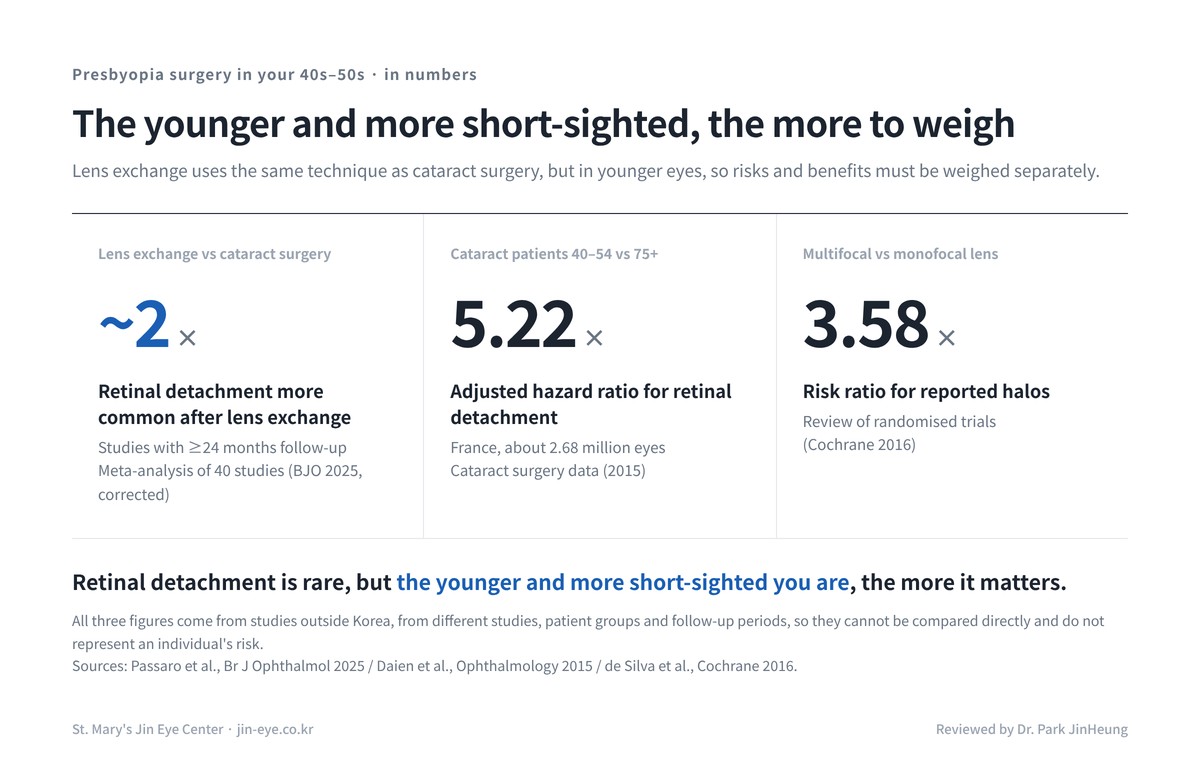
- In a meta-analysis of 40 studies, retinal detachment was about twice as common after lens exchange as after cataract surgery (studies outside Korea).
- After a lens exchange the eye loses any focusing ability it still had; presbyopia-correcting lenses reduce, but do not remove, the need for glasses.
What is refractive lens exchange for presbyopia?
Refractive lens exchange removes a lens that is still clear and replaces it with an artificial intraocular lens to correct presbyopia or refractive error. The technique is the same as cataract surgery, and the type of lens implanted decides how well you see far, intermediate and near.
Presbyopia is the age-related stiffening of the lens that reduces the eye’s ability to focus up close; most people start to notice it around age 40 (AAO: What Is Presbyopia?). The American Academy of Ophthalmology (AAO) lists glasses, contact lenses, eye drops, monovision with corneal laser and lens implants as options, and calls lens replacement refractive lens exchange (RLE). The AAO describes RLE as very similar to cataract surgery and suitable for people with early cataracts or significant long-sightedness (AAO: Refractive Surgery Alternatives).
Once the lens has been replaced, a cataract cannot form again. However, the capsule that holds the artificial lens can become cloudy weeks to years later (posterior capsule opacification), which is treated with a laser opening (AAO: Posterior Capsulotomy).
How is lens exchange for presbyopia different from cataract surgery?
The operation is the same, but the purpose and the starting point differ. Cataract surgery treats a lens that is already cloudy; lens exchange replaces a clear lens to correct vision, so risks and benefits are weighed more strictly.
| Cataract surgery | Refractive lens exchange (RLE) | |
|---|---|---|
| Lens | Cloudy (cataract) | Usually clear, or a very early cataract |
| Main purpose | Treat blurred vision | Correct presbyopia, long- or short-sightedness; reduce dependence on glasses |
| Typical age | Usually 60s and older | Many enquiries from people in their late 40s–50s |
| Technique | Lens removed with ultrasound, artificial lens implanted | The same |
| What you lose | Focusing ability that has already declined | All remaining focusing ability |
| Risks to weigh | Infection, inflammation, retinal detachment and others | The same, with a relatively higher retinal detachment risk at a younger age |
| Deciding factor | Daily difficulty and degree of cloudiness | Whether non-surgical options are not enough, and whether the retina and cornea are suitable |
Whether the lens is cloudy, and how much this affects vision, is checked with a slit-lamp examination and vision tests. If a cataract already affects vision, the same operation becomes cataract treatment and the balance of the decision changes.
Who is a good candidate for lens exchange in their 40s and 50s?
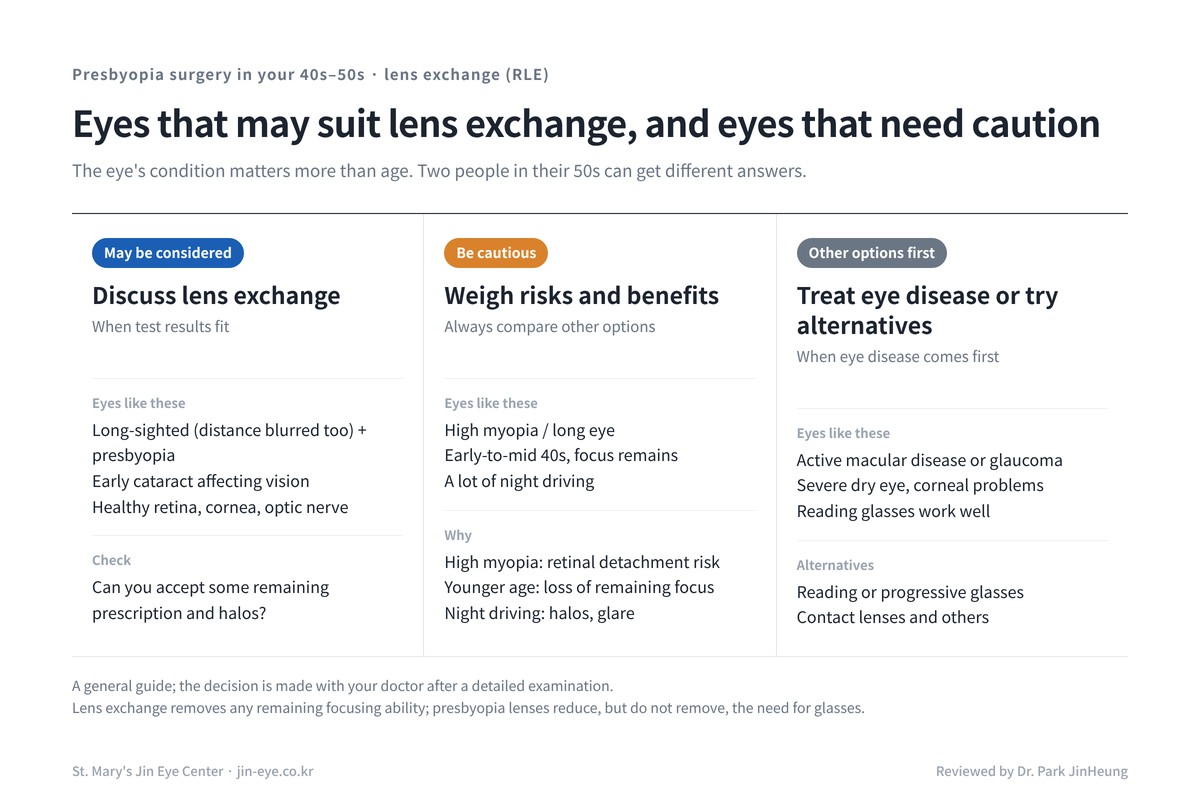
People with long-sightedness and presbyopia who struggle both far and near, people with an early cataract that is starting to affect vision, and people with a healthy retina, cornea and optic nerve can discuss lens exchange. If you are highly short-sighted, in your early-to-mid 40s, or reading glasses work well enough, there is little reason to hurry.
In an AAO EyeNet interview, specialists described hyperopic presbyopic patients from their late 40s to early 60s as ideal candidates and said they take a conservative approach with myopic patients because of retinal risk (AAO EyeNet). Long-sighted eyes tend to blur both far and near with age, so the benefit is larger, and their shorter eye length means a relatively lower retinal detachment risk. Highly short-sighted eyes are longer and often have weaker areas at the edge of the retina, so the detachment risk weighs more. This is expert opinion; actual suitability is decided by your own test results.
| Decision | Eyes like these | Why |
|---|---|---|
| Can be discussed | Long-sightedness + presbyopia; early cataract affecting vision; healthy retina, cornea and optic nerve | Larger benefit, relatively lower risk |
| Be cautious | High myopia / long eye; early-to-mid 40s; a lot of night driving; retinal detachment in the other eye | High myopia: retinal detachment risk; younger age: loss of remaining focus; night driving: halos and glare |
| Other options first | Active macular disease, glaucoma or other conditions; severe dry eye or corneal problems; reading glasses are enough | Risk or dissatisfaction is likely to outweigh the benefit |
A general guide. People of the same age may get different answers depending on their test results.
Does replacing the lens at a younger age increase the risk of retinal detachment?
Retinal detachment is uncommon, but studies show the risk is higher the younger you are when the lens is replaced, the more short-sighted you are, and in men. This is the point to weigh most carefully.
A 2025 meta-analysis of 40 studies and about 8.59 million eyes found that, with at least 24 months of follow-up, retinal detachment was about twice as common after lens exchange as after cataract surgery (Passaro et al., Br J Ophthalmol 2025). A correction published in August 2025 changed the absolute rates, so this article quotes only the relative difference between the two operations (correction notice). The proportion of myopic patients and the differences between studies were large, and many studies had short follow-up or lacked data such as eye length, so the figure cannot be applied directly to an individual.
A French study of about 2.68 million cataract operations in people aged 40 and over found a 0.99% risk of retinal detachment over 4 years (Daien et al., Ophthalmology 2015). People aged 40–54 at surgery had a 5.22 times higher risk than those aged 75 and over, and high myopia (6.12 times) and male sex (2.39 times) also raised the risk. These are cataract surgery data, not lens exchange data, but they show that the same operation carries more risk at a younger age.
In a small study of lens exchange in eyes with myopia above −12 dioptres, 4 of 49 eyes (8.1%) developed retinal detachment over 7 years (Colin et al., Ophthalmology 1999). Surgical technique was different in the 1990s and the group was small, but it shows why extra caution is needed in high myopia. All figures in this section come from studies outside Korea.
Before a lens exchange the pupil is dilated and the retina is examined out to its edge; if there is a tear or a weak area, the doctor decides whether to treat it first. After surgery, if floaters suddenly increase or new flashes appear, contact an eye doctor at once and have a dilated exam the same day if possible. A curtain over your vision or a sudden drop in vision needs urgent care right away, at any hour — see retinal detachment warning signs after cataract surgery.
After lens exchange, can I read without glasses?
A presbyopia-correcting lens often reduces the need for glasses, but do not expect to be glasses-free at every distance. Once the natural lens is replaced, your remaining focusing ability is gone and you rely on the focus the artificial lens provides.
Multifocal and extended depth of focus (EDOF) lenses split light into several focal points or widen the range of focus to support near and intermediate vision. The AAO notes that they reduce dependence on glasses but can cause halos and glare around lights, reduced contrast and less sharp vision in dim light, and that adjustment can take 6–8 weeks (AAO: Presbyopia-Correcting IOLs). A Cochrane review of 20 randomised trials found less dependence on glasses with multifocal than with monofocal lenses, but more halos (risk ratio 3.58) and glare (de Silva et al., Cochrane 2016). The review covered cataract patients and studies outside Korea.
| Option | What you can expect | What you accept |
|---|---|---|
| Monofocal (set for distance) | Sharp distance vision, few halos | Reading glasses for near |
| Monofocal monovision | One eye set for distance, the other for near, to reduce dependence on glasses | Needs adaptation to the difference between the eyes; depth perception and night vision may be slightly reduced |
| EDOF (extended depth of focus) | Comfortable far-to-intermediate vision (computer) | Small print may still need reading glasses; halos possible |
| Multifocal (trifocal and others) | Less dependence on glasses at far, intermediate and near | Possible halos, glare and reduced contrast; adjustment period |
These are general tendencies; actual results vary from person to person.
In your mid-40s you may still have quite a lot of focusing ability, so after a lens exchange some distances can feel less comfortable than before. If you drive a lot at night or your work depends on fine contrast, give more weight to halos and reduced contrast. Lens choices are compared in multifocal vs monofocal lenses for cataract surgery in Korea.
What are the alternatives to lens exchange for presbyopia?
Non-surgical options such as reading glasses, progressive glasses and contact lenses come first; depending on the situation, corneal laser monovision or eye drops may also be discussed. If you manage comfortably without surgery, there is little reason to hurry into a lens exchange.
Writing down what bothers you in daily life makes the decision easier. If only small print is a problem, reading or progressive glasses often solve it; if glasses get in the way of sport or work, contact lenses can be tried first. If you are also long-sighted and distance is blurred too, or an early cataract has started to cause glare and blur, there is more reason to discuss surgery.

How does St. Mary’s Jin Eye Center assess presbyopia surgery in Korea for international patients?
A detailed examination checks the lens, refractive error, eye length, cornea, retina and optic nerve, and then we decide together whether surgery is needed and, if so, which lens suits you. If another correction is better than surgery for your eyes, we will tell you so.
Our two directors, Dr. Park JinHeung and Dr. Park Jae-hyun, are ophthalmologists formerly on the faculty of Seoul St. Mary’s Hospital, specialising in the retina and the anterior segment respectively, and both are regular members of the Korean Retina Society. Drawing on more than 21,000 presbyopia and cataract operations, we assess the retina together with the lens and compare 14 types of intraocular lens (Alcon, J&J and others) for your lifestyle and eyes. If you have a cataract, see cataract surgery in Korea: the Zero Cataract™ programme; lens prices for international patients are in cataract surgery cost in Korea; if you already have a retinal condition, see cataract surgery in Korea with a retinal disease.
For lens surgery the clinic’s cataract surgery guidance applies to travel planning: at least the check-up on day 3 after surgery before flying, and about one week in Korea recommended; your own schedule is confirmed after the examination — see how long to stay in Korea for cataract surgery. If warning symptoms appear after you return home, see a local eye doctor promptly rather than waiting to reach us.
Lens exchange can correct presbyopia and refractive error together, but it has limits and possible side effects. You may still need glasses for some distances because of a small remaining refractive error, posterior capsule opacification can develop, and complications such as infection (endophthalmitis), macular swelling, retinal detachment or lens dislocation occur rarely. Presbyopia-correcting lenses can cause halos and reduced contrast, and replacing an implanted lens is harder than the first operation. That is why the decision to replace a clear lens should be made after a full explanation and without hurrying.
Frequently asked questions
Can I have lens exchange for presbyopia in my 40s?
It is possible in some cases, but it is better not to hurry. In your early-to-mid 40s you still have some focusing ability, and in cataract surgery data people aged 40–54 had a 5.22 times higher risk of retinal detachment than those aged 75 and over (study outside Korea). If you are long-sighted or have an early cataract and a healthy retina, it can be discussed; if you are highly short-sighted, more caution is needed. The decision is based on a detailed examination.
Is refractive lens exchange the same operation as cataract surgery?
The technique is the same: the natural lens is removed and an artificial lens is implanted. But cataract surgery treats a cloudy lens, whereas lens exchange replaces a clear lens to correct presbyopia or refractive error. That is why lens exchange is judged more strictly — whether non-surgical options are not enough and whether the benefit outweighs the risk.
How high is the risk of retinal detachment after lens exchange?
It is uncommon but reported to be higher than after cataract surgery. In a meta-analysis of 40 studies, retinal detachment was about twice as common after lens exchange as after cataract surgery. High myopia, a long eye, younger age and male sex increase the risk. These are studies outside Korea. After surgery, contact an eye doctor at once and have an exam the same day if possible if floaters suddenly increase or flashes appear; get urgent care right away for a curtain over your vision or a sudden drop in vision.
With a presbyopia lens, will I never need reading glasses?
Presbyopia-correcting lenses reduce dependence on glasses but do not guarantee freedom from glasses at every distance. Depending on the lens, you may need reading glasses for small print or in dim light, and halos, glare and reduced contrast can occur. Adjustment can take several weeks.
If my lens is replaced, can I still get a cataract later?
A cataract cannot form again after the lens is replaced with an artificial one. However, the capsule holding the lens can become cloudy (posterior capsule opacification), and this is usually treated with a quick laser procedure that restores clear vision.
Can a highly short-sighted person have lens exchange for presbyopia?
It is possible, but this is the situation that calls for the most caution. Highly short-sighted eyes are longer and often have weaker areas at the edge of the retina, so the retinal detachment risk after lens exchange is higher. The retina is examined carefully with a dilated pupil before surgery, and risks and benefits are compared with other options before deciding.
Where is St. Mary’s Jin Eye Center?
337 Gangnam-daero, Seocho-gu, Seoul (1F, 4F, 5F), about 5 minutes on foot from Gangnam Station Exit 5. Hours are Mon–Fri 09:00–18:00 (lunch 13:00–14:00) and Sat 09:00–15:00 (Korea time). You can book online or call +82-2-577-7782; presbyopia surgery consultations are based on a detailed eye examination.
- 337 Gangnam-daero, Seocho-gu, Seoul (1F, 4F, 5F) — about 5 minutes on foot from Gangnam Station Exit 5
- Hours (KST): Mon–Fri 09:00–18:00 (lunch 13:00–14:00), Sat 09:00–15:00
- Phone +82-2-577-7782 · E-mail jin.eye.center@gmail.com
- Registered medical institution for international patients in Korea
- Clinic facts and prices: St. Mary’s Jin Eye Center — facts and 2026 prices
References
- Passaro ML, Kilic D, Virgili G, et al. Retinal detachment incidence in refractive lens exchange versus cataract surgery: uncommon versus rare – systematic review and meta-analysis. Br J Ophthalmol 2025;109(7):756-764. PubMed
- Correction: Retinal detachment incidence in refractive lens exchange versus cataract surgery. Br J Ophthalmol 2025. PubMed
- Daien V, Le Pape A, Heve D, Carriere I, Villain M. Incidence, Risk Factors, and Impact of Age on Retinal Detachment after Cataract Surgery in France: A National Population Study. Ophthalmology 2015;122(11):2179-2185. PubMed
- Colin J, Robinet A, et al. Retinal detachment after clear lens extraction for high myopia: seven-year follow-up. Ophthalmology 1999. PubMed
- de Silva SR, Evans JR, Kirthi V, Ziaei M, Leyland M. Multifocal versus monofocal intraocular lenses after cataract extraction. Cochrane Database Syst Rev 2016;12:CD003169. PMC
- American Academy of Ophthalmology. What Is Presbyopia? aao.org
- American Academy of Ophthalmology. Refractive Surgery: Alternative Procedures. aao.org
- American Academy of Ophthalmology. Presbyopia-Correcting IOLs. aao.org
- American Academy of Ophthalmology. What Is Posterior Capsulotomy? aao.org
- Schena LB. Getting Clear On Refractive Lens Exchange. EyeNet Magazine, American Academy of Ophthalmology, 2011. aao.org
This article is general medical information about presbyopia surgery and refractive lens exchange and does not replace an individual diagnosis or treatment. Suitability for surgery and lens choice depend on your examination results and eyes, and every operation can have side effects. The figures quoted come from studies outside Korea. Zero Cataract™ is the name of the clinic’s cataract care programme (trademark application No. 40-2026-0207205). Written 6 November 2026.