Trifocal vs EDOF lens comes down to two things: how well you can read small print without glasses, and how much lights blur or form halos at night. A trifocal lens splits light into three focal points (far, intermediate and near) so you can read a book or phone; an EDOF (extended depth of focus) lens extends the range of focus, typically from distance to intermediate (computer) range. In meta-analyses comparing trifocal lenses mainly with diffractive EDOF lenses, trifocal lenses gave better near vision and spectacle independence, EDOF lenses were similar or slightly better at intermediate distance, and results for halos were mixed.
Medically reviewed by Dr. Park JinHeung, Director, St. Mary’s Jin Eye Center (Ophthalmologist, PhD; Adjunct Professor, Seoul St. Mary’s Hospital) · Last updated 2026-11-09
There is no lens that is simply better — there is a lens that fits the distances you use most and the condition of your eyes. This guide from St. Mary’s Jin Eye Center, about 5 minutes on foot from Gangnam Station Exit 5 in Seoul, explains how the two lenses work, how they differ for reading, computer work and night driving, and how to choose before cataract surgery in Korea.
- Both lenses give similar distance vision; the differences are at near and in halos around lights.
- For small print (books, phones), trifocal lenses scored about one line better on the eye chart in a meta-analysis (studies outside Korea).
- For intermediate distance (computer, dashboard), EDOF lenses are similar or slightly better.
- For halos, one meta-analysis found more with trifocal lenses and another found no clear difference.
- With an EDOF lens you may still need reading glasses for small print; with a trifocal lens you may need time to adapt to halos at night.
Trifocal vs EDOF lens: how do the two intraocular lenses differ?
A trifocal lens uses a diffractive pattern to send light to three focal points, while an EDOF lens extends a single focus forwards and backwards to widen the range that is in focus. That is why trifocal lenses are strong at near, and EDOF lenses are strong at seeing from distance to intermediate range with fewer breaks.
The American Academy of Ophthalmology (AAO) explains that multifocal lenses have several focusing zones and the brain learns to pick the right one, while EDOF lenses have one correcting zone stretched over a range of distances, so vision moves between distances relatively smoothly (AAO: Presbyopia-Correcting IOLs). A trifocal is a multifocal design with focal points for far, intermediate and near. Because light is shared between several focal points, less light goes to each distance and halos can appear around lights.
EDOF lenses are not all built the same way. Some use a partly diffractive design, and others are non-diffractive, extending the range of focus only through the shape of the lens surface (refraction). Results depend on the design, so the findings for one EDOF lens should not be applied directly to another. Some recent lenses even combine trifocal and EDOF features, so it is more accurate to compare lenses by which distances they are designed for than by their names.
| Trifocal lens | EDOF (extended depth of focus) lens | |
|---|---|---|
| How it works | Diffractive pattern splits light into three focal points (far, intermediate, near) | Extends the range of focus (diffractive or non-diffractive designs) |
| Strongest at | Near (books, phones) | Distance to intermediate (computer, dashboard) |
| Weaker at | Intermediate can be slightly less sharp, depending on the lens | Small print and other near tasks |
| Halos and glare | Some studies report more halos and glare | Depends on the design; results vary between studies |
| Examples | PanOptix family, FINEVISION and others | Vivity, PureSee and others |
Lens classifications follow each manufacturer’s description of its design; even within the same family, products differ in where they place focus and how they share light. Availability in Korea can change over time.
The basic differences between monofocal and multifocal lenses are covered in multifocal vs monofocal lenses for cataract surgery in Korea; this article focuses on comparing trifocal and EDOF lenses within presbyopia-correcting lenses.
Can you read small print better with a trifocal lens?
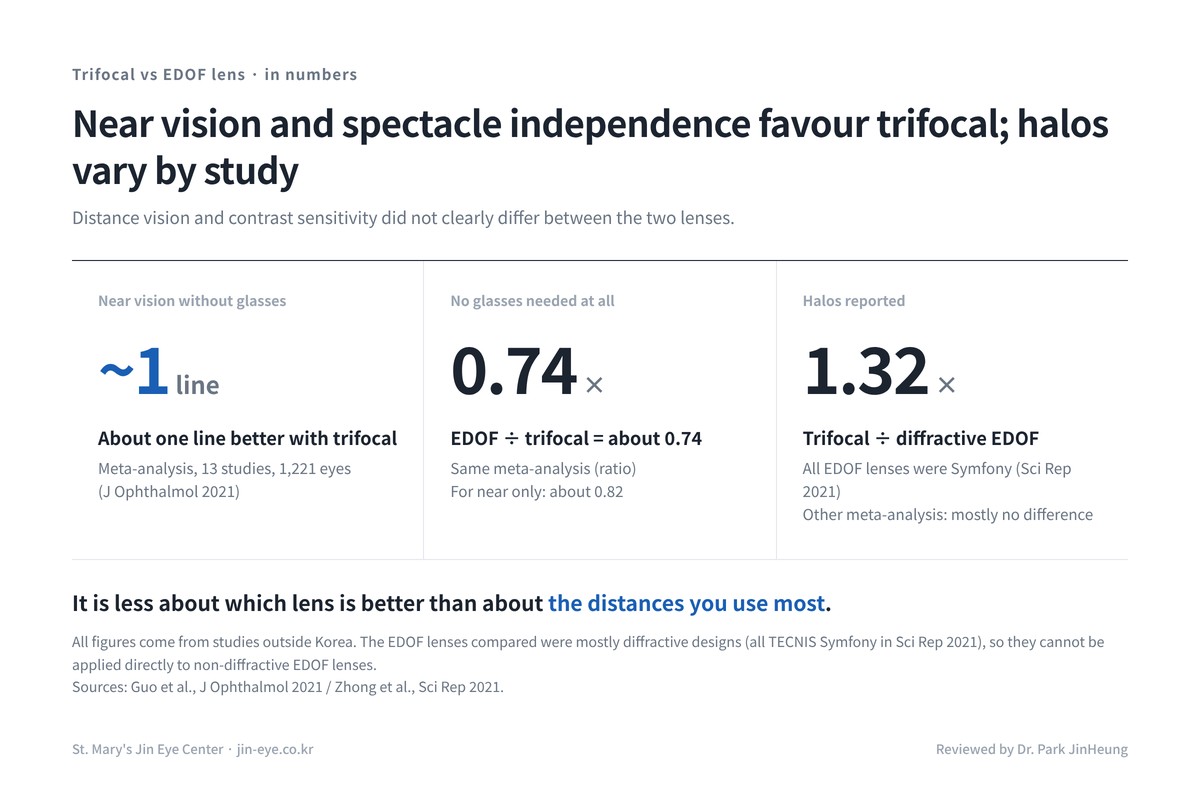
Yes, on average. In meta-analyses comparing the two lenses, trifocal lenses gave about one line better near vision without glasses on the eye chart, and more people lived without glasses.
In a 2021 meta-analysis of 13 studies and 1,221 eyes, EDOF lenses gave binocular uncorrected near vision 0.10 logMAR worse than trifocal lenses — about one line on the eye chart (Guo et al., J Ophthalmol 2021). The proportion of people who needed no glasses at all was about 0.74 times as high with EDOF lenses as with trifocal lenses, and the proportion free of glasses for near was about 0.82 times as high. Distance vision did not differ between the two lenses. In both meta-analyses the EDOF lens was a single, partly diffractive product (TECNIS Symfony), so these figures cannot be applied directly to non-diffractive EDOF lenses such as Vivity or PureSee. These are studies outside Korea.
Another 2021 meta-analysis (13 studies; 898 trifocal and 624 EDOF eyes) also found better near vision and near spectacle independence with trifocal lenses (Zhong et al., Sci Rep 2021). All the EDOF lenses in that analysis were one partly diffractive product (TECNIS Symfony). So if you do a lot of close work — books, phones, sewing — and want to rely on reading glasses as little as possible, a trifocal lens tends to have the advantage. If you choose an EDOF lens, it is better to know in advance that you may need reading glasses for small print or in dim light.
Which is more comfortable for computers and tablets?
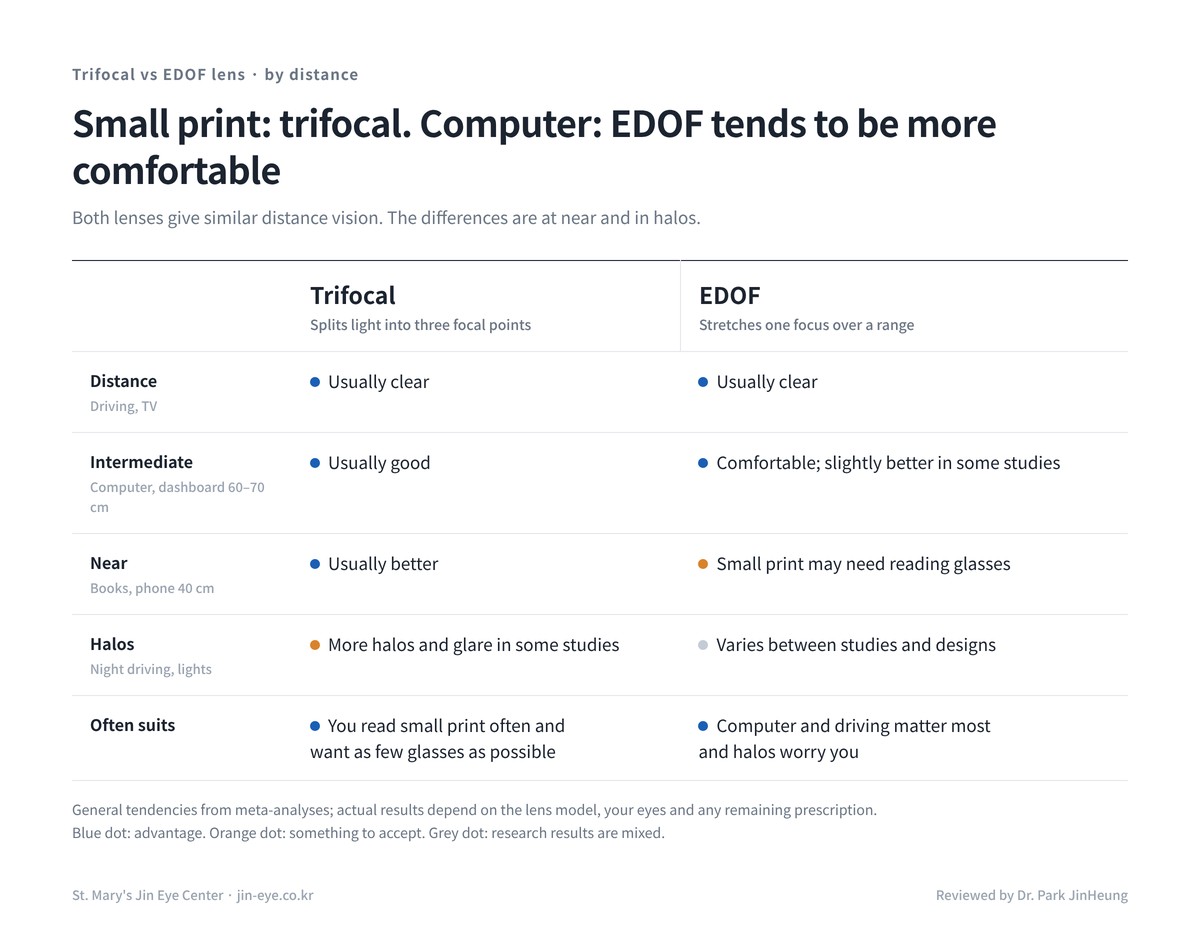
At intermediate distance EDOF lenses are similar or slightly better, but the difference is small. Trifocal lenses also have an intermediate focus, so computer work is often comfortable with them too.
In the 2021 meta-analysis above, binocular uncorrected intermediate vision was 0.08 logMAR better with EDOF lenses, but there was no difference when each eye was tested separately (Guo et al., J Ophthalmol 2021). The other meta-analysis also found EDOF lenses slightly ahead at intermediate distance (Zhong et al., Sci Rep 2021). In a randomised trial of 30 people (60 eyes), uncorrected vision at 66 cm was on average 0.03 logMAR better with the EDOF lens — statistically significant, but well under one line on the eye chart (Webers et al., J Cataract Refract Surg 2020). These are studies outside Korea.
In daily life, the difference you notice can depend more on your screen distance, font size, lighting and any remaining prescription. If you spend most of the day at a monitor and read small print only occasionally, an EDOF lens often suits; if you switch between a monitor and books or a phone for long periods, a trifocal lens often suits. The dashboard and navigation screen when driving are also at intermediate distance.
Which causes fewer halos when driving at night?
Studies disagree. One meta-analysis found more halos with trifocal lenses and another found no clear difference, so EDOF lenses may tend to cause fewer halos, but this cannot be stated as certain.
A meta-analysis comparing trifocal lenses with a diffractive EDOF lens found the proportion of people reporting halos about 1.32 times higher with trifocal lenses, with no statistically significant difference in glare (Zhong et al., Sci Rep 2021). The other meta-analysis found no clear difference in halos or glare in most studies, and similar contrast sensitivity (Guo et al., J Ophthalmol 2021). In the randomised trial above, halos that interfered with daily life were reported by 39% with the trifocal and 21% with the EDOF lens — this looked different but was not statistically significant (Webers et al., 2020). These are studies outside Korea.
A prospective, non-randomised US study comparing patient reports for a non-diffractive EDOF lens (60 people) and a trifocal lens (59 people) found that 85% with the EDOF lens and 69% with the trifocal lens reported no or only slight halos and glare in dim light (Hovanesian et al., Clin Ophthalmol 2022). In the same study, 83% with the trifocal lens and 33% with the EDOF lens never needed glasses — a difference in the opposite direction. Because it was not randomised and the groups were small, it should be taken only as supporting information. With some lens designs, near spectacle independence and the burden of halos can trade off against each other.
Looking at presbyopia-correcting lenses as a whole, a Cochrane review of 20 randomised trials found, across the 7 studies that analysed halos, that people with multifocal lenses were 3.58 times as likely to report halos as those with monofocal lenses (de Silva et al., Cochrane 2016). The AAO also notes that presbyopia-correcting lenses can cause halos and glare around lights and reduced contrast, and that people who drive a lot at night or pilots may benefit less (AAO). If you drive at night for work or night vision matters especially to you, weigh this most heavily — a monofocal or enhanced monofocal lens may suit you better.
Which lens suits your daily life?
Decide first which distance you use most and what you would find hardest to give up. If small print matters most, start with a trifocal lens; if computer work and driving matter most and halos worry you, start with an EDOF lens — the final choice is made from your eye examination.
| Your daily life | Lens to consider first | Also keep in mind |
|---|---|---|
| A lot of close work (books, phone, sewing) and you want to rely on reading glasses as little as possible | Trifocal | You may need time to adapt to halos around lights at night |
| Most of the day at a computer, small print only occasionally | EDOF | Small print or dim light may still need reading glasses |
| Frequent night driving, or night vision matters for your work | EDOF or a monofocal-type lens | Think carefully about any presbyopia-correcting lens |
| Sensitive to glare, detail-oriented personality | EDOF or a monofocal-type lens | Set expectations carefully during the consultation |
| Macular disease, glaucoma, corneal disease or severe dry eye | Assess the condition first | A monofocal lens may be better than a presbyopia-correcting lens |
A general guide. Depending on your results, using different lenses in the two eyes or setting the focus slightly differently in each eye can also be an option.
When choosing a lens, the condition of your eyes comes before the type of lens. The AAO explains that people who already have an eye disease are at greater risk of not getting a good result with presbyopia-correcting lenses (AAO). A study of patients who came in dissatisfied with presbyopia-correcting lenses also found remaining prescription and dry eye to be the most common causes, and advised postponing premium lenses when ocular surface disease is significant (Gibbons et al., Clin Ophthalmol 2016). That is why we examine the macula and retina, corneal shape and astigmatism, and the tear film before choosing a lens. For eyes with retinal disease, see cataract surgery in Korea with a retinal condition.

How long does it take to adapt, and what are the side effects?
Getting used to every distance with a presbyopia-correcting lens can take a few weeks, and halos often become less noticeable over time but may not disappear completely. If blur persists, we check for treatable causes such as remaining prescription, dry eye or posterior capsule opacification.
The AAO says it can take 6–8 weeks after surgery with a presbyopia-correcting lens to focus fully at every distance (AAO). Whether trifocal or EDOF, common causes of blur after surgery are remaining refractive error and dry eye; months to years later, the membrane behind the lens can become cloudy (posterior capsule opacification) (Gibbons et al., 2016). These causes often improve with eye drops, laser treatment or glasses, so regular check-ups matter.
If your vision suddenly drops, or eye pain and redness get worse, contact an eye doctor at once without waiting for your scheduled check-up. If floaters suddenly increase or new flashes appear, contact us at once and have a dilated examination the same day if possible; if a curtain covers your vision, get urgent care right away, at any hour. If this happens after you fly home, see a local eye doctor promptly — see retinal detachment warning signs after cataract surgery.
How does St. Mary’s Jin Eye Center help international patients choose between trifocal and EDOF lenses?
We first ask about the distances you use most, night driving, your personality and expectations, then check the retina, cornea and tear film with a detailed examination and choose the lens together. If a monofocal-type lens suits your eyes better than a presbyopia-correcting lens, we will tell you so.
Our two directors, Dr. Park JinHeung and Dr. Park Jae-hyun, are ophthalmologists formerly on the faculty of Seoul St. Mary’s Hospital, specialising in the retina and the anterior segment respectively, and both are regular members of the Korean Retina Society. Drawing on more than 21,000 presbyopia and cataract operations, we assess the retina before surgery and compare trifocal, EDOF and monofocal-type lenses among 14 intraocular lenses (Alcon, J&J and others) for your lifestyle and eyes. The overall process from examination to same-day surgery and aftercare is described in cataract surgery in Korea: the Zero Cataract™ programme, and full costs in cataract surgery cost in Korea. If you are in your 40s or 50s without a cataract, see presbyopia surgery in Korea: refractive lens exchange.
| Lens (per eye) | Type | Price (KRW) |
|---|---|---|
| PanOptix (Alcon, USA) | Trifocal | 3,000,000 |
| Clareon PanOptix (Alcon, USA) | Trifocal | 4,500,000 |
| FINEVISION (PhysIOL, Belgium) | Trifocal | 2,800,000 |
| AT LISA tri (ZEISS, Germany) | Trifocal | 4,000,000 |
| Vivity (Alcon, USA) | EDOF (non-diffractive) | 3,000,000 |
| Clareon Vivity (Alcon, USA) | EDOF (non-diffractive) | 4,500,000 |
| PureSee (J&J, USA) | EDOF (non-diffractive) | 3,000,000 |
2026 prices for international patients, per eye; toric (astigmatism) versions are the same price. A full eye examination is 80,000 KRW. The lens and final cost are confirmed after the examination; other lenses, including hybrid designs, are listed on the price page.
For travel planning, the clinic’s cataract surgery guidance is at least the check-up on day 3 after surgery before flying, and about one week in Korea is recommended; your own schedule is confirmed after the examination — see how long to stay in Korea for cataract surgery.
Trifocal and EDOF lenses reduce dependence on glasses, but they have side effects and limits. Halos, glare and reduced contrast can occur, you may need glasses because of a small remaining prescription, and some people cannot adapt and consider exchanging the lens. Complications of cataract surgery itself, such as infection (endophthalmitis), macular swelling, retinal detachment or a displaced lens, occur rarely. That is why a lens should be chosen after hearing about its limits as well as its benefits.
Frequently asked questions
Which is better, a trifocal or an EDOF lens?
Neither is better for everyone. In meta-analyses, trifocal lenses gave better near vision and spectacle independence, EDOF lenses were similar or slightly better at intermediate distance, and distance vision did not differ. The right lens depends on how often you read small print, how much you use a computer and drive, and how sensitive you are to halos; the final choice is made from your eye examination.
With an EDOF lens, will I still need reading glasses?
An EDOF lens can reduce your need for glasses at distance and computer range, but you may still need reading glasses for small print or in dim light. In a 2021 meta-analysis, near vision without glasses was about one line worse with EDOF than with trifocal lenses (studies outside Korea). If reading without glasses matters most to you, tell us at the consultation.
Will a trifocal lens make night driving difficult?
Trifocal lenses can cause halos around lights; one meta-analysis found more halos than with EDOF lenses and another found no difference. Halos often become less noticeable over time but may not disappear completely. If you drive at night for work or night vision is especially important, consider EDOF or monofocal-type lenses as well.
Which lens is best if I work at a computer a lot?
If you spend most of the day at a monitor and read small print only occasionally, an EDOF lens is often comfortable. Trifocal lenses also have an intermediate focus, so if you switch between a monitor and books or a phone for long periods, a trifocal lens may suit you. Tell us your screen distance, font size and work environment at the consultation.
How long do halos and blur last after surgery?
The AAO says it can take 6–8 weeks to focus fully at every distance with a presbyopia-correcting lens. If blur persists, we check for treatable causes such as remaining prescription, dry eye or posterior capsule opacification. If your vision suddenly drops or pain and redness get worse, contact an eye doctor at once without waiting for your check-up.
Can I have a trifocal or EDOF lens if I have macular degeneration or glaucoma?
It is not ruled out, but caution is needed. The AAO explains that people with an existing eye disease are at greater risk of not getting a good result with presbyopia-correcting lenses. We look at the severity and treatment plan of the condition and the results of macular and optic nerve tests, and decide together whether a monofocal-type lens would be better.
Where is St. Mary’s Jin Eye Center?
337 Gangnam-daero, Seocho-gu, Seoul (1F, 4F, 5F), about 5 minutes on foot from Gangnam Station Exit 5. Hours are Mon–Fri 09:00–18:00 (lunch 13:00–14:00) and Sat 09:00–15:00 (Korea time). You can book online or call +82-2-577-7782; lens consultations are based on a detailed eye examination.
- 337 Gangnam-daero, Seocho-gu, Seoul (1F, 4F, 5F) — about 5 minutes on foot from Gangnam Station Exit 5
- Hours (KST): Mon–Fri 09:00–18:00 (lunch 13:00–14:00), Sat 09:00–15:00
- Phone +82-2-577-7782 · E-mail jin.eye.center@gmail.com
- Registered medical institution for international patients in Korea
- Clinic facts and prices: St. Mary’s Jin Eye Center — facts and 2026 prices
References
- Guo Y, Wang Y, Hao R, Jiang X, Liu Z, Li X. Comparison of Patient Outcomes following Implantation of Trifocal and Extended Depth of Focus Intraocular Lenses: A Systematic Review and Meta-Analysis. J Ophthalmol 2021;2021:1115076. PMC
- Zhong Y, Wang K, Yu X, Liu X, Yao K. Comparison of trifocal or hybrid multifocal-extended depth of focus intraocular lenses: a systematic review and meta-analysis. Sci Rep 2021;11:6699. PMC
- Webers VSC, et al. Comparison of the intermediate distance of a trifocal IOL with an extended depth-of-focus IOL: results of a prospective randomized trial. J Cataract Refract Surg 2020;46(2):193-203. DOI
- Hovanesian JA, Jones M, Allen QB. Clin Ophthalmol 2022;16:145-152 (non-diffractive EDOF vs trifocal: patient satisfaction, halos and spectacle independence). PMC
- de Silva SR, Evans JR, Kirthi V, Ziaei M, Leyland M. Multifocal versus monofocal intraocular lenses after cataract extraction. Cochrane Database Syst Rev 2016;12:CD003169. PMC
- Gibbons A, Ali TK, Waren DP, Donaldson KE. Clin Ophthalmol 2016;10:1965-1970 (causes and correction of dissatisfaction after presbyopia-correcting IOLs). DOI
- American Academy of Ophthalmology. Presbyopia-Correcting IOLs. aao.org
- American Academy of Ophthalmology. Intraocular Lenses (IOL) for Cataract Surgery. aao.org
This article is general medical information about trifocal and EDOF intraocular lenses and does not replace an individual diagnosis or treatment. Lens choice and suitability for surgery depend on your examination results and eyes, and every operation can have side effects. The figures quoted come from studies outside Korea. Lens product names are examples to explain the designs. Zero Cataract™ is the name of the clinic’s cataract care programme (trademark application No. 40-2026-0207205). Written 9 November 2026.