
If you suddenly see more floaters, new flashes of light, or a curtain or shadow over part of your vision after cataract surgery, do not wait for your next check-up: these can be signs of a retinal tear or retinal detachment. A curtain, a shadow or a sudden drop in vision needs urgent care right away; new floaters or flashes need a call to an eye doctor at once and, if possible, a dilated retinal exam the same day.
Medically reviewed by Dr. Park JinHeung, Director, St. Mary’s Jin Eye Center (Ophthalmologist, PhD; Adjunct Professor, Seoul St. Mary’s Hospital) · Last updated 2026-11-02
Retinal detachment after cataract surgery is uncommon, but an eye that has had cataract surgery is known to be more prone to it than an eye that has not. Most new floaters come from the gel inside the eye separating from the retina (posterior vitreous detachment), yet symptoms alone cannot show whether the retina has torn. This guide from St. Mary’s Jin Eye Center, about 5 minutes on foot from Gangnam Station Exit 5 in Seoul, separates the glare and grittiness that are common after surgery from the signs that need an eye doctor straight away — including what to do if they start after you have flown home.
- A curtain or shadow over your vision, a sudden drop in vision, or a shower of black spots with blurred vision: get urgent eye care now, whatever the time — an emergency eye service or an emergency department.
- New or increasing floaters, or new flashes of light: call an eye doctor at once and, if possible, have a dilated retinal exam the same day.
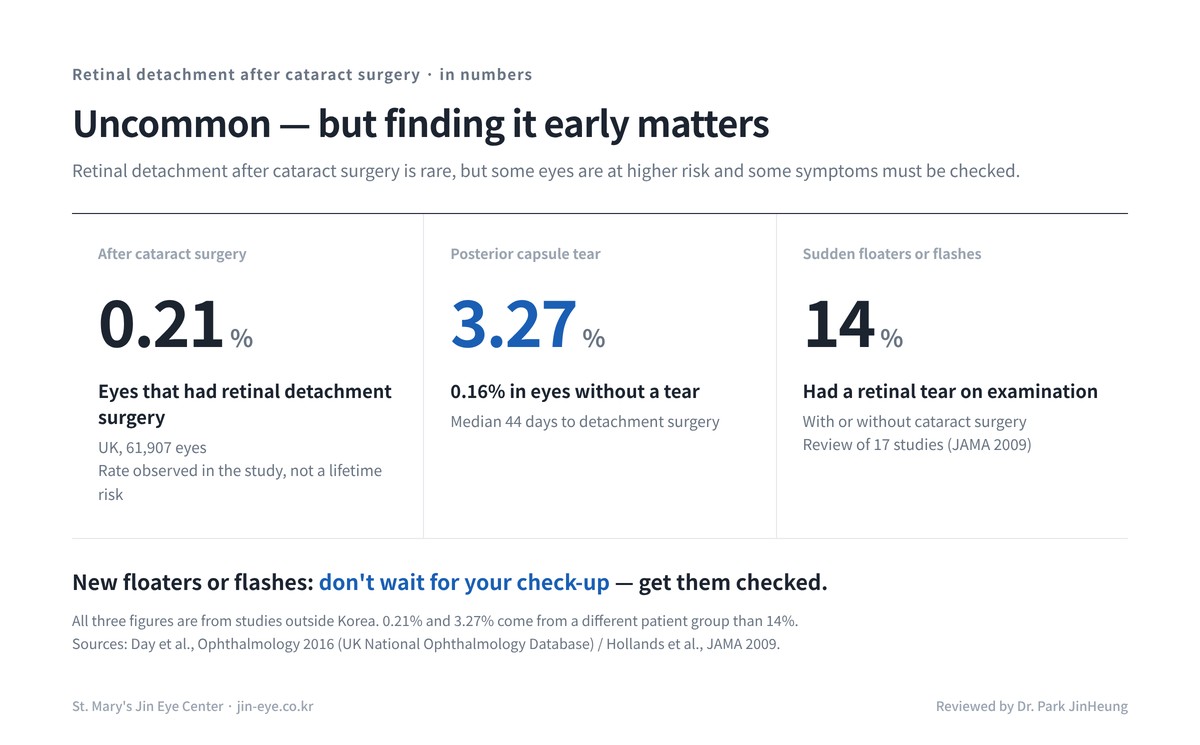
- In people with sudden floaters or flashes — whether or not they had cataract surgery — about 14% had a retinal tear (review of 17 studies).
- In UK data on more than 60,000 eyes, 0.21% needed retinal detachment surgery after cataract surgery, but 3.27% of eyes whose posterior capsule tore during surgery did.
- A retinal tear found early can often be sealed with laser; a retinal detachment usually needs surgery.
Are floaters and flashes after cataract surgery a sign of retinal detachment?
Usually they come from posterior vitreous detachment, but some are the start of a retinal tear or detachment. Symptoms cannot tell them apart, so new floaters or flashes need an eye examination.
The inside of the eye is filled with a clear gel called the vitreous. With age it becomes more liquid and pulls away from the retina. Clumps in the gel cast shadows that you see as floaters, and when the gel tugs on the retina you may see flashes of light. In most people this settles, but where the gel is firmly attached the retina can tear, and if fluid passes through the tear the retina detaches.
A systematic review of 17 studies of people with sudden floaters or flashes — whether or not they had had cataract surgery — found a retinal tear in 14% (Hollands et al., JAMA 2009). A feeling that your own vision had dropped was the symptom most strongly linked to a tear, and even when the first exam showed only posterior vitreous detachment, a tear was found within 6 weeks in 3.4%. That is why you should keep any re-check your doctor recommends and come back if your symptoms change.
Does cataract surgery increase the risk of retinal detachment?
Cataract surgery is a known risk factor for retinal detachment, but detachment is uncommon. The risk is higher in long, highly short-sighted (myopic) eyes and in eyes whose posterior capsule tore during surgery.
The American Academy of Ophthalmology (AAO) lists previous eye surgery, such as cataract surgery, as a factor that makes retinal detachment more likely (AAO: Detached Retina). Replacing the natural lens with a thin artificial lens changes the inside of the eye, and this may bring posterior vitreous detachment forward.
A UK National Ophthalmology Database study of 61,907 eyes found that 0.21% had retinal detachment surgery after cataract surgery (Day et al., Ophthalmology 2016). This was the rate observed during the study in eyes followed for at least 3 months — not a lifetime risk. In eyes whose posterior capsule (the thin membrane behind the lens) tore during surgery the rate was 3.27%, compared with 0.16% in eyes without a tear. The median time to retinal detachment surgery was 44 days after a capsule tear and 6.3 months without one. The authors advised warning these patients about symptoms and carefully examining the dilated retina during the first 2 months.
A population-based study from Olmsted County, USA, also found male sex, younger age, myopia and a longer eye to be risk factors for retinal detachment after cataract surgery (Erie et al., Ophthalmology 2006).
| Risk factor | Why it matters | What you can do |
|---|---|---|
| High myopia / long eye | The retina is often thinner, sometimes with weak areas at the edge | Ask about the result of your peripheral retinal exam before surgery |
| Posterior capsule tear during surgery | 3.27% needed retinal detachment surgery in UK data (0.16% without a tear) | Learn the warning symptoms and keep dilated check-ups during the first 2 months |
| Male sex, younger age | Identified as risk factors in a population-based study | See an eye doctor promptly if symptoms appear, whatever your age |
| Retinal disease in the other eye, family history | A family history of retinal problems is a risk factor | Tell the doctor at your visit |
Having a risk factor does not mean a detachment will happen, and detachment can occur without one. Figures are from studies outside Korea.
Which symptoms mean you should see an eye doctor right away?
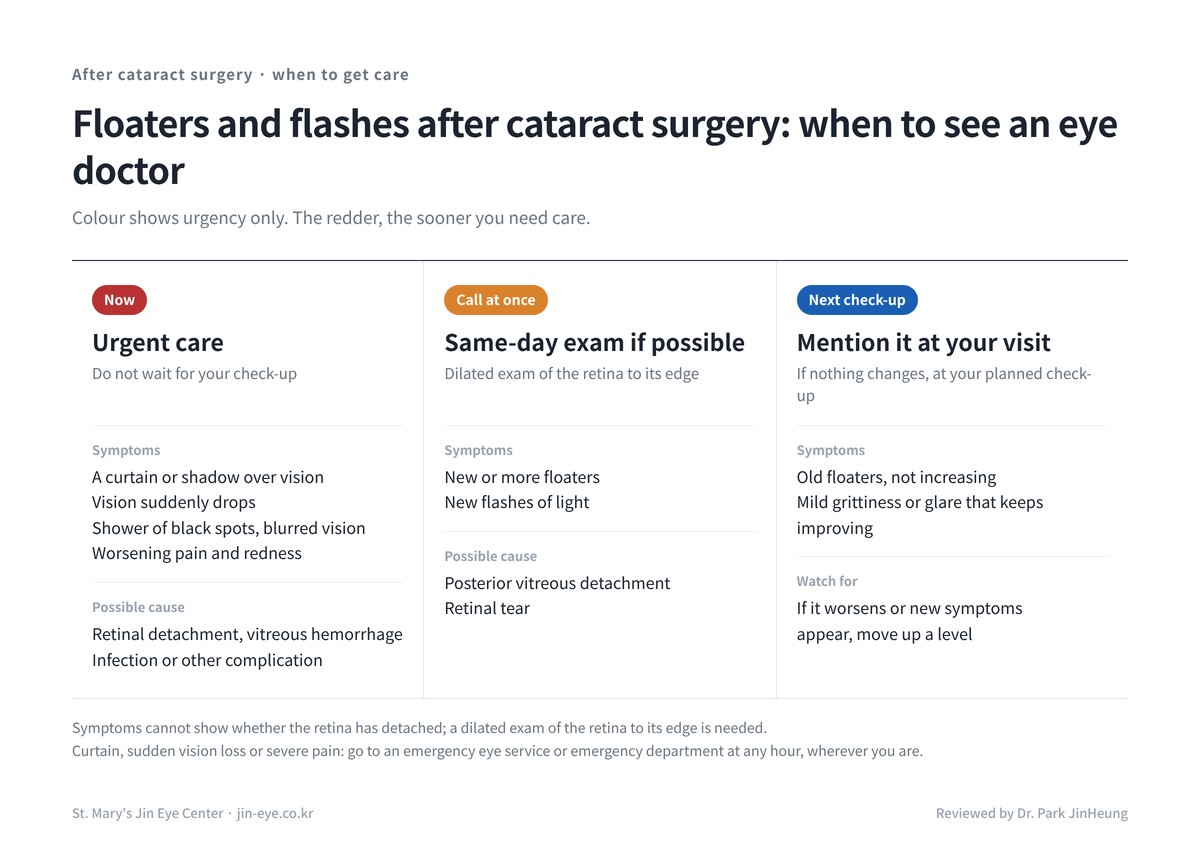
A curtain or shadow over your vision or a sudden drop in vision needs urgent care now. New floaters or flashes need a call to an eye doctor at once and, if possible, an exam the same day — even if your scheduled check-up is only a few days away.
The AAO advises contacting an eye doctor immediately if you see flashes, many new floaters, a shadow in your side vision, or a gray curtain covering part of your vision (AAO: What Are Floaters and Flashes?). A curtain-like loss of vision can mean the retina has already started to detach, so it is the most urgent sign. Sudden wavy or distorted vision also needs urgent attention.
| When | Symptoms | Possible cause |
|---|---|---|
| Now — urgent | A curtain or shadow over part of your vision; vision suddenly drops; a shower of black spots with blurred vision | Retinal detachment, vitreous hemorrhage |
| Now — urgent | Straight lines or objects suddenly look wavy or distorted | Retinal detachment or another retinal/macular problem |
| Now — urgent | Within days of surgery: worsening pain with redness and blurred vision | Infection (endophthalmitis) or inflammation after surgery |
| Call at once; exam the same day if possible | New or more floaters; new flashes of light | Posterior vitreous detachment, retinal tear |
| At your next check-up | Old floaters that are not increasing; mild grittiness or glare that keeps improving | Usual healing (move up a row if it gets worse or new symptoms appear) |
A general guide. If you are unsure, treat it as the more urgent row, and follow the instructions of the clinic that did your surgery.
How are normal healing symptoms different from warning signs?
Glare, grittiness and slightly blurred vision right after surgery usually improve day by day. A new or spreading shadow, a sudden increase in floaters or flashes that keep coming back are not part of normal healing.
For days to weeks after cataract surgery your eye may feel gritty, light may seem too bright and lights may have halos. Some people also notice reflections from the edge of the artificial lens or a faint crescent-shaped shadow at the side of their vision (negative dysphotopsia) early after surgery. These often fade, but it is hard to tell such a shadow from the shadow of a detaching retina yourself. A shadow that is new to you should be checked by an eye doctor — do not assume it is dysphotopsia.
| Common while healing | Needs checking right away | |
|---|---|---|
| Light | Glare, halos around lights (getting better over time) | New or repeated flashes of light |
| Floaters | Old floaters, unchanged | A sudden increase in floaters or a shower of black spots |
| Shadow | A faint crescent at the edge of vision early after surgery (negative dysphotopsia) — have a new one checked | A curtain-like shadow that spreads across your vision |
| Vision | Gradually clearer over days to weeks | Vision that was improving suddenly drops; lines look distorted |
| Pain / redness | Mild grittiness; redness that keeps fading | Pain and redness that get worse, with blurred vision |
See a doctor if even a common symptom gets worse or lasts. If in doubt, treat it as a warning sign.
A simple self-check can help you notice changes. In good light, cover one eye with your hand and look at a straight line such as a door or window frame and at the whole room; then switch eyes and look at the same scene. If part of the view is missing or lines bend in one eye only, see a doctor straight away. This check cannot rule out a retinal tear or detachment: if you have warning symptoms such as new floaters or flashes, you still need a dilated retinal exam even if everything looks normal.

How is it examined and treated?
The eye doctor dilates your pupil and examines the retina out to its edge to look for a tear or detachment. A retinal tear is often treated with laser; a retinal detachment usually needs surgery.
Retinal tears usually form near the edge of the retina, which cannot be seen well through a small pupil, so a dilated exam is the standard test; if bleeding inside the eye blocks the view, an ultrasound scan is added. Your vision will be blurry and light-sensitive for a few hours afterwards, so do not drive yourself.
| Finding | What it means | Usual next step |
|---|---|---|
| Posterior vitreous detachment only | The gel has separated from the retina but the retina is not torn | Learn the warning symptoms; re-check when your doctor advises |
| Retinal tear | The retina is torn but has not significantly detached | Laser treatment around the tear (photocoagulation) is often considered |
| Retinal detachment | Fluid has passed through the tear and lifted the retina | Surgery (vitrectomy, scleral buckle and others) is needed in most cases |
Treatment depends on the position and size of the tear and how much of the retina has detached (AAO Preferred Practice Pattern 2020).
Treating a detachment before it reaches the macula — the centre of the retina used for sharp vision — gives a better chance of keeping vision. Once the macula has detached, vision may recover only partly even if the retina is reattached, and more than one operation is sometimes needed. Some operations place a gas bubble in the eye: you may need to keep a certain head position for a while, and you must not fly while gas remains in the eye. This is why the time from first symptoms to examination matters so much.
What if symptoms start after you fly home from Korea?
Do not delay care while trying to reach the clinic in Korea. For a curtain, a shadow or a sudden drop in vision, go at once to an emergency eye service or emergency department where you are. For new floaters or flashes, contact a local eye doctor at once and have a dilated retinal exam the same day if possible; if a timely exam cannot be arranged, go to an emergency eye service rather than waiting for a scheduled appointment.
Retinal detachment can happen months or even years after cataract surgery, so the warning signs remain important after you return home. Before you leave Korea, keep a written note of your surgery date, which eye was operated on and the lens that was implanted, and bring it — with the names of the eye drops you are using — when you see a local eye doctor. This helps the doctor examine you quickly.
After a dilated exam you should not drive, so go with someone if you can. Avoid rubbing or pressing on your eye and avoid strenuous exercise until you have been examined. Once you have been seen locally, you can also let us know by e-mail (jin.eye.center@gmail.com) or phone (+82-2-577-7782).
At St. Mary’s Jin Eye Center, international patients can usually fly home after the check-up on day 3 after surgery if the eye is healing as expected and the doctor agrees, and we recommend staying about one week — see how long to stay in Korea for cataract surgery.
How does St. Mary’s Jin Eye Center check the retina before and after cataract surgery?
The detailed exam before cataract surgery includes OCT imaging of the macula and a check of risk factors for retinal detachment, with a dilated examination of the peripheral retina when needed to look for tears or weak areas. OCT alone cannot rule out peripheral tears or predict whether a detachment will occur. After surgery we explain the warning symptoms and ask you to contact us at once if they appear, whatever your check-up schedule.
Our two directors, Dr. Park JinHeung and Dr. Park Jae-hyun, are ophthalmologists formerly on the faculty of Seoul St. Mary’s Hospital, specializing in the retina and the anterior segment respectively, and both are regular members of the Korean Retina Society. Drawing on more than 21,000 presbyopia and cataract operations, we assess the retina together with the cataract and plan the lens and treatment from your test results. If you already have a retinal condition, see cataract surgery in Korea with a retinal disease; for how our cataract programme works, see cataract surgery in Korea: the Zero Cataract™ programme.
Cataract surgery is an effective way to restore vision, but it has limits and possible side effects. You may still need glasses for some distances because of a small remaining refractive error, a secondary cataract (posterior capsule opacification) can develop and may need YAG laser treatment, and complications such as infection (endophthalmitis), macular swelling or retinal detachment occur rarely. Because retinal detachment can appear long after surgery, remember the warning signs for years, not just weeks. Choosing between lens types is covered in multifocal vs monofocal lenses.
Frequently asked questions
Is it normal to see floaters after cataract surgery?
New floaters after cataract surgery are usually caused by posterior vitreous detachment and most people have no retinal damage. But new or increasing floaters must be checked: call an eye doctor at once and have a dilated retinal exam the same day if possible. If black spots suddenly shower down and your vision blurs, get urgent care now. Old floaters that are not increasing can be mentioned at your next check-up.
What should I do if I see flashes of light after cataract surgery?
Flashes can occur when the vitreous gel pulls on the retina. If they are new, do not wait for your check-up: contact an eye doctor at once and have an exam the same day if possible, because it is hard to tell them apart from light reflections from the artificial lens yourself. If you also have a shadow or curtain over your vision, get urgent care now.
How urgent is a curtain or shadow over my vision?
It is the most urgent sign. The retina may already be detaching, so get urgent eye care now — an emergency eye service or emergency department if your clinic is closed or you are abroad. Treatment before the detachment reaches the macula gives a better chance of keeping vision.
How common is retinal detachment after cataract surgery?
It is uncommon. In a UK national database study of 61,907 eyes, 0.21% had retinal detachment surgery after cataract surgery; this is the rate observed during the study, not a lifetime risk. The rate was 3.27% in eyes whose posterior capsule tore during surgery, and high myopia with a long eye, male sex and younger age were also reported as risk factors.
Can retinal detachment happen years after cataract surgery?
Yes. It can occur months or years after surgery. In the UK data the median time to retinal detachment surgery was 6.3 months in eyes without a capsule tear. Even long after surgery, see an eye doctor promptly if you notice new floaters, flashes or a shadow over your vision.
I live abroad. What should I do if symptoms start after I return home from Korea?
Do not wait to reach us first. For a curtain, shadow or sudden drop in vision, go to an emergency eye service or emergency department where you are; for new floaters or flashes, see a local eye doctor the same day if possible, or an emergency eye service if that cannot be arranged. Bring a note of your surgery date, the operated eye, the implanted lens and your eye drops. After you have been examined you can also contact us by e-mail or phone.
Where is St. Mary’s Jin Eye Center?
337 Gangnam-daero, Seocho-gu, Seoul (1F, 4F, 5F), about 5 minutes on foot from Gangnam Station Exit 5. Hours are Mon–Fri 09:00–18:00 (lunch 13:00–14:00) and Sat 09:00–15:00 (Korea time). You can book online or call +82-2-577-7782; for urgent symptoms such as a curtain over your vision, do not wait for an appointment.
- 337 Gangnam-daero, Seocho-gu, Seoul (1F, 4F, 5F) — about 5 minutes on foot from Gangnam Station Exit 5
- Hours (KST): Mon–Fri 09:00–18:00 (lunch 13:00–14:00), Sat 09:00–15:00
- Phone +82-2-577-7782 · E-mail jin.eye.center@gmail.com
- Registered medical institution for international patients in Korea
- Clinic facts and prices: St. Mary’s Jin Eye Center — facts and 2026 prices
References
- Day AC, Donachie PHJ, Sparrow JM, Johnston RL. United Kingdom National Ophthalmology Database Study of Cataract Surgery: Report 3: Pseudophakic Retinal Detachment. Ophthalmology 2016;123(8):1711-1715. PubMed
- Hollands H, Johnson D, Brox AC, et al. Acute-onset floaters and flashes: is this patient at risk for retinal detachment? JAMA 2009;302(20):2243-2249. PubMed
- Erie JC, Raecker MA, Baratz KH, et al. Risk of retinal detachment after cataract extraction, 1980-2004: a population-based study. Ophthalmology 2006;113(11):2026-2032. PubMed
- Flaxel CJ, Adelman RA, Bailey ST, et al. Posterior Vitreous Detachment, Retinal Breaks, and Lattice Degeneration Preferred Practice Pattern. Ophthalmology 2020;127(1):P146-P181. PubMed
- American Academy of Ophthalmology. Detached Retina. aao.org
- American Academy of Ophthalmology. What Are Floaters and Flashes? aao.org
This article is general medical information about symptoms that can occur after cataract surgery and does not replace an individual diagnosis or treatment. Symptoms alone cannot show whether the retina has detached, so do not rely on this article to judge your own eyes — see an eye doctor promptly if new symptoms appear. Every operation can have side effects, and results and treatment depend on your test results and eyes. The figures quoted come from studies outside Korea. Zero Cataract™ is the name of the clinic’s cataract care programme (trademark application No. 40-2026-0207205). Written 2 November 2026.