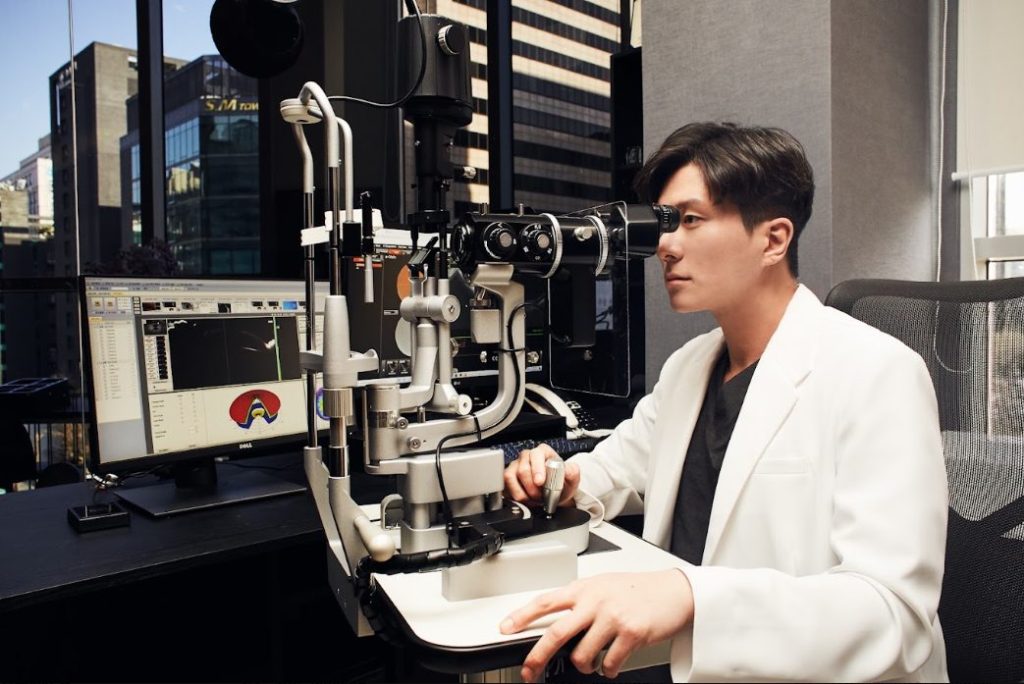
Cataract surgery cost in Korea depends mostly on the lens you choose. At St. Mary’s Jin Eye Center in Gangnam, Seoul, the 2026 price is ₩1,500,000 per eye with a monofocal lens and ₩2,200,000–₩6,500,000 per eye with enhanced monofocal, extended depth-of-focus (EDOF) or multifocal lenses; the cataract examination is ₩100,000. The final quote is confirmed after the exam, because the right lens depends on your retina, cornea and tear film — and on whether one or both eyes need surgery.
Medically reviewed by Dr. Park JinHeung, Director, St. Mary’s Jin Eye Center (Ophthalmologist, PhD; Adjunct Professor, Seoul St. Mary’s Hospital) · Last updated 2026-10-30
This guide explains the five things that decide your final quote, our 2026 lens price list (14 price options), whether a more expensive lens is better for your eyes, how insurance usually works for international patients, a checklist for comparing quotes from different clinics and how many days to plan in Seoul. St. Mary’s Jin Eye Center is about 5 minutes on foot from Gangnam Station Exit 5.
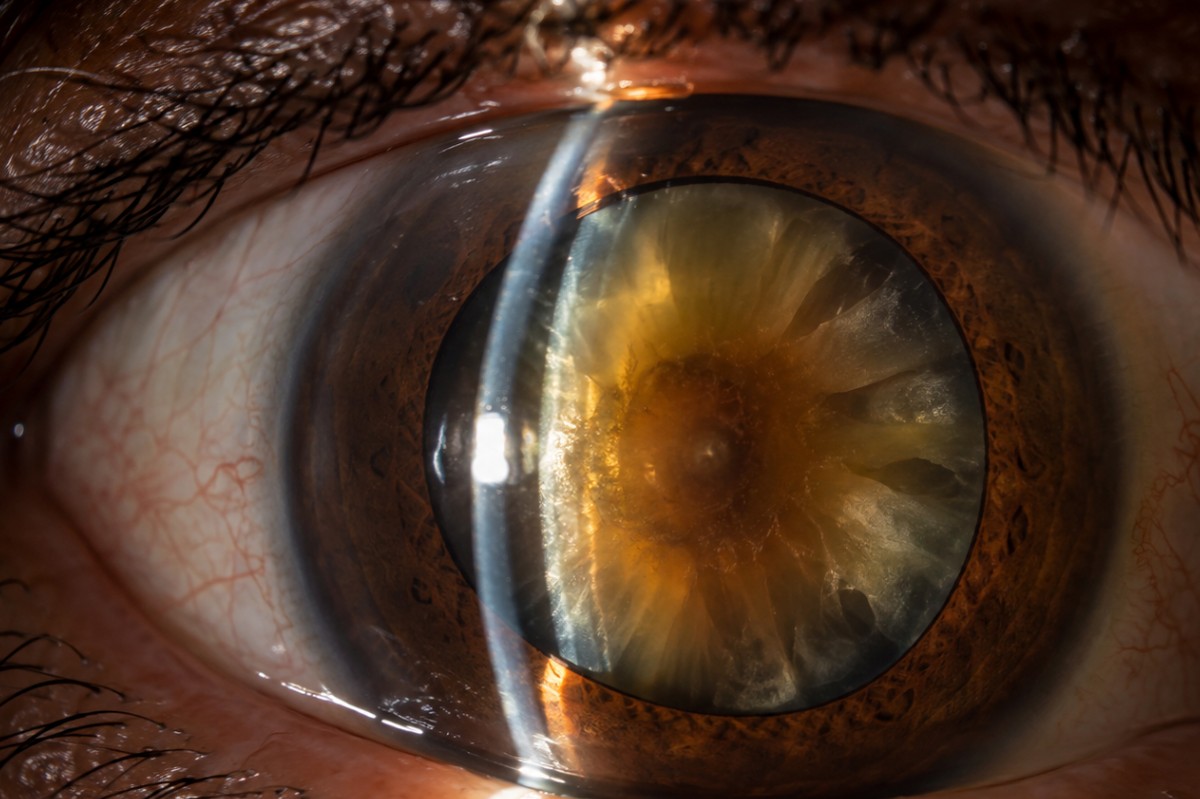
How far a cataract has progressed is checked by widening the pupil with dilating eye drops and examining the lens directly with a slit-lamp microscope. When the centre of the lens is dense and yellow-brown, with wedge-shaped opacities at the edge as in the image above, the cataract is advanced: the cloudy lens scatters light, reducing the clarity of the image on the retina, and can cause significant loss of vision. A harder, more advanced cataract can change the surgical approach, the operating time and what must be checked beforehand — another reason the final quote is given only after the detailed examination.
What decides the cost of cataract surgery in Korea?
Four things decide the clinic’s quote — the lens, one or both eyes, the tests your eyes need and any other eye conditions. What you finally pay out of pocket also depends on your insurance. Of these, the lens makes by far the biggest difference.
Cataract surgery removes the cloudy natural lens and replaces it with an artificial lens (intraocular lens, IOL). The operation itself is similar for everyone; what changes the quote is which lens is implanted, which tests are needed before surgery and whether one or both eyes are treated. If both eyes have surgery, the surgery and the lens are charged for each eye separately.
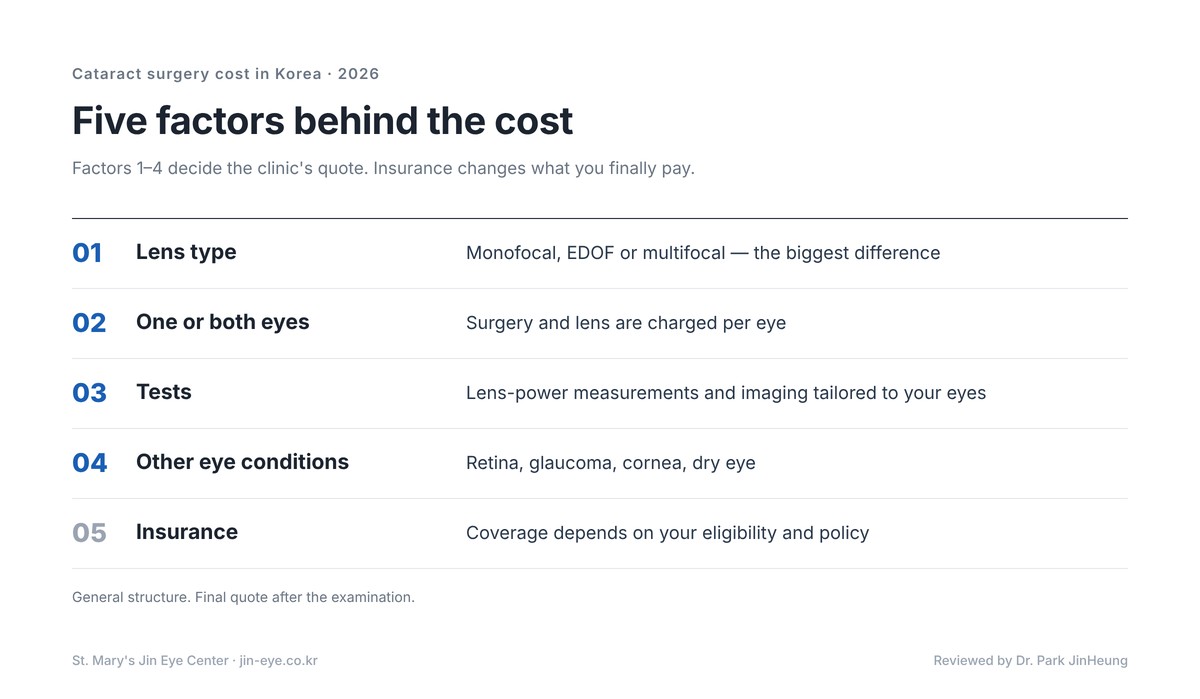
| Factor | What changes | Effect on the cost | When it is decided |
|---|---|---|---|
| Lens type | Monofocal, enhanced monofocal, EDOF or multifocal; with or without astigmatism correction (toric) | The biggest difference — ₩1,500,000 to ₩6,500,000 per eye at our clinic | After the exam and consultation |
| One or both eyes | Surgery and lens are charged per eye | A both-eye quote is the sum of two per-eye prices; the lens can differ between eyes | After the exam |
| Tests | Measurements for lens power, corneal imaging, retinal imaging (OCT) | Cataract exam ₩100,000; extra tests only if your eyes need them | At the exam |
| Other eye conditions | Retinal disease, glaucoma, corneal disease, dry eye | Treatment may be needed first or separately, and can change the lens choice | After the test results |
| Insurance | Korean National Health Insurance, travel or home-country health insurance | For self-pay patients, affects possible reimbursement; people eligible for Korean National Health Insurance may be billed under a different fee structure | Your eligibility and policy terms |
A general structure. Prices are St. Mary’s Jin Eye Center’s 2026 prices for international patients; ask us what each price includes before you travel.
How much does cataract surgery cost in Korea? 2026 prices by lens
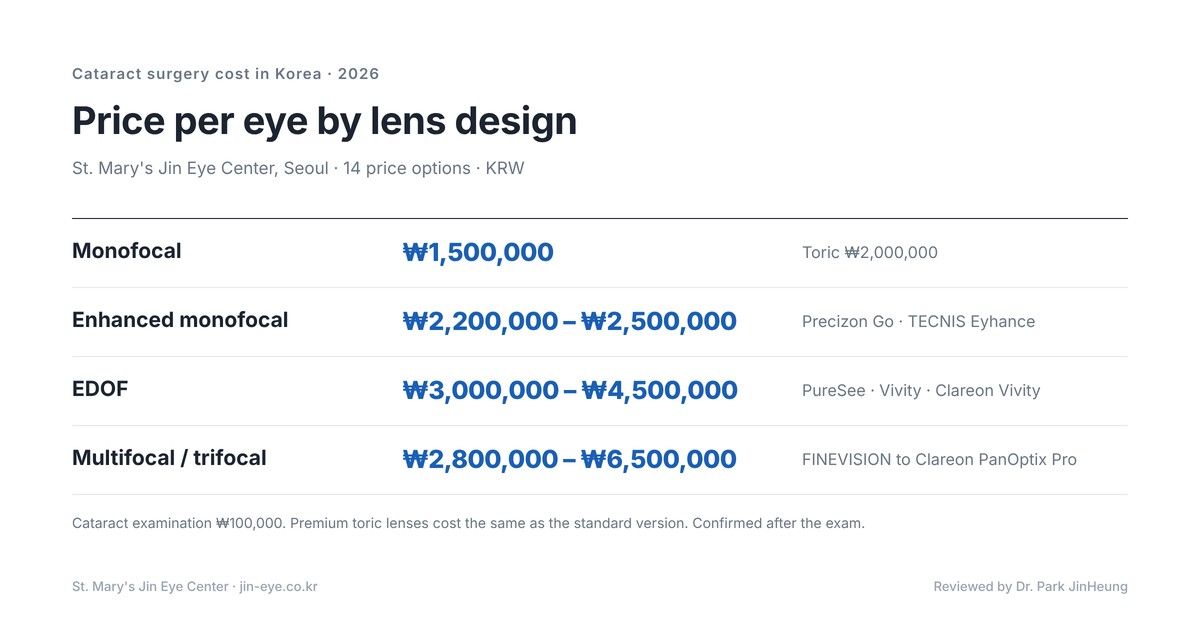
At St. Mary’s Jin Eye Center, cataract surgery costs ₩1,500,000 to ₩6,500,000 per eye, depending on the lens. The cataract examination (₩100,000) is charged separately.
All prices below are per eye and in Korean won. The toric (astigmatism-correcting) version of a premium lens costs the same as the standard version of that lens; the Clareon Monofocal Toric is ₩2,000,000. Prices are confirmed after the detailed examination — please ask us what each price includes (for example medication and follow-up visits).
| Lens | Manufacturer (country) | Design | Price per eye (KRW, 2026) |
|---|---|---|---|
| Clareon Monofocal | Alcon (USA) | Monofocal | ₩1,500,000 |
| Clareon Monofocal Toric | Alcon (USA) | Monofocal, corrects astigmatism | ₩2,000,000 |
| Precizon Go | Ophtec (Netherlands) | Enhanced monofocal (intermediate) | ₩2,200,000 |
| TECNIS Eyhance | Johnson & Johnson (USA) | Enhanced monofocal | ₩2,500,000 |
| FINEVISION | PhysIOL (Belgium) | Trifocal | ₩2,800,000 |
| TECNIS Synergy | Johnson & Johnson (USA) | Continuous-range multifocal | ₩3,000,000 |
| TECNIS PureSee | Johnson & Johnson (USA) | EDOF | ₩3,000,000 |
| AcrySof PanOptix | Alcon (USA) | Trifocal | ₩3,000,000 |
| AcrySof IQ Vivity | Alcon (USA) | EDOF | ₩3,000,000 |
| AT LISA tri / AT ELANA | ZEISS (Germany) | Trifocal | ₩4,000,000 |
| Clareon PanOptix | Alcon (USA) | Trifocal | ₩4,500,000 |
| Clareon Vivity | Alcon (USA) | EDOF | ₩4,500,000 |
| TECNIS Odyssey | Johnson & Johnson (USA) | Full visual range (diffractive–refractive design) | ₩5,000,000 |
| Clareon PanOptix Pro | Alcon (USA) | Trifocal (quadrifocal optical design) | ₩6,500,000 |
| Cataract examination | — | — | ₩100,000 |
St. Mary’s Jin Eye Center prices for international patients, 2026. Prices are confirmed after the examination; what is included is explained when you book.
All of our prices, doctors and equipment are summarised on St. Mary’s Jin Eye Center — facts and 2026 prices.
Is a more expensive lens better for my eyes?
Not necessarily. Higher-priced lenses may improve intermediate or near vision and reduce dependence on glasses, depending on their design — but each involves trade-offs such as halos or glare, so the right lens depends on your eyes and how you use them.
A 2016 Cochrane review of 20 randomised trials found that people with multifocal lenses were less likely to need glasses (risk ratio 0.63, low certainty) but more likely to see halos around lights (risk ratio 3.58, moderate certainty) than people with monofocal lenses. Glare was also more common with multifocal lenses (risk ratio 1.41, low certainty), while distance vision was similar (de Silva et al., Cochrane 2016). These findings concern the lenses included in the review and do not directly compare newer premium lens models; they are international studies, not Korean data.
If you have macular disease, advanced glaucoma, an irregular cornea or uncontrolled dry eye, or if you drive a lot at night, a monofocal lens may be considered first, or an EDOF lens that suits your eye may be discussed. In a survey by the Korea Consumer Agency, 60 of 135 complaints about cataract surgery (44.4%) concerned multifocal lenses, and the agency advised patients to understand the need, effects and side effects before deciding (Seoul Metropolitan Government / Korea Consumer Agency, 2021). Choosing a lens by your test results and daily needs — not by price — helps avoid unnecessary cost and disappointment. Which lens suits whom is explained in our multifocal vs monofocal lens guide.
Which tests are included, and why do some people need more?
Every patient needs the basic measurements that calculate the lens power. Extra tests depend on other eye conditions and on the lenses being considered.
| Test group | What it checks | When more is needed |
|---|---|---|
| Basic exam and biometry | Vision, refraction, eye pressure, slit-lamp exam, eye length and corneal curvature (IOL Master 700) | Before every cataract operation |
| Corneal imaging | Corneal shape and astigmatism (Pentacam HR), ocular surface and tear film | When a toric or multifocal lens is considered, or after previous LASIK or LASEK |
| Retinal exam | Macula, retina and optic nerve, including OCT | With diabetic retinopathy, macular degeneration, epiretinal membrane or other retinal disease, and when a multifocal lens is considered |
| Treatment of other conditions | Dry eye or eyelid inflammation, retinal disease | When a problem that should be treated first is found |
General flow at St. Mary’s Jin Eye Center. Any test not included in the examination fee is explained, with its price, before it is done.
More tests are usually not about raising the bill: a hidden retinal problem or uncontrolled dry eye directly affects the lens choice and your vision after surgery. Our two doctors divide their work between the retina and the anterior segment, so the retina is checked together with the lens before cataract surgery. The full examination takes about one hour, followed by about one hour of consultation.
Will insurance pay for cataract surgery in Korea?
It depends on your insurance. International visitors who are not enrolled in Korea’s National Health Insurance usually pay the clinic’s self-pay price; whether travel or home-country insurance reimburses you depends on your policy.
In Korea, cataract surgery with a monofocal lens is covered by National Health Insurance for people enrolled in it, while premium presbyopia-correcting lenses, including multifocal lenses and commonly used EDOF models, are generally non-covered items; the exact billing depends on the lens and the applicable rules. If you live in Korea and are enrolled in National Health Insurance, your costs are structured differently from the international prices on this page — please tell us when you book.
If you plan to claim from travel insurance or your home-country health insurer, check before you travel whether planned (elective) cataract surgery abroad is covered and which documents they require, and ask us which documents we can provide. Since 2021, Korea has required prior explanation of designated non-covered medical services and their costs (Korea.kr policy briefing, 2020), so ask for an itemised written quote before surgery.
How should I compare cataract surgery quotes?
Before comparing prices, make sure the quotes are for the same thing: one eye or both, the same lens model, the same tests and the same follow-up care.
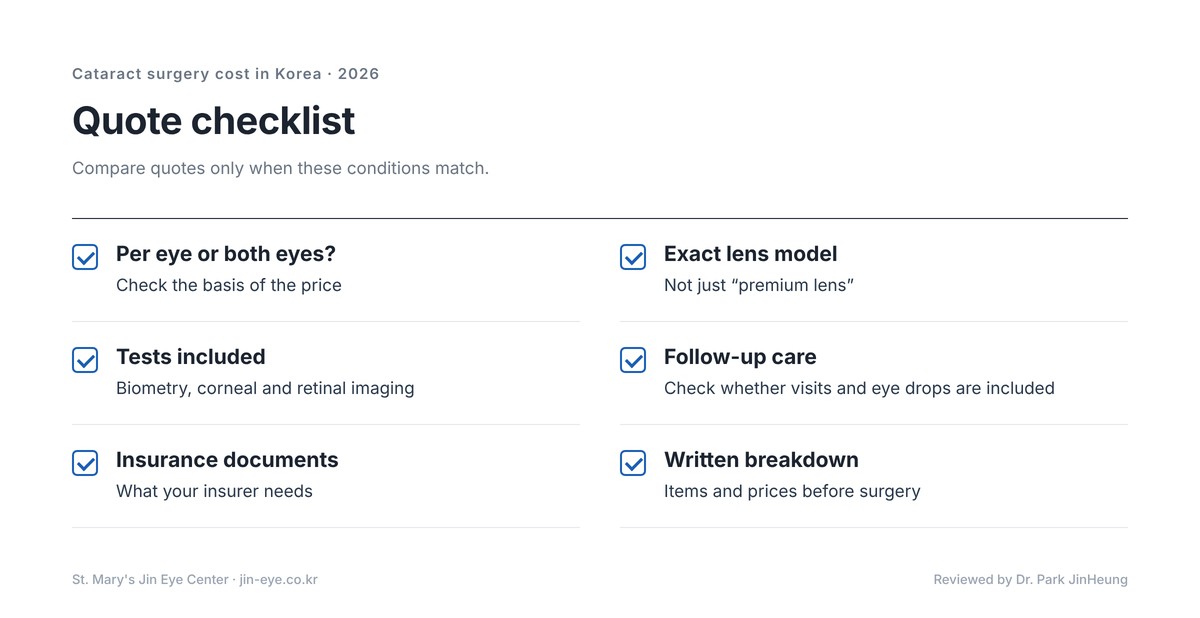
Ask whether the price is per eye or for both eyes, the exact lens name (not just “premium lens”), which tests and eye drops are included, how many follow-up visits are included, and what happens if extra treatment is needed. A quote that names the lens model is easier to compare than a package price.
It also helps to know about care that may be needed later. Months or years after surgery, the membrane behind the lens can become cloudy (posterior capsule opacification); when it affects vision, it can usually be treated with a short Nd:YAG laser procedure. In a UK study of 20,763 eyes aged 65 and over with single-piece monofocal lenses, 5.8–19.3% of eyes had YAG laser treatment within five years, depending on the lens model (Ursell et al., Eye 2020). This is a UK study, not Korean data.
How does St. Mary’s Jin Eye Center prepare your final quote?
We examine your eyes first, narrow down the lens options in a specialist consultation and then explain the cost for the lens and surgery plan you choose — so the price is not fixed before we know which lens suits you.
| Step | What happens | Cost |
|---|---|---|
| Before travel | Book online and send recent eye records and your travel dates; tell us the lenses you are interested in | Ask about prices and what is included |
| Exam (about 1 hour) | IOL Master 700 measurements, Pentacam HR corneal imaging, retinal exam including OCT, tear film check | Cataract examination ₩100,000 |
| Consultation (about 1 hour) | Results explained; the distances you use most and your expectations are discussed | Lens options with their per-eye prices |
| Decision | Lens, target distance, one or both eyes and the surgery date are decided | Final quote confirmed before surgery |
| Surgery and check-ups | Same-day surgery is possible depending on the results; check-ups the next day and at least on day 3 | Follow-up care explained in advance |
Based on St. Mary’s Jin Eye Center’s cataract care pathway; it changes with your test results. The quote does not guarantee a surgical result.
Plan to stay in Seoul until at least the check-up on day 3 after surgery; about one week is recommended. If both eyes need surgery, one eye is usually operated on first and the second eye after checking the first, so tell us your travel dates and we will plan the schedule with you. The two directors, Dr. Park JinHeung and Dr. Park Jae-hyun, are former faculty of Seoul St. Mary’s Hospital, and the clinic’s ophthalmologists have performed about 21,000 cataract and presbyopia operations. Our full cataract guide for international patients is Cataract Surgery in Korea — Zero Cataract™, and travel help is on our international patients page.
What are the risks after cataract surgery, and when should I seek care?
Whatever lens you choose, cataract surgery has limits and possible side effects. Some leftover prescription may remain and glasses may still be needed, posterior capsule opacification can develop, and rarely complications such as infection inside the eye (endophthalmitis), macular swelling or retinal detachment can occur.
- Sudden loss of vision, severe eye pain or rapidly increasing redness: you need urgent same-day eye assessment — contact the clinic that operated on you at once, and do not wait for a scheduled check-up or for the clinic to reopen.
- New flashes of light, a sudden increase in floaters or a curtain-like shadow: possible retinal tear or detachment — seek same-day eye care.
- Outside opening hours in Korea, go to a hospital emergency department with ophthalmology services; if you are already home, see a local ophthalmologist or eye emergency service the same day.
Frequently asked questions
How much does cataract surgery cost in Korea?
At St. Mary’s Jin Eye Center in Seoul, cataract surgery costs ₩1,500,000 per eye with a monofocal lens and ₩2,200,000–₩6,500,000 per eye with enhanced monofocal, EDOF or multifocal lenses (2026). The cataract examination is ₩100,000. The final price is confirmed after the exam.
Why does the cost of cataract surgery differ from person to person?
Mainly because of the lens. The cost also depends on whether one or both eyes are treated, which tests your eyes need and whether other eye conditions need treatment. Insurance then changes what you finally pay.
Is the price per eye or for both eyes?
Our cataract prices are per eye. If both eyes have surgery, the surgery and lens are charged for each eye, and the two eyes can have different lenses. Always check whether a quote is per eye or for both eyes.
Does a toric lens for astigmatism cost more?
For our premium lenses, the toric version costs the same as the standard version of the same lens. The Clareon Monofocal Toric is ₩2,000,000 per eye, compared with ₩1,500,000 for the Clareon Monofocal.
Is a multifocal lens worth the extra cost?
It depends on your eyes and lifestyle. In a Cochrane review, multifocal lenses reduced the need for glasses but halos around lights were more common. With macular disease, advanced glaucoma, an irregular cornea or frequent night driving, a monofocal or EDOF lens may suit you better.
Will my insurance cover cataract surgery in Korea?
If you are not enrolled in Korea’s National Health Insurance, you usually pay the clinic’s self-pay price. Whether travel or home-country insurance reimburses you depends on your policy, so check before you travel which documents your insurer needs and ask us which we can provide.
How many days should I stay in Seoul for cataract surgery?
Plan to stay until at least the check-up on day 3 after surgery; about one week is recommended. If both eyes are treated, the second eye is usually done after checking the first, so share your travel dates when you book.
- 337 Gangnam-daero, Seocho-gu, Seoul (1F, 4F, 5F) — about 5 minutes on foot from Gangnam Station Exit 5
- Hours (KST): Mon–Fri 09:00–18:00 (lunch 13:00–14:00), Sat 09:00–15:00
- Phone +82-2-577-7782 · E-mail jin.eye.center@gmail.com
- Registered medical institution for international patients in Korea
- Clinic facts and prices: St. Mary’s Jin Eye Center — facts and 2026 prices
References
- de Silva SR, Evans JR, Kirthi V, et al. Multifocal versus monofocal intraocular lenses after cataract extraction. Cochrane Database Syst Rev. 2016;12:CD003169. Read
- Ursell PG, Dhariwal M, O’Boyle D, et al. 5 year incidence of YAG capsulotomy and PCO after cataract surgery with single-piece monofocal intraocular lenses: a real-world evidence study of 20,763 eyes. Eye. 2020. Read
- Seoul Metropolitan Government. Cataract surgery complaints rising — know the effects and side effects (Korea Consumer Agency survey, 2021-11-05, in Korean). Read
- Korea.kr policy briefing. Non-covered treatment prices to be disclosed by clinics; prior explanation required (2020-12-31, in Korean). Read
This article is general information about the cost structure of cataract surgery and does not replace an individual diagnosis or an insurance decision. Prices are St. Mary’s Jin Eye Center’s 2026 prices for international patients and are confirmed after the examination. The right lens, whether surgery is possible and your vision afterwards depend on your test results and eyes, and every operation can have side effects. Zero Cataract™ is the name of the clinic’s cataract care programme (trademark application No. 40-2026-0207205).