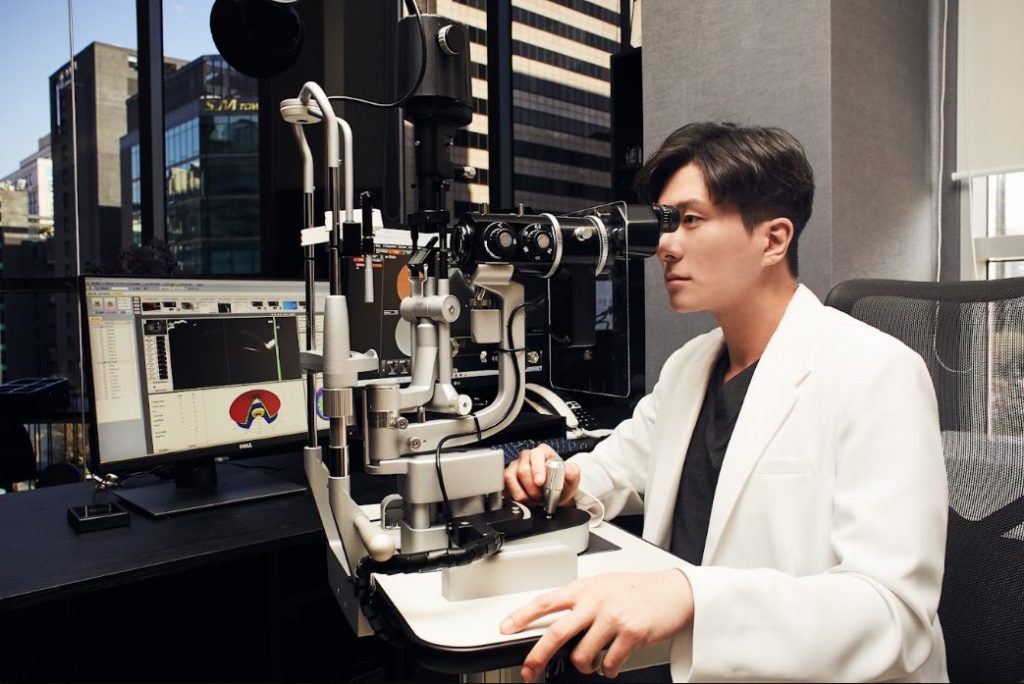
Cataract surgery in Korea at St. Mary’s Jin Eye Center, an eye clinic in Gangnam, Seoul, can be done on the same day as your eye exam when test results, scheduling and your medical condition allow: about 1 hour of tests, about 1 hour of specialist consultation, the operation itself, which usually takes around 10 minutes per eye, then 30–60 minutes of rest. Zero Cataract™ is the clinic’s name for this cataract care program — the operation itself is standard cataract surgery.
Medically reviewed by Dr. Park JinHeung, Director, St. Mary’s Jin Eye Center (Ophthalmologist, PhD; Adjunct Professor, Seoul St. Mary’s Hospital) · Last updated 2026-10-12
Zero Cataract™ is the name of St. Mary’s Jin Eye Center’s cataract care program. It is not a new surgical technique or an official procedure name, and it does not mean that cataracts become “zero” or that surgery has no complications. The operation is standard phacoemulsification (removing the cloudy lens with ultrasound) with an intraocular lens (IOL) implant. The program aims to reduce three burdens — discomfort, waiting and day-to-day inconvenience — and “ZERO” describes that goal, not a promised result. This guide follows the four steps — exam, specialist consultation, surgery and aftercare — and adds what international patients need to plan a trip: same-day conditions, per-eye lens prices, how long to stay in Korea and the warning signs that need urgent care.
What is the Zero Cataract™ program at this Korean eye clinic?
The difference is not the surgical method but how the care pathway is designed. The three goals are less discomfort (a quicker return to daily life), less waiting (same-day surgery when suitable) and less inconvenience (a lens chosen for your eyes and lifestyle).
| Goal | What it tries to reduce | How | Limits |
|---|---|---|---|
| Less discomfort | Discomfort during surgery and the burden of getting back to daily life | Topical (eye-drop) anesthesia, a pre-surgery talk about anxiety and anesthesia options, step-by-step aftercare instructions | How much discomfort you feel varies from person to person |
| Less waiting | Extra trips between the exam and the operation | A schedule that lets exam, consultation and surgery happen on one day | Surgery may be scheduled on a separate day depending on test results, the surgeon’s judgment and availability |
| Less inconvenience | Dependence on glasses and trouble at certain distances | Lens counseling across 14 IOL types, matched to your eye findings and the distances you use most | With any lens, halos or situations that still need glasses can occur |
Zero Cataract™ — Korean trademark application No. 40-2026-0207205 (application pending, not a registered trademark). “ZERO” describes a goal and does not guarantee results.
Surgery is performed by the two directors, Dr. Park JinHeung and Dr. Park Jae-hyun, both board-certified ophthalmologists and former faculty of Seoul St. Mary’s Hospital, with retina and anterior segment as their respective fields. The doctors’ cumulative experience includes more than 21,000 presbyopia and cataract operations. Cataract surgery uses the Alcon Centurion Vision System and the ZEISS OPMI Lumera surgical microscope, among other equipment. Experience and equipment are facts about the clinic and do not guarantee an individual result. An overview of cataract and presbyopia care is on the cataract surgery page.
How does cataract surgery day work at an eye clinic in Seoul?
About 1 hour of tests, about 1 hour of consultation, the operation, then 30–60 minutes of rest before you leave. You come back the next day for a check-up, and later visits are planned according to how your eye is healing.
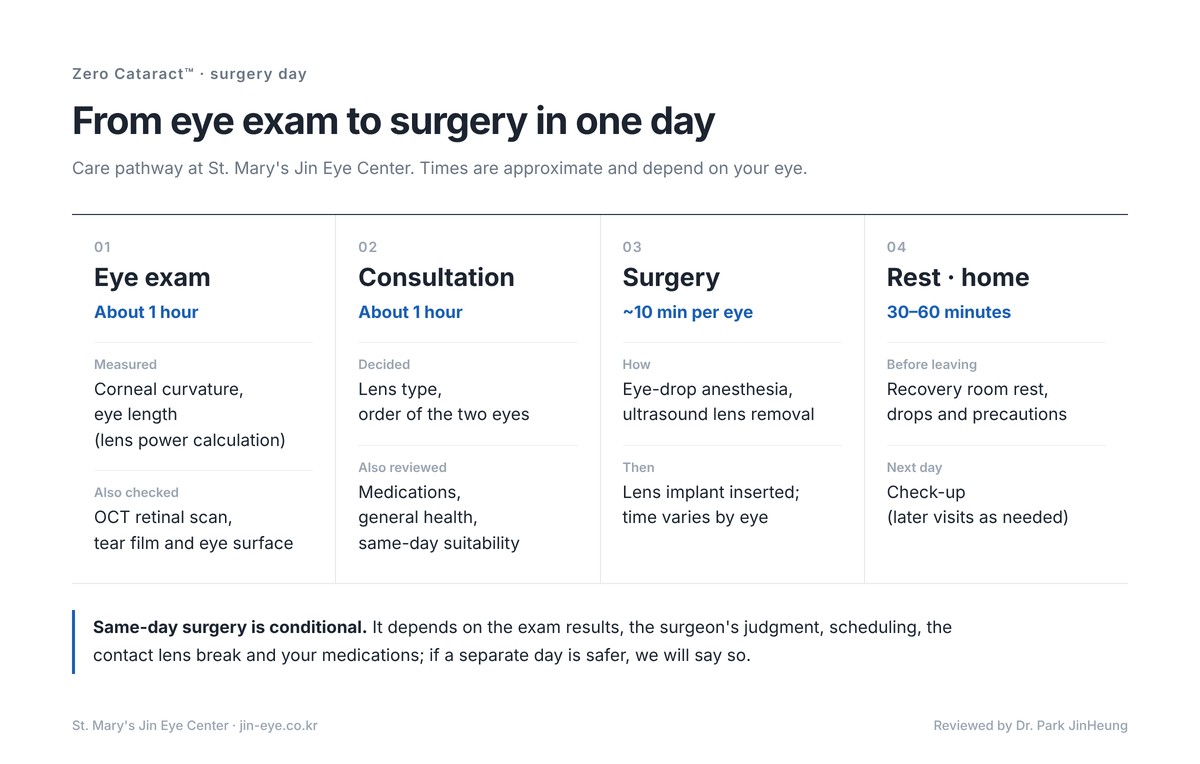
| Step | Time (approx.) | What happens |
|---|---|---|
| ① Eye exam | About 1 hour | Corneal curvature and eye length measured (ZEISS IOLMaster 700) to calculate lens power, corneal tomography (OCULUS Pentacam HR), retinal exam including OCT, tear film and ocular surface check |
| ② Consultation | About 1 hour | Results explained, lens type and target distance chosen, order of the two eyes, medications and general health reviewed, decision on whether same-day surgery is suitable |
| ③ Surgery | Usually around 10 minutes per eye | Eye-drop anesthesia → small incision → cloudy lens removed with ultrasound → IOL inserted. Operating time depends on the eye |
| ④ Rest | 30–60 minutes | Rest in the recovery room, instructions on eye drops and precautions, next-day check confirmed |
Approximate times based on the clinic’s care pathway. Dilating drops are used, so do not drive yourself on exam or surgery day, and come with a companion if possible.
The corneal curvature and eye length measured during the exam are the basis of the lens power calculation. Inaccurate measurements can affect the choice of lens power and leave a residual refractive error after surgery, so contact lens wear must be stopped for the recommended period and the eye surface is checked before measuring. The retinal exam looks for problems such as macular disease that could affect the result. How a retinal condition changes timing and lens choice is explained in cataract surgery with a retinal condition.
Can I have cataract surgery in Korea on the same day as my eye exam?
Yes, if your test results and eye condition are suitable for surgery, the operation can follow the exam on the same day. Same-day surgery depends on the exam, booking availability and medical suitability, and in the situations below a separate day is safer.
| Checked before same-day surgery | Why | A separate day may be scheduled when |
|---|---|---|
| Contact lens break | Lenses change the shape of the cornea and can alter the lens power calculation | Contact lenses have not been stopped for the clinic’s recommended period (soft 5 days, hard/RGP 2 weeks, orthokeratology 4 weeks), or measurements remain unstable |
| Dry eye and ocular surface | An unstable tear film can make measurements unreliable | The eye surface should be treated first and measured again |
| Retina and optic nerve | Macular degeneration, glaucoma and similar conditions change the order of treatment and lens choice | Another condition needs treatment first, or more tests are needed |
| Medications and general health | Blood-thinning medications, diabetes management and blood pressure control are reviewed | General health needs to be stabilized first. Do not stop any medication on your own — tell the doctor at consultation |
The contact lens break is the clinic’s standard guidance; a longer break or repeat measurement may be needed depending on the cornea and wearing history.
The ASCRS ocular surface algorithm notes that ocular surface disease can distort pre-operative measurements, and that treating it before surgery can improve results (Starr et al., J Cataract Refract Surg, 2019). So same-day surgery is an option when everything is in place; accurate measurement comes first. If you are flying in, mention that you would like same-day surgery when you book online, and share your contact lens type, a list of your medications and any recent eye records in advance. This helps avoid an unplanned extra day.
Is cataract surgery painful?
Most operations are done under eye-drop anesthesia, and discomfort during surgery is usually modest, but it varies between people. You may feel pressure or see bright light.
Topical anesthesia numbs the surface of the eye with drops. A Cochrane systematic review comparing it with an injection around the eye (sub-Tenon’s anesthesia) — 7 studies, 617 people — found pain during surgery was on average about 1.1 points higher on a 0–10 scale with drops. The authors judged this difference statistically significant but possibly not clinically important, and concluded that both are accepted, safe methods (Guay & Sales, Cochrane Database Syst Rev, 2015).
If you are very anxious or find it hard to keep your eye still, say so at the consultation so the anesthesia plan can be discussed. A gritty feeling or glare can last a few days after surgery, but pain that keeps getting worse or a sudden drop in vision is not normal: get an in-person eye examination immediately, and if urgent eye care is not available, go to an emergency department rather than waiting for an online reply.
How do I choose an intraocular lens, and how much does cataract surgery cost in Korea?
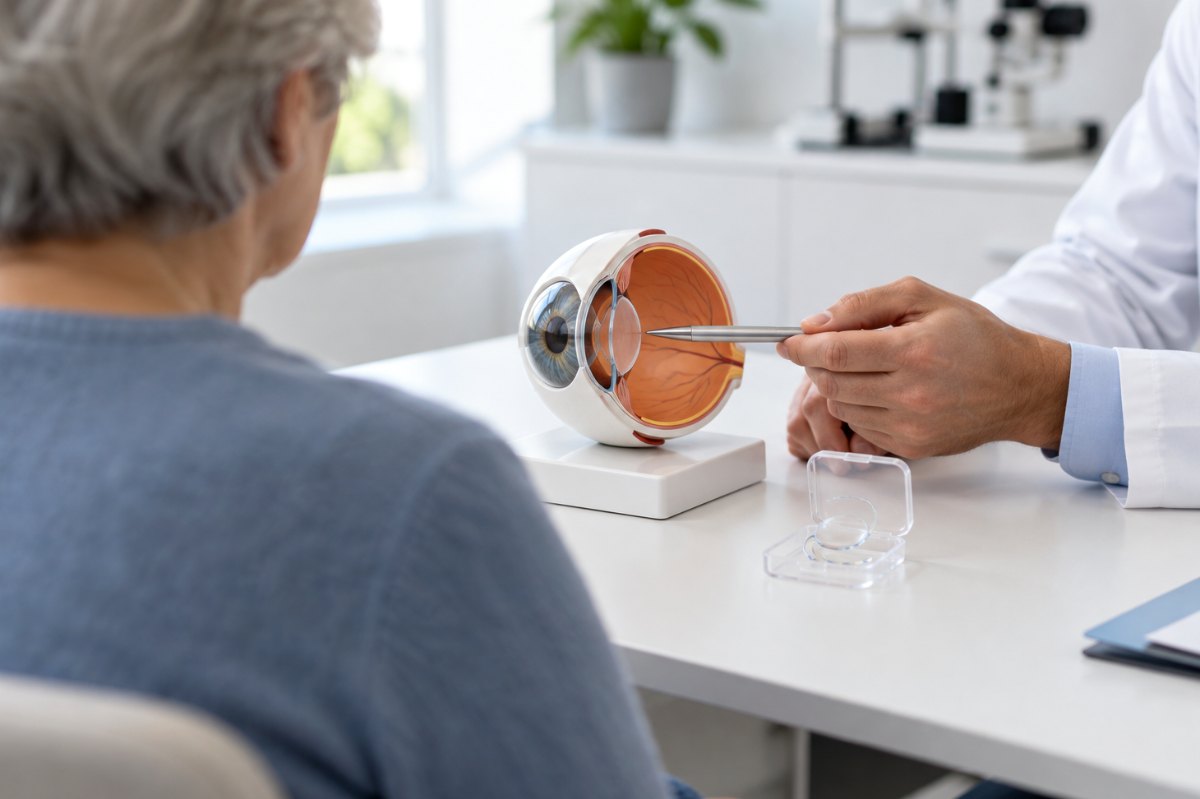
Choosing a lens means deciding which distances you want to see without glasses and whether your eye suits that lens. Multifocal lenses may reduce dependence on glasses but cause halos more often, so they do not suit every eye. Prices are per eye and depend on the lens.
| Lens design | Typical range of vision | Also consider |
|---|---|---|
| Monofocal | One distance clearly (usually far) | Reading glasses are usually needed for near |
| Enhanced monofocal (varies by product) | Mainly far, with some help at intermediate | Reading glasses may be needed for small print |
| Extended depth of focus (EDOF) | Far to intermediate | Near may be weaker than with multifocals; halos can occur |
| Multifocal | Depending on the product, far and near, or far, intermediate and near | Halos, glare and reduced contrast sensitivity are more common |
Toric lenses correct astigmatism and can be combined with these designs. Products within the same group also differ.
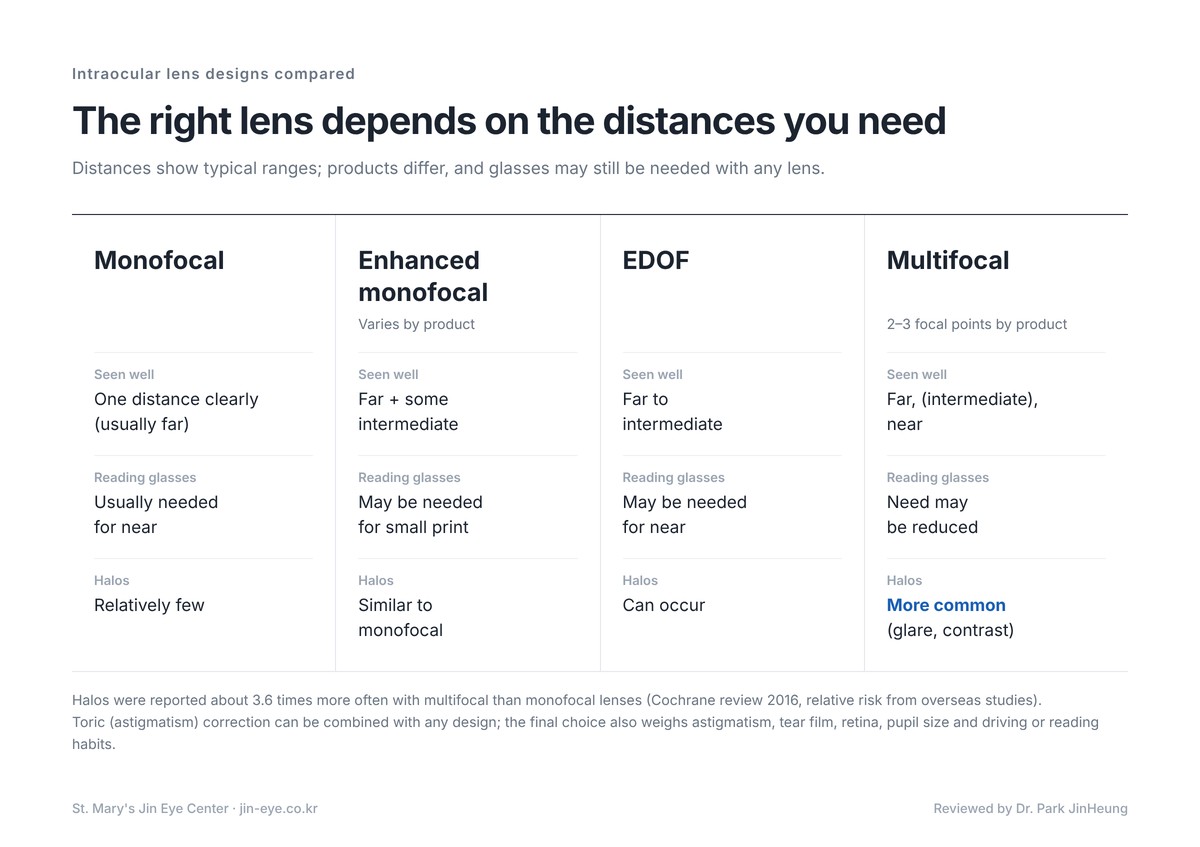
In a Cochrane review of multifocal versus monofocal lenses (20 trials), the relative risk of remaining dependent on glasses was 0.63 with multifocal lenses (low-certainty evidence), while the relative risk of reporting halos was 3.58 — about 3.6 times as often (moderate-certainty evidence; de Silva et al., 2016). This is a relative risk; it does not mean that a fixed share of multifocal patients will have halos. A meta-analysis comparing EDOF with monofocal lenses (9 studies, 1,336 eyes) found better uncorrected intermediate and near vision, but more frequent halos and reduced contrast sensitivity (Liu et al., BMC Ophthalmol, 2019).
The consultation therefore looks at corneal astigmatism and shape (higher-order aberrations), the tear film and ocular surface, the retina, macula and optic nerve, pupil size, and the distances you use most — driving, reading, phone or computer. For example, people who drive a lot at night or who have macular disease may not suit a multifocal lens, and a monofocal lens may be the better choice for some eyes. St. Mary’s Jin Eye Center offers 14 IOL types (Alcon, J&J and others), including Clareon PanOptix Pro, first launched in Korea in April 2026.
| Lens (cataract surgery, per eye) | Maker | Price per eye |
|---|---|---|
| Clareon Monofocal | Alcon | ₩1,500,000 |
| Clareon Monofocal Toric | Alcon | ₩2,000,000 |
| Precizon Go | Ophtec | ₩2,200,000 |
| TECNIS Eyhance | J&J | ₩2,500,000 |
| FINEVISION | PhysIOL | ₩2,800,000 |
| TECNIS Synergy · TECNIS PureSee | J&J | ₩3,000,000 |
| AcrySof PanOptix · AcrySof IQ Vivity | Alcon | ₩3,000,000 |
| AT LISA tri · AT ELANA | ZEISS | ₩4,000,000 |
| Clareon PanOptix · Clareon Vivity | Alcon | ₩4,500,000 |
| TECNIS Odyssey | J&J | ₩5,000,000 |
| Clareon PanOptix Pro | Alcon | ₩6,500,000 |
| Cataract examination | — | ₩100,000 |
Clareon Monofocal Toric is the astigmatism-correcting version of Clareon Monofocal. Surgery prices above are per eye, and the ₩100,000 cataract examination is charged separately; all prices are finalized after a detailed eye exam. Ask us what each price includes. Prices as of October 2026.
The full price list for cataract surgery and vision correction is on our St. Mary’s Jin Eye Center facts and prices page. Your final quote depends on the lens chosen for your eye, astigmatism correction and whether one or both eyes are treated. To ask about lens options and a same-day surgery consultation, send a booking request.
How long should I stay in Korea after cataract surgery, and what aftercare is needed?
Plan to stay at least until the check-up on the third day after surgery — you can fly home after that check if the eye is healing well and the surgeon agrees — and we recommend staying about one week. After surgery, keep water out of the operated eye for 1 week, wear an eye shield at night for 2 weeks, and avoid saunas, eye make-up, swimming and strenuous exercise for 4 weeks.
| When | Do | Avoid |
|---|---|---|
| Surgery day | Rest in the recovery room, leave with a companion, start the prescribed drops | Touching or rubbing the eye, driving yourself |
| Next day | Check-up (eye pressure, inflammation, vision) | Stopping drops on your own before the check |
| Day 3 | Check-up before flying home (minimum for international patients) | Booking a flight that leaves before this check |
| Up to 1 week | Use drops as prescribed, protective glasses outdoors if needed | Getting water in the operated eye when washing your face or hair or showering |
| Up to 2 weeks | Plastic eye shield while sleeping | Sleeping face-down or pressing on the eye |
| Up to 4 weeks | Keep follow-up appointments (with an ophthalmologist at home after you return) | Public baths and saunas, eye make-up, hair perms and dye, swimming and strenuous exercise, smoking and alcohol |
Based on St. Mary’s Jin Eye Center’s cataract aftercare guidance. Other clinics may use different periods; your surgeon’s instructions come first.
Being allowed to fly after the day-3 check does not mean recovery is complete; vision may keep changing for some weeks, and the right time for new glasses differs between people. Driving should wait until your vision has been checked and the doctor advises it. Both eyes are usually operated on separately: one eye first, then the other after checking the result, with the interval decided with your surgeon — so ask about the total stay when booking if you want both eyes done. Arrange a follow-up with an ophthalmologist near home before you travel. Day-by-day travel planning is covered in how long to stay in Korea for cataract surgery, and support for overseas visitors is on our international patients page.
What are the risks and limitations of cataract surgery?
The most common later problem is posterior capsule opacification; the rare but important one is endophthalmitis (infection inside the eye). Cataract surgery is common and well established, but it is not risk-free.
Posterior capsule opacification is clouding of the capsule that holds the lens implant; it is not the cataract coming back. In a UK observational study of 20,763 eyes (patients aged 65 or older) with specific monofocal lens models, 5.8–19.3% of eyes underwent Nd:YAG laser capsulotomy within 5 years, depending on the lens model (Ursell et al., Eye, 2020). The figure varies with lens type and patient characteristics. If it affects vision, it can be treated in the clinic with a short Nd:YAG laser procedure.
Endophthalmitis is rare but can seriously affect vision. In a US health system analysis of 216,141 non-complex cataract operations, 34 cases occurred within 90 days — about 0.016% — roughly 1–2 per 10,000 operations (Shorstein et al., Am J Ophthalmol, 2021). During surgery, the capsule that holds the implant can tear (posterior capsule rupture), and if the eye ends up with an unexpected prescription (residual refractive error), glasses or an additional procedure may be needed. Other possible problems include inflammation, a temporary rise in eye pressure, macular swelling (macular edema) and retinal detachment, which is why scheduled check-ups after surgery matter.
| If you notice | Possible cause | When to get help |
|---|---|---|
| Sudden drop in vision, severe pain, worsening redness or more discharge | Endophthalmitis, inflammation, raised eye pressure | Immediately — get an urgent in-person eye examination. In Korea, contact our clinic; outside clinic hours or if urgent eye care is not available, go to an emergency department |
| A sudden shower of floaters, flashes of light, or a curtain over part of your vision | Retinal tear or detachment | Immediately — urgent in-person eye examination (outside clinic hours, an emergency department with eye care) |
| Vision slowly becoming cloudy again months or years later | Posterior capsule opacification | Book an outpatient appointment |
General guidance only — not for self-diagnosis. If you have already returned home, do not wait for an email reply: see a local ophthalmologist or emergency department in person.
Frequently asked questions
Is Zero Cataract™ a special type of cataract surgery?
No. Zero Cataract™ is St. Mary’s Jin Eye Center’s name for its cataract care program covering the exam, consultation, surgery and follow-up. The operation itself is standard cataract surgery (phacoemulsification with an intraocular lens). “ZERO” describes the goal of less discomfort, less waiting and less inconvenience; it does not mean zero cataracts or zero complications.
Can I have cataract surgery in Korea on the same day as the eye exam?
Often yes, if the exam results, booking availability and your medical condition allow it. A separate day may be safer if your contact lenses were not removed long enough, your eye surface needs treatment, another eye condition needs attention first or your general health needs to be stabilized.
How long does cataract surgery take?
The operation itself usually takes around 10 minutes per eye but depends on the eye. On a same-day visit, add about 1 hour for tests, about 1 hour for the consultation and 30–60 minutes of rest afterwards.
Are both eyes operated on the same day?
Usually one eye is operated on first and the other after the first result has been checked. The interval and order are decided with your surgeon based on your eyes and test results, so ask about the total stay when booking.
How long should I stay in Korea after cataract surgery?
At least until the check-up on the third day after surgery; you can fly home after that check if the eye is healing well and the surgeon agrees. We recommend staying about one week, and arranging a follow-up with an ophthalmologist at home.
How much does cataract surgery cost in Korea?
At St. Mary’s Jin Eye Center, cataract surgery is priced per eye by lens, from ₩1,500,000 (Clareon monofocal) to ₩6,500,000 (Clareon PanOptix Pro), and the cataract examination is ₩100,000. All prices are finalized after a detailed eye exam.
Where is St. Mary’s Jin Eye Center?
337 Gangnam-daero, Seocho-gu, Seoul (1st, 4th and 5th floors), about a 5-minute walk from Gangnam Station Exit 5. Hours are 09:00–18:00 on weekdays (lunch 13:00–14:00) and 09:00–15:00 on Saturdays. International patients can book online or call +82-2-577-7782.
- Address: 337 Gangnam-daero, Seocho-gu, Seoul (1F, 4F, 5F) — about a 5-minute walk from Gangnam Station Exit 5
- Hours: Mon–Fri 09:00–18:00 (lunch 13:00–14:00), Sat 09:00–15:00
- Phone: +82-2-577-7782 · Email: jin.eye.center@gmail.com
- Registered medical institution for international patients in Korea
- Prices and clinic facts: facts and prices page
This article is general medical information and does not replace an individual diagnosis or treatment. Whether surgery is suitable, which lens to use, whether same-day surgery is possible and how recovery goes depend on your exam results and eye condition, and every surgery carries a risk of side effects. Do not use this article to judge symptoms after surgery — seek care promptly. Zero Cataract™ is the subject of a pending Korean trademark application (No. 40-2026-0207205). Last updated 2026-10-12.