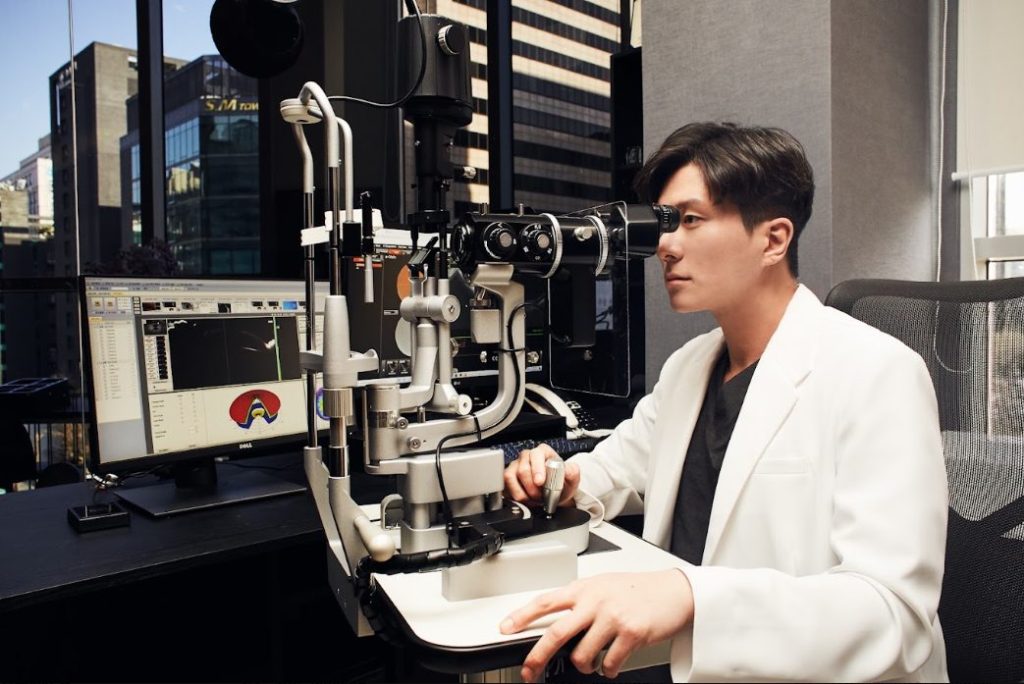
The Clareon TruPlus IOL is Alcon’s new monofocal plus (enhanced monofocal) intraocular lens for cataract surgery, now launched in Korea. It is designed to keep the clear distance vision of a monofocal lens while improving intermediate vision at about arm’s length — a computer screen or a car dashboard. Reading small print usually still needs glasses, and published clinical results are still limited.
Medically reviewed by Dr. Park JinHeung, Director, St. Mary’s Jin Eye Center (Ophthalmologist, PhD; Adjunct Professor, Seoul St. Mary’s Hospital) · Last updated 2026-11-16
TruPlus differs from diffractive trifocal lenses in optical design and target range. Instead of splitting light into several focal points with diffractive rings, it uses a very small change of curvature in the centre of the lens, so halos and glare are designed to stay at the level of a standard monofocal lens. Below, our ophthalmologists explain the design using Alcon’s launch materials, how it compares with other lens types, who it suits and who should consider a different lens.
- TruPlus is a monofocal plus lens: monofocal-quality distance vision with a slightly wider intermediate range; its design differs from diffractive trifocals.
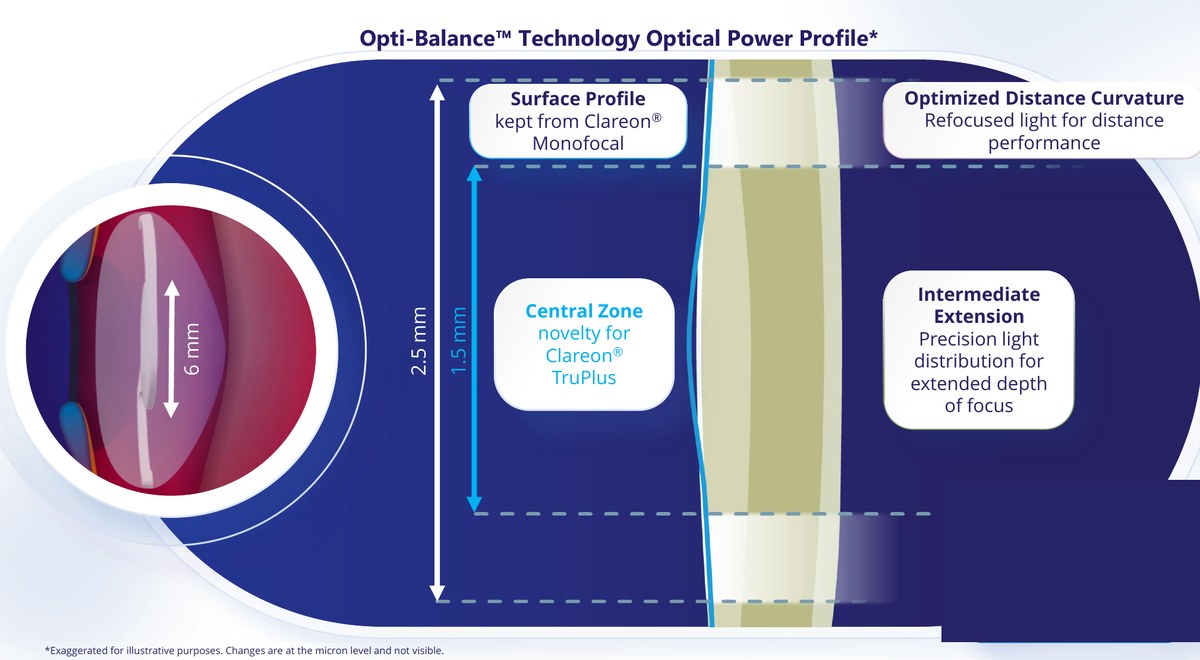
- Opti-Balance technology changes the curvature at sub-micron level within the central 1.5 mm; the lens is refractive and non-diffractive.
- It suits people who put sharp distance vision first but also want better vision at computer and dashboard distances.
- Small print on books and phones usually still needs reading glasses; if you want near vision too, EDOF or multifocal lenses are discussed.
- A toric version corrects corneal astigmatism; the final choice depends on corneal, retinal and tear-film tests and your lifestyle.
- International patients: stay at least until the check-up on day 3; about one week in Korea is recommended.
What is the Clareon TruPlus IOL?
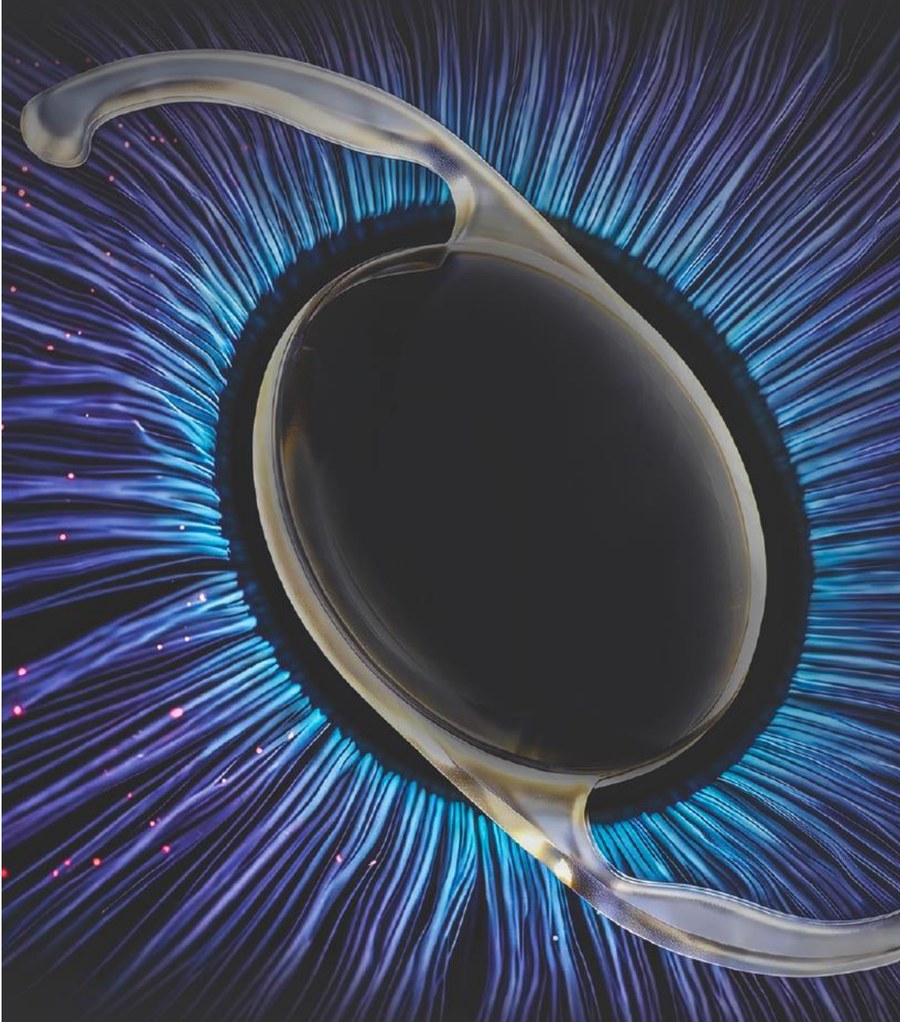
TruPlus is a monofocal plus intraocular lens built on Alcon’s Clareon lens platform. It is designed to keep monofocal distance quality while improving intermediate vision, placing it between a standard monofocal and an EDOF lens.
Alcon introduced TruPlus and TruPlus Toric at the American Society of Cataract and Refractive Surgery (ASCRS) meeting in April 2026 and announced launches in other markets afterwards (Alcon press release, 2026). The functional IOL classification published in 2024 with the European Society of Cataract and Refractive Surgeons (ESCRS) groups lenses that extend the range of focus slightly beyond a standard monofocal as ‘enhanced’ (monofocal plus), and TruPlus is a lens of this design (ESCRS, 2024).
TruPlus uses the same hydrophobic acrylic material and 6 mm optic as the Clareon monofocal and is implanted with a preloaded single-use injector (AutonoMe). If astigmatism needs correcting, TruPlus Toric can be considered; the available power range and the actual astigmatism correction are confirmed for the model supplied in Korea and from your pre-operative tests (CRST, 2026).
How does Opti-Balance technology extend intermediate vision?
A sub-micron change of curvature within about the central 1.5 mm sends a little more light towards intermediate distances, while the surrounding curvature is optimised for distance to keep distance image quality.
According to Alcon, TruPlus has the same spherical aberration (−0.2 μm) as the Clareon monofocal and is a refractive lens without diffractive rings or sharp added-power zones; power changes smoothly only within the central 2.5 mm.
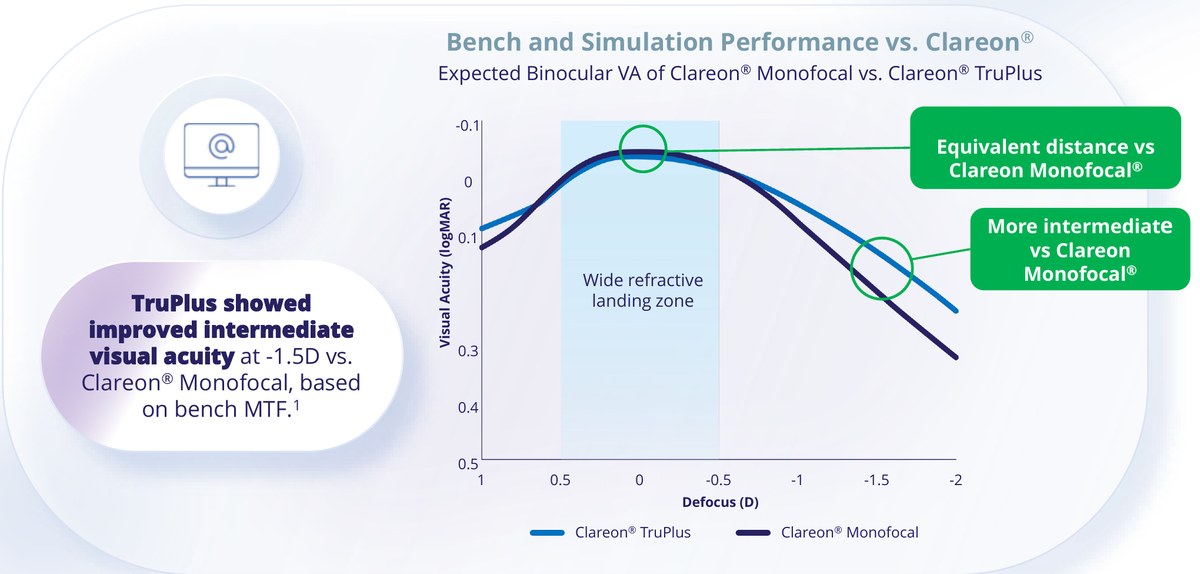
In bench optical measurements and simulation, expected visual acuity at −1.5 D (about 66 cm) was about 3.5 letters better than with the Clareon monofocal, with similar predicted distance acuity (Alcon press release, 2026). These are model-eye results; real vision depends on your eye and the target refraction.
How does a monofocal plus lens differ from monofocal, EDOF and multifocal lenses?
All four types are set for clear distance vision; they differ in how far they extend into intermediate and near distances, and in the halos and glare that may come with that. TruPlus extends the range only slightly in exchange for keeping visual symptoms at the monofocal level.
| Monofocal | Monofocal plus (TruPlus) | EDOF | Multifocal (trifocal) | |
|---|---|---|---|---|
| Main range | Distance | Distance + some intermediate | Distance to intermediate | Distance, intermediate and near |
| Small print (about 40 cm) | Reading glasses mostly | Reading glasses usually | May need glasses for small print | Less need for glasses |
| Halos and glare | Least | Designed to be similar to monofocal | May increase slightly | May increase |
| Optics | Single focus | Refractive, central micro-curvature | Varies by lens | Mostly diffractive |
| Examples at our clinic | Clareon Monofocal | Clareon TruPlus | Clareon Vivity and others | PanOptix and others |
General tendencies by lens type; lenses within a category also differ. TruPlus intermediate performance is so far based mainly on manufacturer bench data.
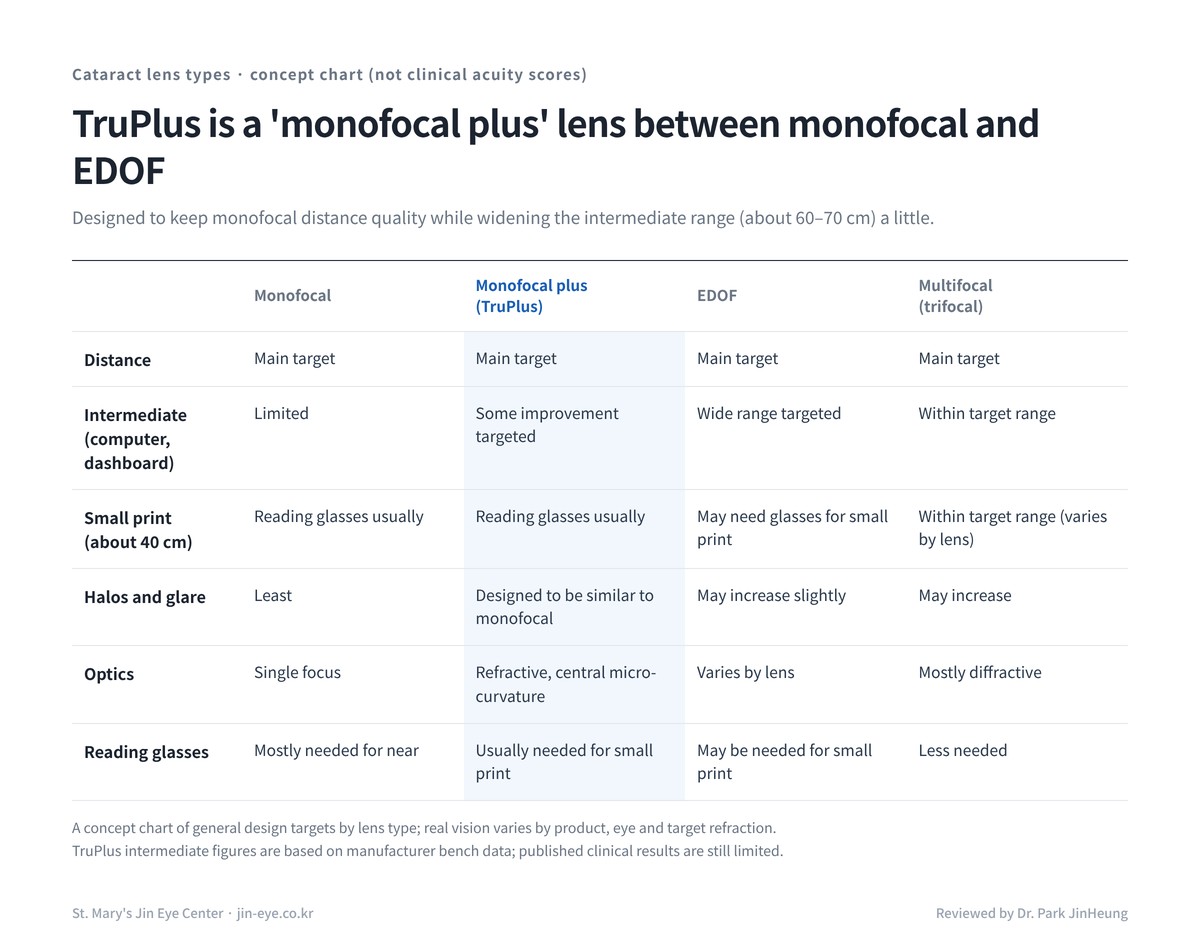
The basic differences are in multifocal vs monofocal lenses, and trifocal and EDOF lenses are compared in trifocal vs EDOF lenses.
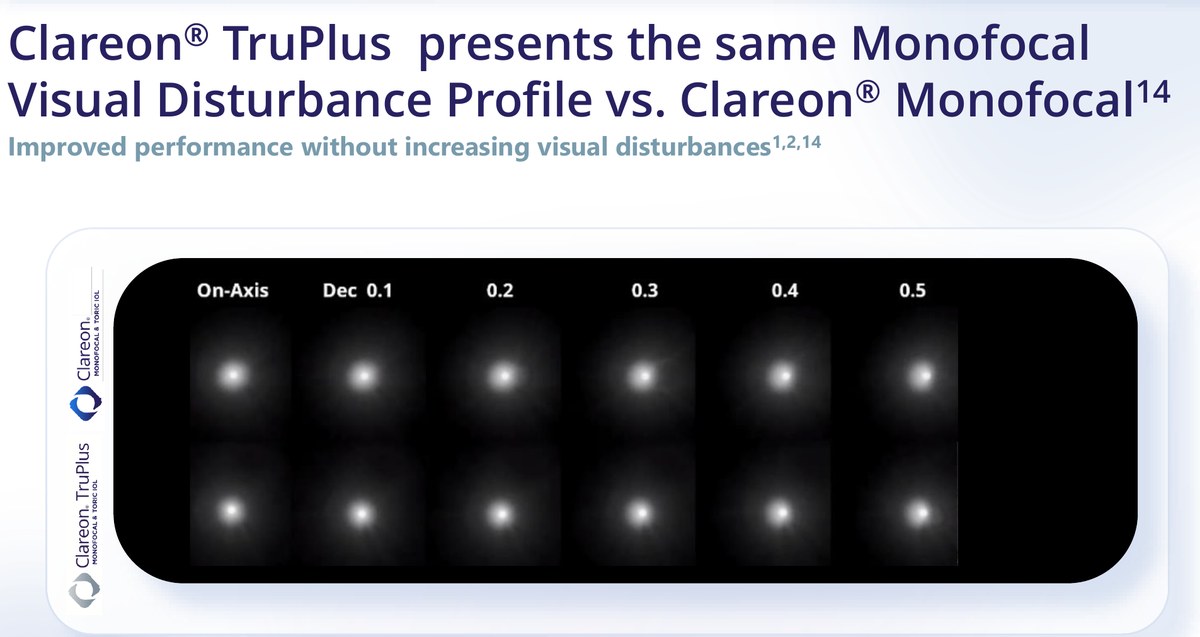
Does the TruPlus lens cause halos or glare?
In Alcon’s bench data, the halo and glare pattern of TruPlus matched the Clareon monofocal. However, no intraocular lens can be said to cause no halos at all, and clinical comparisons in patients are still limited.
Multifocal lenses split light between focal points, so halos around lights at night can occur. TruPlus has no diffractive rings and aims to keep these symptoms at the monofocal level; a US ophthalmology journal described it as an option for patients who declined multifocal or EDOF lenses because of concerns about halos (CRST, 2026).
The same article notes that clinical trials are still ongoing, so suitability is currently judged from the optical design. That is why, even for frequent night drivers, we check pupil size, corneal aberrations and the tear film before surgery.
Who is TruPlus right for, and who should consider another lens?
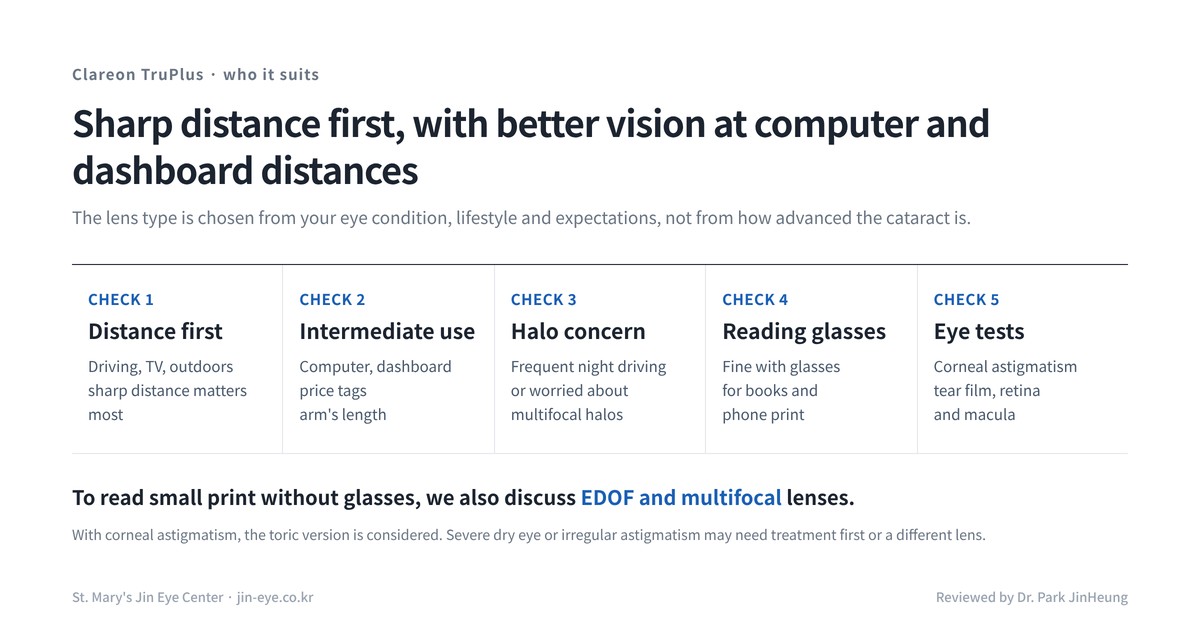
It suits people who put sharp distance vision first, want better vision at computer and dashboard distances, and accept reading glasses for small print. If you want to read without glasses, EDOF or multifocal lenses may suit you better.
| If… | TruPlus | Also keep in mind |
|---|---|---|
| You drive a lot and distance quality matters most | Often a good fit | The lens is targeted for distance |
| You use computers, dashboards or cook a lot | Often a good fit | The intermediate gain varies |
| You worry about multifocal halos or drive at night often | Worth considering | No lens is completely free of halos |
| You want to read small print without glasses | Compare with other lenses | Discuss EDOF or multifocal |
| You have corneal astigmatism | Consider the toric version | Amount and axis are measured precisely |
| You have severe dry eye or irregular astigmatism | Treat or re-evaluate first | Measurement error and lower quality of vision |
A general guide; retinal, macular or corneal conditions can change the recommended lens.
What are the benefits of the Clareon platform and the toric lens?
TruPlus uses the same lens body (platform) as the widely used Clareon monofocal and toric lenses, designed to stay stable in position inside the eye. For a toric lens, the less it rotates after surgery, the better the astigmatism correction is maintained.
In a study at the Medical University of Vienna following 126 eyes with the Clareon toric lens of the same platform for 6 months, mean rotation from the end of surgery to 6 months was 1.33°, and only 2 lenses rotated more than 5° (Schartmüller et al., Eye Vis 2024). This study used the Clareon toric lens, not TruPlus; it was investigator-initiated and supported by Alcon. TruPlus Toric is also built on the Clareon platform, but its actual rotational stability needs to be confirmed in clinical data on TruPlus Toric itself.
What are the limits and risks of cataract surgery with TruPlus?
Cataract surgery with TruPlus carries the general risks of cataract surgery, including infection, inflammation, raised eye pressure, posterior capsule opacification and retinal detachment. Limits of the lens itself are that reading glasses are usually needed and that clinical data are still limited.
The American Academy of Ophthalmology notes that complications such as endophthalmitis, retinal detachment and posterior capsule opacification can rarely occur after cataract surgery (AAO, cataract surgery). Whatever the lens, seek care at once if vision suddenly drops, pain or redness worsens, or flashes and floaters suddenly increase — see warning signs of retinal detachment after cataract surgery.
If the final refraction is slightly off target or the cornea is irregular, the intermediate benefit can be smaller, which is why precise measurement before surgery matters.
How do I choose TruPlus at St. Mary’s Jin Eye Center, and how long should I stay?
After a full cataract examination of corneal astigmatism and aberrations, tear film, retina and macula, and a discussion of your driving, computer and reading needs, we choose the lens with you from several options including TruPlus. If TruPlus does not suit your eyes, we recommend another lens.
Our two directors, Dr. Park JinHeung and Dr. Park Jae-hyun, are ophthalmologists formerly on the faculty of Seoul St. Mary’s Hospital, specialising in the retina and the anterior segment respectively, and both are regular members of the Korean Retina Society. We use lenses from several manufacturers, including the Alcon Clareon family (Clareon monofocal and toric, Clareon Vivity, PanOptix), so we are not limited to one lens.
For travel planning, the clinic’s cataract surgery guidance is at least the check-up on day 3 after surgery before flying, and about one week in Korea is recommended — see how long to stay in Korea for cataract surgery. The TruPlus lens fee is quoted at consultation after the examination; the cost structure and prices of other lenses are in cataract surgery cost in Korea.
Frequently asked questions
How is the Clareon TruPlus IOL different from a multifocal lens?
TruPlus is introduced by Alcon as a monofocal plus (enhanced monofocal) lens, and its optical design and target range differ from diffractive trifocal lenses. It is designed to keep monofocal distance quality while improving intermediate vision, using a small curvature change in the centre of the lens rather than diffractive rings that split light into several focal points.
Will I still need reading glasses with TruPlus?
Usually yes, for small print. TruPlus aims to extend intermediate vision at about arm’s length, such as a computer or dashboard. If you want to read books or phones without glasses, it is worth discussing EDOF or multifocal lenses as well.
How is TruPlus different from a standard monofocal lens?
It aims for the same distance quality with a slightly wider intermediate range. In Alcon’s bench measurements and simulation, expected acuity at about 66 cm was about 3.5 letters better than with the Clareon monofocal. These are model-eye results, and real vision depends on your eye.
Can TruPlus cause halos or glare?
In Alcon’s bench data, the halo and glare pattern of TruPlus matched the Clareon monofocal. However, no intraocular lens can be said to cause no halos at all, and clinical comparisons in patients are still limited.
Can I have TruPlus if I have astigmatism?
If you have corneal astigmatism, the TruPlus Toric version can be considered. The amount and axis of astigmatism are measured precisely before surgery, and the lens is chosen within the power range of the model supplied in Korea. Irregular astigmatism or severe dry eye may need treatment first or a different lens.
How long should I stay in Korea for cataract surgery with TruPlus?
Plan to stay at least until the check-up on day 3 after surgery; about one week in Korea is recommended. Your exact schedule is confirmed after the examination, and the doctor may ask you to stay longer depending on healing.
Where can I get a TruPlus consultation at an eye clinic in Seoul?
St. Mary’s Jin Eye Center is at 337 Gangnam-daero, Seocho-gu, Seoul (1F, 4F, 5F), about 5 minutes on foot from Gangnam Station Exit 5. Lens consultations, including TruPlus, are based on the results of a full cataract examination; you can book online or call +82-2-577-7782.
- 337 Gangnam-daero, Seocho-gu, Seoul (1F, 4F, 5F) — about 5 minutes on foot from Gangnam Station Exit 5
- Hours (KST): Mon–Fri 09:00–18:00 (lunch 13:00–14:00), Sat 09:00–15:00
- Phone +82-2-577-7782 · E-mail jin.eye.center@gmail.com
- Registered medical institution for international patients in Korea
- Clinic facts and prices: St. Mary’s Jin Eye Center — facts and 2026 prices
References
- Alcon. Alcon Launches Clareon TruPlus, Enhanced Design Monofocal and Toric IOLs, at ASCRS 2026. Press release, 6 April 2026. Alcon
- Alcon. Clareon TruPlus product material (IMG-CLP-2600003) and Alcon data on file 2025 — bench data.
- Cataract & Refractive Surgery Today. An Update on Advanced Technology IOLs. September 2026. CRST
- ESCRS EuroTimes. Towards a Unified IOL Classification (on Ribeiro et al., J Cataract Refract Surg 2024;50(8):794-798). ESCRS
- Schartmüller D, et al. Rotational stability and refractive outcomes of a new hydrophobic acrylic toric intraocular lens. Eye Vis 2024;11:25. Eye and Vision
- American Academy of Ophthalmology. IOL Implants: Lens Replacement After Cataracts. AAO
- American Academy of Ophthalmology. What Is Cataract Surgery? AAO
This article is general medical information about the Clareon TruPlus intraocular lens and cataract surgery and does not replace an individual diagnosis or treatment. The choice of lens and the results depend on your examination and eyes, and every operation can have side effects. Product images and performance graphs are Alcon materials based on bench (laboratory) data. Figures from studies outside Korea are not Korean figures. Medical devices are used within their approved indications in Korea. Written 16 November 2026.