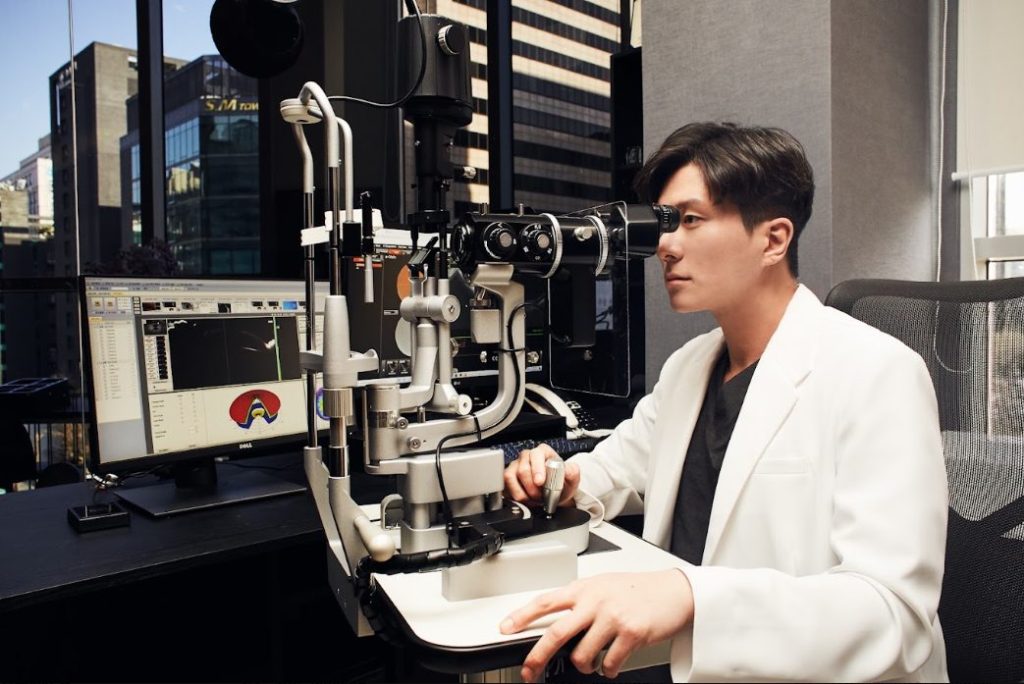
SMILE vs LASEK recovery time differs mainly in the first week. With SILK, a SMILE-type procedure performed with the 7th-generation J&J ELITA, many people return to daily life, study and desk work after the check-up the next day, depending on their vision and comfort. With all-laser TransPRK on the SCHWIND AMARIS 1050RS, the aim is light daily activity from day 2, but the corneal surface needs 3–5 days to heal, best vision can take more than a month, and returning to study or work may take longer depending on pain and vision.
Medically reviewed by Dr. Park JinHeung, Director, St. Mary’s Jin Eye Center (Ophthalmologist, PhD; Adjunct Professor, Seoul St. Mary’s Hospital) · Last updated 2026-11-13
SILK (smooth incision lenticular keratomileusis) is a lenticule-based laser procedure on the Johnson & Johnson ELITA platform; it is related to, but distinct from, ZEISS SMILE. The best time for laser eye surgery is usually a break you can plan backwards from: the end of exams, the weeks before a new semester, or the gap between two jobs. This guide explains who can have surgery, how the recovery of SILK and TransPRK differs day by day, how much time to set aside, how long to stay in Seoul, and how to choose for your eyes and your schedule.
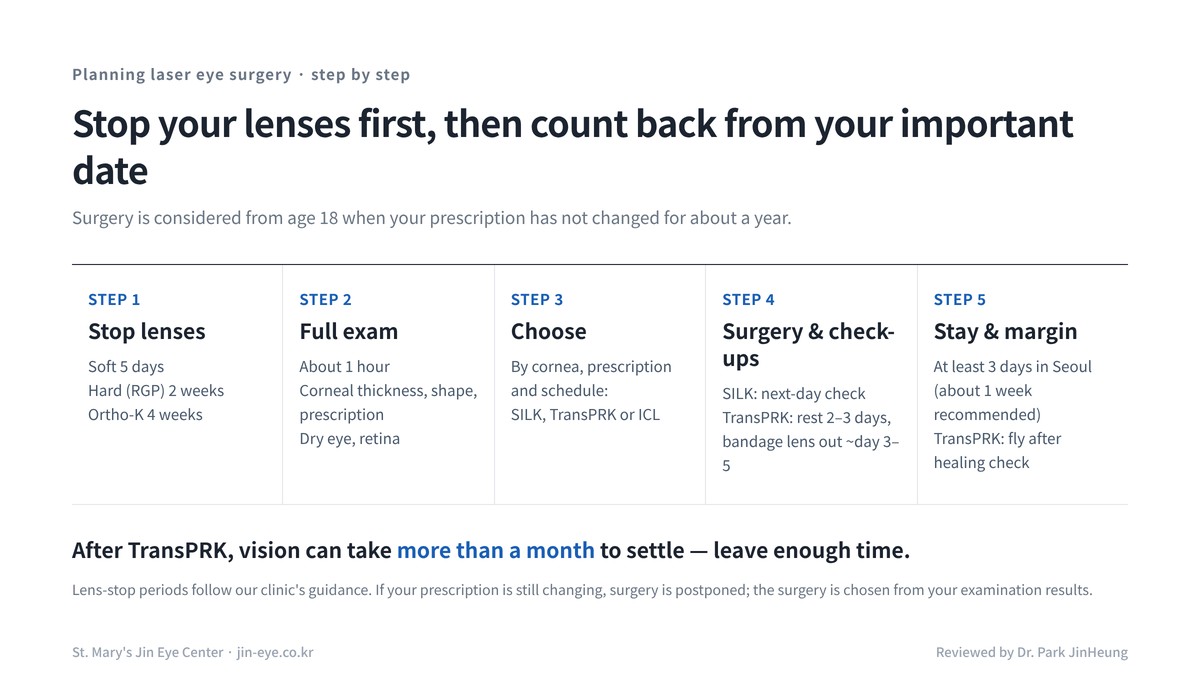
- Surgery is considered from age 18 when your prescription has not changed for about a year.
- Stop contact lenses before the exam: soft 5 days, hard (RGP) 2 weeks, ortho-K 4 weeks.
- SILK: back to daily life after the next-day check. TransPRK: light daily activity from day 2; the bandage contact lens is removed at the clinic around day 3–5, and resting for the first 2–3 days is recommended.
- Vision settles faster after SILK; after TransPRK it can take more than a month.
- International patients: plan at least 3 days in Seoul and about one week is recommended; after TransPRK, leave only after the doctor has confirmed healing and removed the bandage lens.
- Which surgery suits you is decided after examining corneal thickness and shape, prescription, dry eye and your schedule.
When is the best time for laser eye surgery?
Stop your contact lenses, have the full examination, then choose a surgery date that leaves enough recovery time before exams, interviews, a new semester or a new job. For SILK allow a few days before an important date; for TransPRK allow at least 1–2 weeks, and ideally about a month.
The American Academy of Ophthalmology (AAO) advises that people having laser vision correction should be at least 18, ideally older than 21 when vision is more likely to have stopped changing, and that their prescription should not have changed in the past year (AAO, PRK). If your prescription is still changing, it is better to wait.
Contact lenses change the shape of the cornea, so they must be stopped before the examination: at our clinic soft lenses 5 days, hard (RGP) lenses 2 weeks and orthokeratology (ortho-K) lenses 4 weeks before. Details are in contact lenses before SILK/SMILE in Korea.
| When | What to do | What to check |
|---|---|---|
| 5 days to 4 weeks before the exam | Stop contact lenses, wear glasses | Soft 5 days · hard 2 weeks · ortho-K 4 weeks |
| Exam day | Full examination (about 1 hour) and consultation | Corneal thickness and shape, prescription, dry eye, retina |
| After the results | Choose the surgery and the date | Compare recovery time with exams, a new semester, a job start or your flight home |
| First week after surgery | Scheduled check-ups | SILK: next day · TransPRK: before and after bandage lens removal |
| Before your important date | Let vision settle, manage dryness | After TransPRK, best vision can take more than a month |
A general sequence based on our clinic’s care pathway; your schedule depends on your examination results.
How do SILK and TransPRK differ?
SILK leaves the corneal surface in place: a thin lens-shaped piece of tissue (lenticule) is created inside the cornea and removed through a small incision. TransPRK uses the laser to remove the surface layer (epithelium) and then reshape the cornea beneath it. This difference explains the different recovery, discomfort and suitable eyes.
Our 1DAY SMILE programme is SILK performed with the 7th-generation J&J ELITA, a different manufacturer’s device from ZEISS SMILE. Because the surface is preserved, discomfort right after surgery tends to be lower, and many people can resume routine daily activities after the next-day check-up, depending on their vision, comfort and the doctor’s assessment.
Our 2DAYS LASEK programme is all-laser TransPRK on the SCHWIND AMARIS 1050RS, in which the laser removes the epithelium and reshapes the cornea without alcohol. Light indoor activity from day 2 is a recovery goal, not a guarantee: pain, tearing and light sensitivity may occur during the first 2–3 days, and the surface usually takes 3–5 days to heal.
| SILK (1DAY SMILE) | TransPRK (2DAYS LASEK) | |
|---|---|---|
| Laser | 7th-generation J&J ELITA | SCHWIND AMARIS 1050RS |
| Method | Lenticule removed through a small incision | Laser removes the epithelium and reshapes the surface |
| Operating time (clinic guidance) | About 10 minutes | About 5 minutes |
| Return to daily life | After the next-day check; desk work and study | Light indoor activity from day 2; study and work depend on pain and vision |
| Bandage contact lens | Not needed | Removed at the clinic after the surface heals (3–5 days) |
| Early discomfort | Blur, foreign-body feeling, dryness | Pain, tearing and glare possible for 2–3 days |
| Vision settles | Relatively fast | Can take more than a month |
| Often suits | Myopia and astigmatism with enough corneal thickness | Thinner corneas, if the remaining thickness and corneal shape allow |
Operating times and recovery guidance are our clinic’s; driving starts only after the doctor has checked your vision and glare. A broader comparison is in SMILE LASIK Korea vs LASEK: 6 differences.
What is the SMILE vs LASEK recovery time, day by day?
Many people return to daily life the day after SILK, depending on their vision and comfort. After TransPRK the aim is light daily activity from day 2, but the corneal surface usually takes 3–5 days to heal. Light activity, surface healing and stable vision are different stages, and after TransPRK best vision can take more than a month.
In a clinical trial of SILK with the ELITA at two centres in India (85 people, 170 eyes, average myopia −4.14 D), uncorrected vision of 20/20 or better was reached by 65.9% of eyes the day after surgery, 85.4% at one week and 91.5% at one month (Sachdev et al., Clin Ophthalmol 2023). These are vision measurements, not the share of people able to do every activity the next day; the study had no control group and was supported by the manufacturer.
The AAO says that after SMILE-type surgery most people can return to most normal activities within a day or two, and vision keeps improving over days to weeks (AAO, SMILE).
After PRK-type surgery a bandage contact lens is worn, the eye may hurt for 2–3 days, vision improves gradually over 3–5 days, and best vision can take a month or more (AAO, PRK).
A meta-analysis of 12 studies (1,711 eyes) comparing TransPRK with alcohol-assisted PRK found a trend towards faster epithelial healing with TransPRK and no statistically significant difference in pain, haze or final uncorrected vision, but the studies varied widely and many were not randomised (Alasbali, J Ophthalmol 2022). In two randomised studies treating one eye with each method, healing was the same or faster with TransPRK, but pain on the first day was reported higher with TransPRK, with no difference from day 3 (Hashemi et al., BMC Ophthalmol 2022; Gharieb et al., Korean J Ophthalmol 2021).
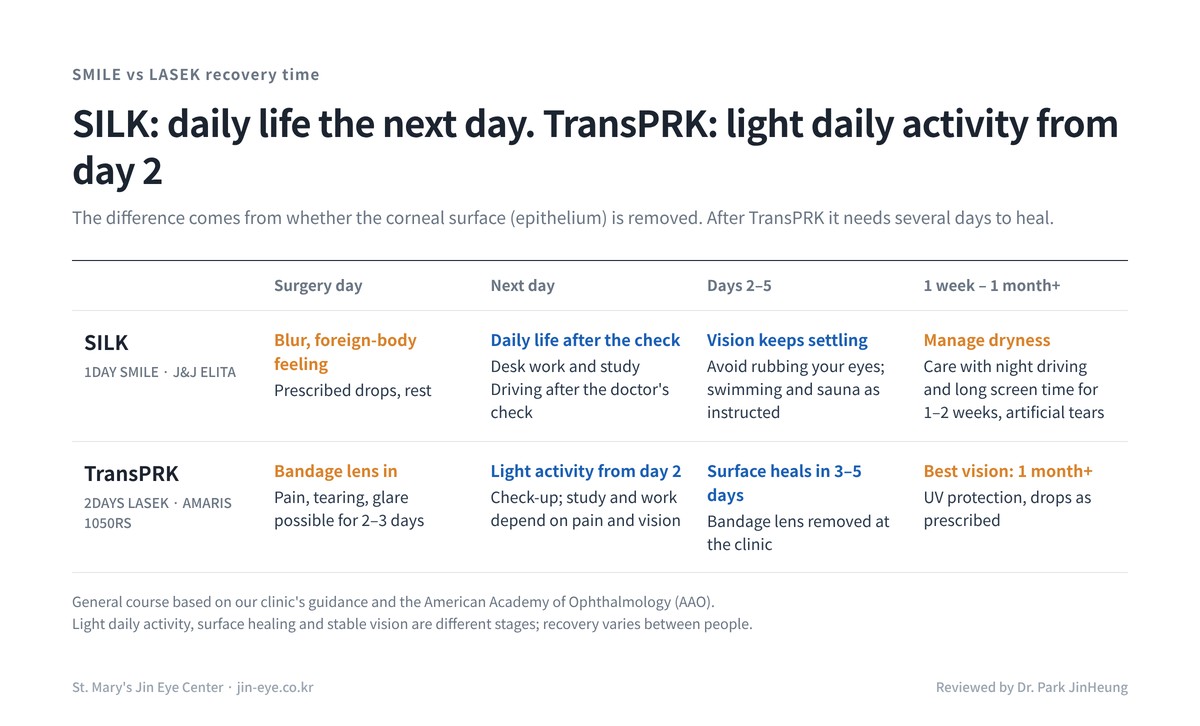
Because results on pain and healing differ between studies, plan to rest for the first 2–3 days after TransPRK and decide when to return to study or work according to your pain and vision. Recovery details are in SILK laser eye surgery in Korea (1DAY SMILE) and TransPRK in Korea (2DAYS LASEK).
Which surgery suits your eyes and your schedule?
First, your eyes must meet the conditions for surgery; then the surgery is matched to your schedule and lifestyle. With enough corneal thickness and a need for fast recovery, SILK; with a thinner cornea whose remaining thickness and shape allow it, TransPRK; with very high myopia or a very thin cornea, an implantable lens (EVO ICL) is considered.
| If… | Consider first | Also keep in mind |
|---|---|---|
| Little time before exams, an interview, a new semester or a new job | SILK | Daily life after the next-day check; driving only after the doctor’s check |
| Your cornea is relatively thin | TransPRK | Possible only if the calculated remaining thickness is enough |
| Very high myopia or a very thin cornea | Implantable lens (EVO ICL) | No corneal tissue removed, but extra tests such as the space inside the eye |
| Severe dry eye | Treat dryness first, then decide | The tear film is managed before surgery |
| Your prescription changed recently | Postpone surgery | Re-examine once the prescription is stable |
A general guide. Laser corneal surgery is not performed if keratoconus is suspected or the Avellino gene test is abnormal.
The surgery is chosen from your examination results, not from the name of the device. With the same prescription, corneal thickness and shape, astigmatism, pupil size and tear film can point to a different surgery. If laser surgery is not suitable because of high myopia or a thin cornea, see EVO ICL in Korea: candidacy, tests and cost.

How long should I stay in Seoul, and what does it cost?
Plan to stay in Seoul for at least 3 days after surgery; about one week is recommended to allow for follow-up care and unexpected delays. After SILK, departure can be considered after the scheduled check-ups if recovery is satisfactory. After TransPRK, the bandage lens is removed at our clinic once the surface has healed, usually around day 3–5, so do not plan to leave before the doctor has confirmed healing. Prices are for both eyes and are confirmed after the examination.
If the examination shows you are eligible, the examination and surgery can be done on the same day; the wait for the Avellino gene test result can add time. These are planning guidelines, not guaranteed departure dates: additional visits or a longer stay may be needed if healing is slow or a complication occurs. Arrange any follow-up you may need after returning home before you travel.
| Procedure (both eyes) | Price (KRW, 2026) |
|---|---|
| SILK — 7th-generation J&J ELITA (1DAY SMILE) | 3,500,000 |
| TransPRK — SCHWIND AMARIS 1050RS (2DAYS LASEK) | 990,000 |
| TransPRK + corneal cross-linking (CXL) | 1,290,000 |
| TransPRK + CXL + EmbryoMembrane | 1,590,000 |
| EVO+ ICL (STAAR, USA) | 4,700,000 (toric 5,700,000) |
| Detailed vision correction exam | 80,000 |
2026 prices for international patients. All prices are for both eyes except the exam fee, and suitability and the final cost are confirmed after the detailed exam. Cross-linking and EmbryoMembrane are added only when clinically indicated; please confirm which examinations, medications and follow-up visits are included in your quotation. Full price lists: St. Mary’s Jin Eye Center — facts and 2026 prices.
What are the side effects, and which symptoms need urgent care?
The most common is dry eye. Halos and glare, under- or over-correction and, after TransPRK, corneal haze can occur, and corneal ectasia is rare. If pain keeps getting worse or vision suddenly drops, contact us at once instead of waiting for your next check-up.
The AAO lists halos and glare at night, under- or over-correction and, rarely, loss of best corrected vision as possible effects of laser vision correction (AAO, LASIK). After PRK-type surgery, mitomycin C can be used during surgery to reduce haze, and regression and ectasia are rare but reported (StatPearls, PRK).
For dryness, a meta-analysis of conventional ZEISS SMILE found milder dry-eye symptoms than with flap-based LASIK (Shen et al., PLoS One 2016); dryness is usually temporary but is often managed with artificial tears for 1–3 months.
| Symptom | What to do |
|---|---|
| Pain getting worse, or vision suddenly dropping | Contact the clinic at once without waiting for your check-up; if you cannot reach us, go to an emergency eye service or emergency department at any hour |
| Increasing redness, discharge or glare so strong you can hardly look at light | Contact us at once, as infection needs to be ruled out |
| The TransPRK bandage lens falls out | Do not put it back yourself — contact us |
| You bump or rub your eye hard | Contact us for a check even without symptoms |
| Mild dryness or foreign-body feeling | Use drops and artificial tears as prescribed; discuss at your check-up |
Follow your doctor’s instructions on continuing or changing prescribed eye drops. If you have sudden loss of vision or severe pain and cannot reach the clinic, use an emergency eye service or emergency department at any hour.
How does St. Mary’s Jin Eye Center plan laser eye surgery for international patients?
We tell you when to stop your contact lenses, check your cornea and retina in a full examination, listen to your schedule and lifestyle, and choose together between SILK, TransPRK and an implantable lens. If the results show it is better to wait, we tell you so.
Our two directors, Dr. Park JinHeung and Dr. Park Jae-hyun, are ophthalmologists formerly on the faculty of Seoul St. Mary’s Hospital, specialising in the retina and the anterior segment respectively, and both are regular members of the Korean Retina Society. Drawing on more than 14,000 vision correction operations, we offer SILK with the 7th-generation J&J ELITA (1DAY SMILE), all-laser TransPRK with the SCHWIND AMARIS 1050RS (2DAYS LASEK) and the EVO ICL by STAAR, USA.
SILK and TransPRK help you live without glasses or contact lenses, but results are not the same for everyone. Dry eye, halos, regression or the need for an enhancement, haze after TransPRK and, rarely, infection or ectasia can occur. Choose the surgery and its timing after hearing both the benefits and what you may have to accept.
Frequently asked questions
I have just finished school exams. Can I have laser eye surgery right away?
If you are 18 or older and your prescription has not changed for about a year, surgery can be considered. The AAO uses 18 as the minimum and says that after 21, when vision is more likely to have stopped changing, is ideal. Stop your contact lenses, have the full examination to confirm your prescription is stable, and postpone surgery if it is still changing.
When should I stop wearing contact lenses before the exam?
At our clinic, soft lenses are stopped 5 days, hard (RGP) lenses 2 weeks and orthokeratology lenses 4 weeks before the examination, because lenses change the shape of the cornea and make measurements inaccurate. If you wear lenses until your exams end, switching to glasses the next day is the fastest schedule.
What is the SMILE vs LASEK recovery time?
After SILK many people return to daily life, such as desk work and study, after the check-up the next day, depending on their vision and comfort. After TransPRK the aim is light daily activity from day 2, but the corneal surface usually takes 3–5 days to heal, when the bandage lens is removed at the clinic; best vision can take more than a month, and returning to study or work may take longer depending on pain and vision. Recovery varies between people.
Is TransPRK less painful than conventional LASEK?
Not necessarily. A meta-analysis of 12 studies found a trend towards faster surface healing and no statistically significant difference in pain, but some randomised studies reported higher pain on the first day, so results are mixed. Pain is possible for 2–3 days after surgery, so plan to rest.
I start university or a new job soon. Which surgery is better?
If time is short, SILK, with return to daily life after the next-day check, is usually easier to schedule. If you have TransPRK, leave at least 1–2 weeks, and ideally about a month, before an important date. The surgery itself is chosen from your corneal thickness, prescription and other results, so tell us your dates at the consultation.
How many days should I stay in Seoul?
Plan at least 3 days in Seoul after surgery; about one week is recommended. After SILK, departure can be considered after the scheduled check-ups if recovery is satisfactory. After TransPRK, the bandage lens is removed at our clinic once the surface has healed, usually around day 3–5, so do not leave before the doctor has confirmed healing; a longer stay may be needed if healing is slow.
Which symptoms after surgery mean I should contact the clinic at once?
Contact us at once if pain keeps getting worse, vision suddenly drops, or redness, discharge or glare increase. If the TransPRK bandage lens falls out, do not put it back yourself. If you have sudden loss of vision or severe pain and cannot reach us, go to an emergency eye service or emergency department at any hour.
- 337 Gangnam-daero, Seocho-gu, Seoul (1F, 4F, 5F) — about 5 minutes on foot from Gangnam Station Exit 5
- Hours (KST): Mon–Fri 09:00–18:00 (lunch 13:00–14:00), Sat 09:00–15:00
- Phone +82-2-577-7782 · E-mail jin.eye.center@gmail.com
- Registered medical institution for international patients in Korea
- Clinic facts and prices: St. Mary’s Jin Eye Center — facts and 2026 prices
References
- American Academy of Ophthalmology. What Is Photorefractive Keratectomy (PRK)? AAO
- American Academy of Ophthalmology. What Are the Risks of SMILE? AAO
- American Academy of Ophthalmology. LASIK — Laser Eye Surgery. AAO
- Gurnani B, Patel BC. Photorefractive Keratectomy. StatPearls, 2025. NCBI
- Sachdev MS, et al. Safety and Effectiveness of Smooth Incision Lenticular Keratomileusis (SILK). Clin Ophthalmol 2023;17:3761-3773 (NCT04200898). Dove Press
- Alasbali T. Transepithelial versus conventional photorefractive keratectomy: a meta-analysis. J Ophthalmol 2022;2022:3022672. PMC
- Hashemi H, et al. Transepithelial PRK versus alcohol-assisted PRK, contralateral randomised trial. BMC Ophthalmol 2022;22:68. PMC
- Gharieb HM, et al. Transepithelial versus alcohol-assisted PRK, contralateral randomised study. Korean J Ophthalmol 2021;35(2):142-152. PMC
- Shen Z, et al. Dry eye after small incision lenticule extraction versus femtosecond laser-assisted LASIK: a meta-analysis. PLoS One 2016;11(12):e0168081. PLoS One
This article is general medical information about SILK and TransPRK laser eye surgery and does not replace an individual diagnosis or treatment. Eligibility, the choice of surgery and recovery depend on your examination results and eyes, and every operation can have side effects. The figures quoted come from studies outside Korea. Medical devices are used within their approved indications in Korea. Written 13 November 2026.