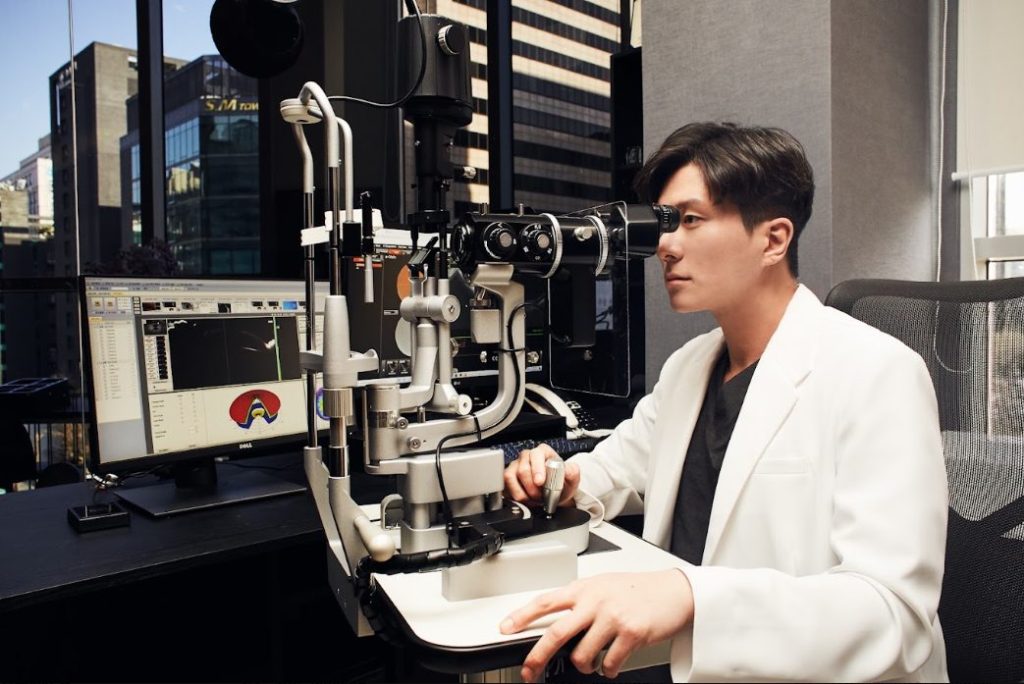
TransPRK in Korea at St. Mary’s Jin Eye Center is all-laser LASEK performed with the SCHWIND AMARIS 1050RS: the laser removes the outer skin of the cornea (epithelium) and corrects myopia and astigmatism in one step, without alcohol, mechanical epithelial removal or a corneal flap. If the eye exam shows you are eligible, the exam and surgery can be done on the same day; the surface usually takes several days to heal, so plan to stay in Seoul for about one week.
Medically reviewed by Dr. Park JinHeung, Director, St. Mary’s Jin Eye Center (Ophthalmologist, PhD; Adjunct Professor, Seoul St. Mary’s Hospital) · Last updated 2026-10-19
“2DAYS LASEK” is the name of our TransPRK program, not a separate operation. The name reflects our goal of light daily activities from about the second day — it is not a typical result for everyone. Healing of the epithelium usually takes several days, and pain, tearing, glare and changing vision are common during that time. This guide answers what international patients ask most: what TransPRK is, how painful it is, how fast the eye heals, who is a good candidate, how many days to stay in Seoul, the cost and the risks.
What is TransPRK, and how is it different from alcohol LASEK and LASIK?
In conventional alcohol-assisted LASEK, the epithelium is loosened with alcohol; in mechanical PRK, it is removed with a brush or another instrument. The excimer laser then reshapes the cornea. In TransPRK (transepithelial PRK), the excimer laser removes the epithelium and then corrects the prescription, without alcohol or mechanical epithelial removal. Like other surface procedures, TransPRK does not create a corneal flap as LASIK does. It may be considered for some patients with thinner corneas, depending on corneal shape, the required correction and the estimated residual corneal thickness. SCHWIND presents the AMARIS 1050RS as the most powerful excimer laser in its AMARIS family.
| Item | TransPRK (2DAYS LASEK) | Source |
|---|---|---|
| Laser | SCHWIND AMARIS 1050RS excimer laser — top model of the AMARIS series | SCHWIND product information |
| Repetition rate | 1050 Hz | SCHWIND product information |
| Eye tracking | 1050 Hz eye tracking with compensation for up to 7 dimensions (7D) of eye movement | SCHWIND product information |
| Epithelium removal | By the laser (no alcohol, no brush) | SCHWIND SmartSurfACE information |
| Surgery time | About 5 minutes of laser surgery (preparation and rest are extra) | St. Mary’s Jin Eye Center |
| Options | Corneal cross-linking (CXL); an amniotic membrane (EmbryoMembrane) to support surface healing | St. Mary’s Jin Eye Center |
Device figures come from the manufacturer; actual settings depend on your prescription and eye. Used within the approved indications in Korea.
Is TransPRK really less painful and faster to heal than alcohol LASEK?
In comparative studies, the epithelium healed about one day sooner after TransPRK, and early pain scores were lower. Final vision, however, was similar to conventional surface surgery, and pain and glare in the first 2–3 days can still occur — the difference is one of degree.
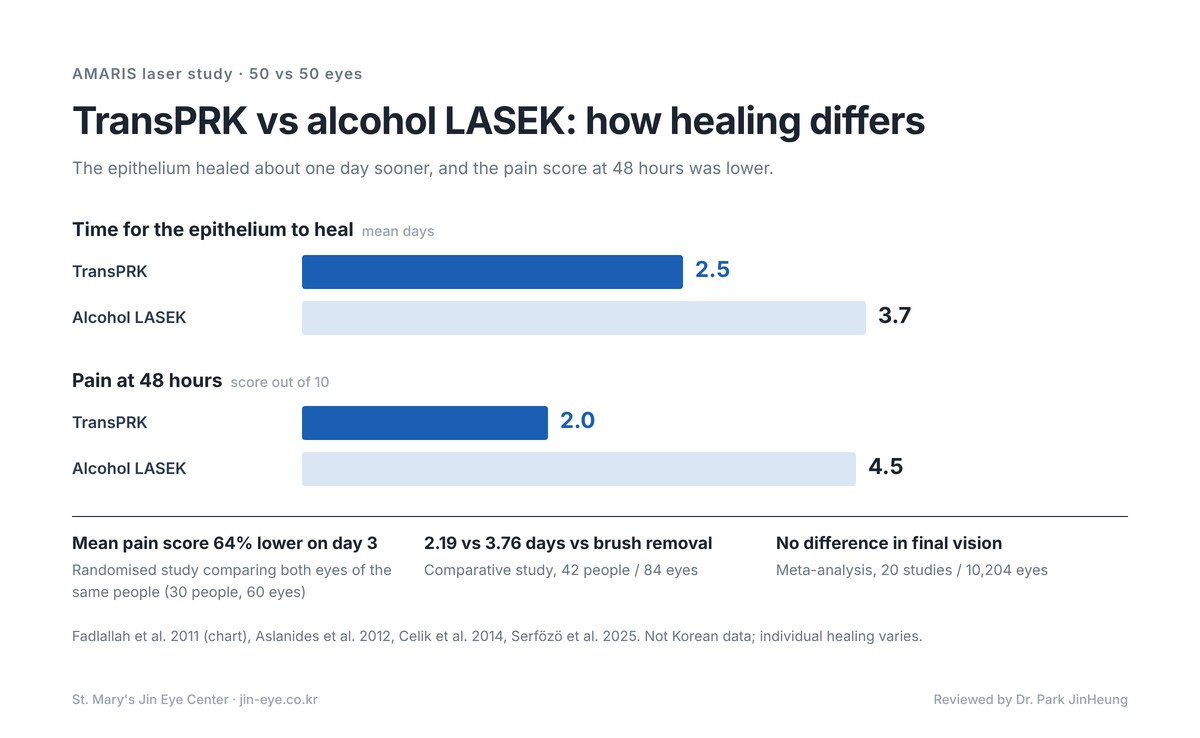
In a comparative study with the AMARIS laser (50 eyes vs 50 eyes), the epithelium closed in 2.5 ± 0.6 days after TransPRK and 3.7 ± 0.8 days after alcohol-assisted PRK; the pain score at 48 hours (0–10) was 2.0 vs 4.5, and there was less haze after TransPRK. Uncorrected vision at 1 week was better in the alcohol group, and there was no difference at 3 months (Fadlallah et al., J Cataract Refract Surg 2011).
In a randomised study comparing the two eyes of the same people (30 people, 60 eyes), the mean pain score on day 3 was 64% lower in TransPRK eyes; 96% of TransPRK eyes had healed by then, while 43% of alcohol-treated eyes had not and needed the bandage lens replaced (Aslanides et al., Clin Ophthalmol 2012). In a study against mechanical (brush) removal (42 people, 84 eyes), healing took 2.19 vs 3.76 days (Celik et al., 2014).
A 2025 meta-analysis (20 studies, 10,204 eyes) found no meaningful difference in final efficacy and safety between TransPRK and conventional PRK (Serfözö et al., J Cataract Refract Surg 2025). Most comparative studies are small, some used earlier AMARIS models, and some (for example Aslanides 2012) included researchers employed by the manufacturer, so treat these numbers as a guide to the healing process — your own healing is checked at each visit.
TransPRK vs SILK vs EVO ICL: which vision correction surgery fits my eyes?
Our clinic offers three vision correction options, and the eye exam — not the brand name — decides which one fits. TransPRK may be considered for some patients with thinner corneas or eyes not suited to lenticule extraction, while EVO ICL may be considered for very high myopia or insufficient corneal thickness for laser correction.
| TransPRK (2DAYS LASEK) | SILK (1DAY SMILE) | EVO ICL | |
|---|---|---|---|
| Method | Laser removes the epithelium and reshapes the corneal surface | Lenticule removed through a small incision | No corneal tissue removed; a lens is placed inside the eye |
| Equipment / lens | SCHWIND AMARIS 1050RS | J&J ELITA | STAAR EVO ICL (USA) |
| Return to daily life | Goal of light activities from about day 2; epithelial healing usually takes several days and varies | Most patients the next day (clinic guidance) | Explained after the exam |
| Often considered for | Some thinner corneas or eyes not suited to lenticule extraction (depending on tests), people in contact sports | Myopia and astigmatism with enough corneal thickness and a normal corneal shape | Very high myopia or very thin corneas |
| Good to know | Pain and glare for the first few days; UV protection after surgery | A minimum corneal thickness is needed for the lenticule | Extra tests such as the space inside the eye (anterior chamber depth) |
A general comparison, not a ranking of procedures. The ophthalmologist chooses the method after reviewing all of your test results.
Read more on our TransPRK (2DAYS LASEK) page, our SILK guide for international patients and our SMILE vs LASEK guide.
Am I a good candidate for TransPRK?
The basic candidate is 18 or older, with myopia or astigmatism that has been stable for the past 6–12 months. A thin cornea does not automatically rule you out: we calculate how much cornea will remain, and whether TransPRK is possible depends on your test results. The pre-operative exam takes about an hour and includes corneal topography, corneal thickness, refraction, eye pressure, a retina check, tear tests and an Avellino gene test, which our clinic performs in-house.
| If you have | Why it matters | Next step |
|---|---|---|
| Age under 18 or a recent change in prescription | The prescription may not be stable yet | Wait until it is stable |
| A thin cornea | Enough cornea must remain after the correction | Eligibility depends on your test results |
| Very high myopia or a very thin cornea | A large correction puts more load on the cornea | Consider EVO ICL |
| Abnormal corneal topography (suspected keratoconus) | Thinning the cornea can lead to ectasia | Laser corneal surgery is not performed unless further evaluation rules out keratoconus or another contraindication |
| A positive Avellino gene test | Laser treatment of the cornea can worsen corneal opacities | Laser corneal surgery is not performed; discuss alternatives |
| Severe dry eye | Dryness can get worse after surgery | Treat it first, then re-test |
| Pregnancy or breastfeeding; uncontrolled diabetes or autoimmune disease | These can change the prescription or affect healing | Adjust the timing of surgery |
Final eligibility is decided by the ophthalmologist after the full exam.
Contact lenses change the shape of the cornea, so stop wearing them before the exam: soft lenses 5 days, hard (RGP) lenses 2 weeks and orthokeratology lenses 4 weeks — longer if your corneal measurements are not yet stable. Details: contact lenses before eye surgery in Korea. Tell us at the exam if anyone in your family has a corneal dystrophy, if you have worn contact lenses for many years or if your eyes are often dry.
How many days do I need to stay in Korea for TransPRK?
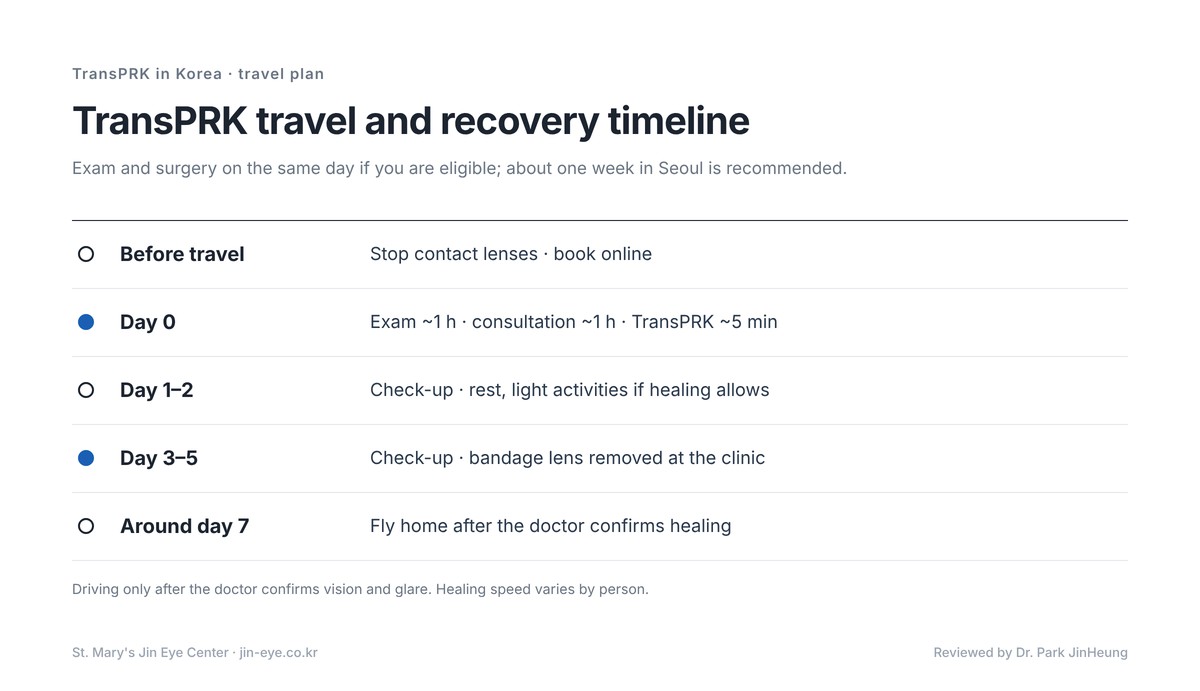
For TransPRK in Korea, plan to stay until at least the check-up on day 3 after surgery; we recommend about one week in Seoul so that the bandage contact lens can be removed at our clinic once the epithelium has healed. Because you arrive having already stopped your contact lenses, the exam and surgery are usually done on the same day by appointment, depending on the results.
| Step | What happens | Time |
|---|---|---|
| Before travel | Stop contact lenses (soft 5 days, RGP 2 weeks, ortho-k 4 weeks); book online and send recent eye records | — |
| Day 0 — exam | Detailed eye exam including the Avellino gene test (result within 3 hours; checked before laser surgery) | About 1 hour |
| Day 0 — consultation | Results, choice of procedure, consent | About 1 hour |
| Day 0 — TransPRK | Numbing eye drops, laser removal of the epithelium and correction, bandage contact lens | About 5 minutes; rest 30–60 minutes, then return to your hotel (do not drive) |
| Day 1–2 | Check-up; rest, with light activities from about day 2 if healing allows | Clinic visit |
| Day 3–5 | Check-up; the bandage lens is removed at the clinic once the epithelium has healed — do not remove it yourself | Clinic visit |
| Around day 7 | Most patients fly home after the doctor confirms healing | Clinic visit |
| After returning home | Use the prescribed eye drops, protect your eyes from UV, follow up with a local ophthalmologist, contact us by e-mail | As advised by the doctor |
A typical schedule for international patients. The doctor may ask you to stay longer depending on healing. On surgery day, allow for waiting time until the Avellino result is ready (up to 3 hours).
Our clinic is a registered medical institution for international patients, about a 5-minute walk from Gangnam Station Exit 5. See the international patients guide for visit planning.
How much does TransPRK in Korea cost? (2026)
TransPRK at St. Mary’s Jin Eye Center costs ₩990,000 for both eyes, and the detailed vision correction exam is ₩80,000. The final price is confirmed after the exam; ask us what is included (medications, check-ups) when you book.
| Procedure (both eyes) | Price (KRW, 2026) |
|---|---|
| TransPRK — SCHWIND AMARIS 1050RS | ₩990,000 |
| TransPRK + corneal cross-linking (CXL) | ₩1,290,000 |
| TransPRK + CXL + EmbryoMembrane | ₩1,590,000 |
| Detailed vision correction exam | ₩80,000 |
All prices are for both eyes except the exam fee and are confirmed after the detailed exam. Whether CXL or EmbryoMembrane is advised depends on your eyes.
Full price lists: St. Mary’s Jin Eye Center facts and 2026 prices · SILK, LASEK and ICL cost in Korea.
Aftercare and risks of TransPRK: which symptoms need urgent care?
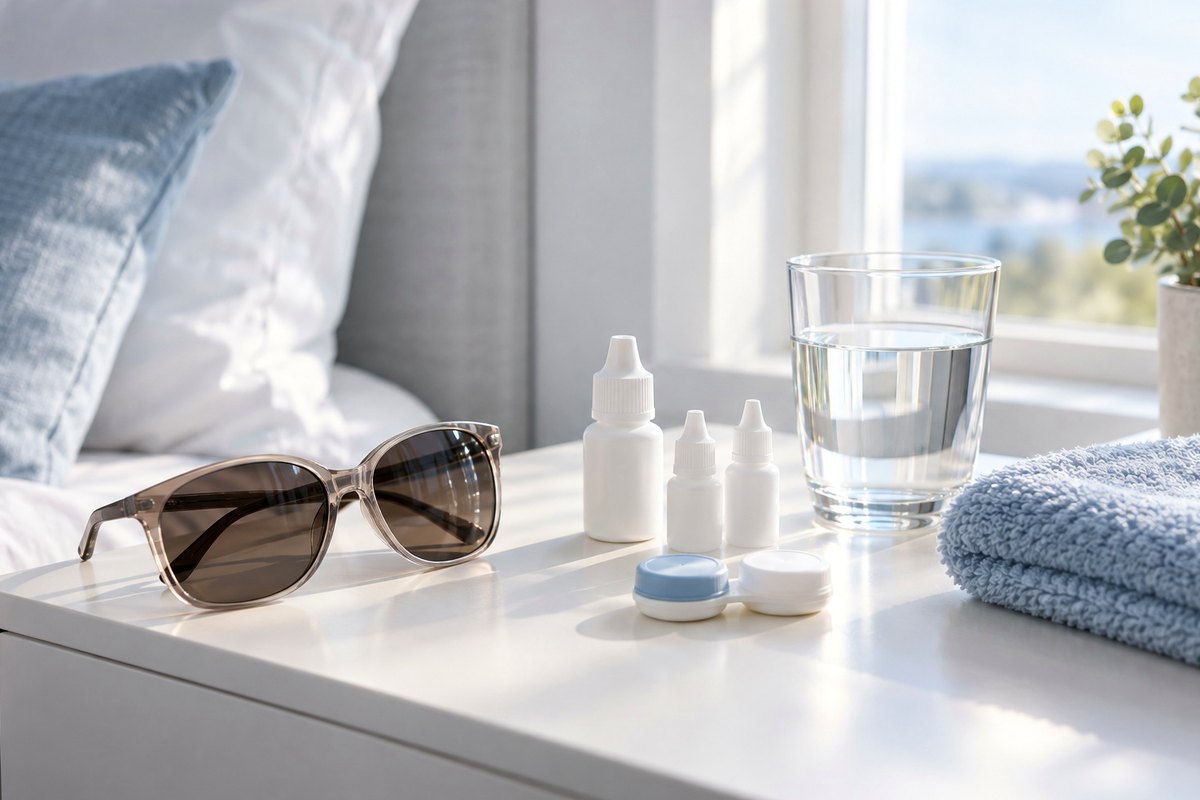
For the first 2–3 days, pain, tearing and glare can occur; they are managed with the prescribed eye drops and, if needed, prescribed pain medicine. Even after the epithelium has healed, vision settles over weeks to months, so UV protection with sunglasses for 1–3 months and the scheduled check-ups matter. Driving starts only after the doctor has checked your vision and glare.
After PRK the epithelium usually closes in 3–4 days, sometimes up to a week; vision improves over weeks and the refraction stabilises in 3–6 months (StatPearls, Photorefractive Keratectomy). Corneal haze is usually most visible 1–2 months after surgery and fades over 6–12 months; the risk is higher with larger corrections (AAO EyeWiki), and an American Academy of Ophthalmology report found evidence that mitomycin C helps prevent haze in larger myopic corrections (Majmudar et al., Ophthalmology 2015).
Dry eye is usually temporary, but one prospective study reported chronic dry eye at 12 months in 5.0% after PRK and 0.8% after LASIK (Bower et al., J Cataract Refract Surg 2015). Corneal ectasia is rare: a systematic review estimated about 20 per 100,000 eyes after PRK, 90 after LASIK and 11 after SMILE in eyes without known risk factors (Moshirfar et al., Ophthalmol Ther 2021); these are estimates from reported cases, not exact rates.
Other possible problems include delayed epithelial healing, some myopia returning over time (regression) and under- or over-correction that needs glasses or an enhancement, decided after the refraction is stable. All surgery carries some risk, and results depend on your eyes.
- Sudden loss of vision, vision getting worse over several days, increasing pain, glare so strong that you cannot look at light, or more redness or discharge — especially in the first 1–2 weeks: seek urgent eye care immediately — contact our clinic during opening hours; outside opening hours in Korea, go to a hospital emergency department with ophthalmology services; if you are already home, see a local ophthalmologist or eye emergency service the same day. Do not rub or press the eye, and follow the treating doctor’s instructions on whether to continue or change your eye drops.
- The bandage lens falls out or the eye suddenly feels as if something is in it: do not put the lens back yourself — contact us at once.
- Haze returning weeks or months later, or vision slowly worsening months or years later: book a check-up.
For the first 1–2 weeks avoid rubbing your eyes, swimming, saunas, intense exercise and eye make-up for the period you are told, and do not stop your eye drops on your own.
Frequently asked questions
Is 2DAYS LASEK different from TransPRK?
2DAYS LASEK is St. Mary’s Jin Eye Center’s name for TransPRK (all-laser LASEK) performed with the SCHWIND AMARIS 1050RS. Unlike conventional alcohol-assisted LASEK or mechanical PRK, the epithelium is removed by the laser rather than with alcohol or an instrument; in comparative studies the epithelium healed about one day sooner, and final vision was similar.
Can I have the exam and TransPRK on the same day?
Yes. If the exam shows that your eyes are suitable, the exam and surgery can be done on the same day by appointment. The Avellino gene test is done in-house and the result is available within 3 hours, so it is checked before surgery.
Is TransPRK painful?
The surgery is done with numbing eye drops. For the first 2–3 days, pain, tearing and glare are common; studies found lower early pain scores than with alcohol LASEK, but how much you feel varies, and it is managed with prescribed drops and pain medicine. Contact us at once if pain keeps increasing.
Can I resume daily activities two days after TransPRK?
Our goal is light daily activities from about day 2, but epithelial healing varies, so we advise you after the check-up. Vision can fluctuate for the first days, and driving starts only after the doctor confirms your vision and glare.
How long should I stay in Seoul?
Stay until at least the day-3 check-up after surgery; about one week is recommended so that the bandage lens can be removed at our clinic after the epithelium has healed (usually around day 3–5).
Can I have TransPRK with a thin cornea?
We calculate the corneal thickness that will remain and the corneal shape, and eligibility depends on your test results. If too little would remain or myopia is very high, we discuss EVO ICL; if keratoconus is suspected, laser corneal surgery is not performed.
How much does TransPRK cost in Korea?
At St. Mary’s Jin Eye Center TransPRK costs ₩990,000 for both eyes, ₩1,290,000 with CXL and ₩1,590,000 with CXL and EmbryoMembrane (2026); the detailed exam is ₩80,000. The final price is confirmed after the exam.
- 337 Gangnam-daero, Seocho-gu, Seoul (1F, 4F, 5F) — about 5 minutes on foot from Gangnam Station Exit 5
- Hours (KST): Mon–Fri 09:00–18:00 (lunch 13:00–14:00), Sat 09:00–15:00
- Phone +82-2-577-7782 · E-mail jin.eye.center@gmail.com
- Registered medical institution for international patients in Korea
- Clinic facts and prices: St. Mary’s Jin Eye Center — facts and 2026 prices
This article is general medical information and does not replace an individual diagnosis. Whether you can have surgery, which method is used and how fast you heal depend on your test results, and every operation can have side effects.