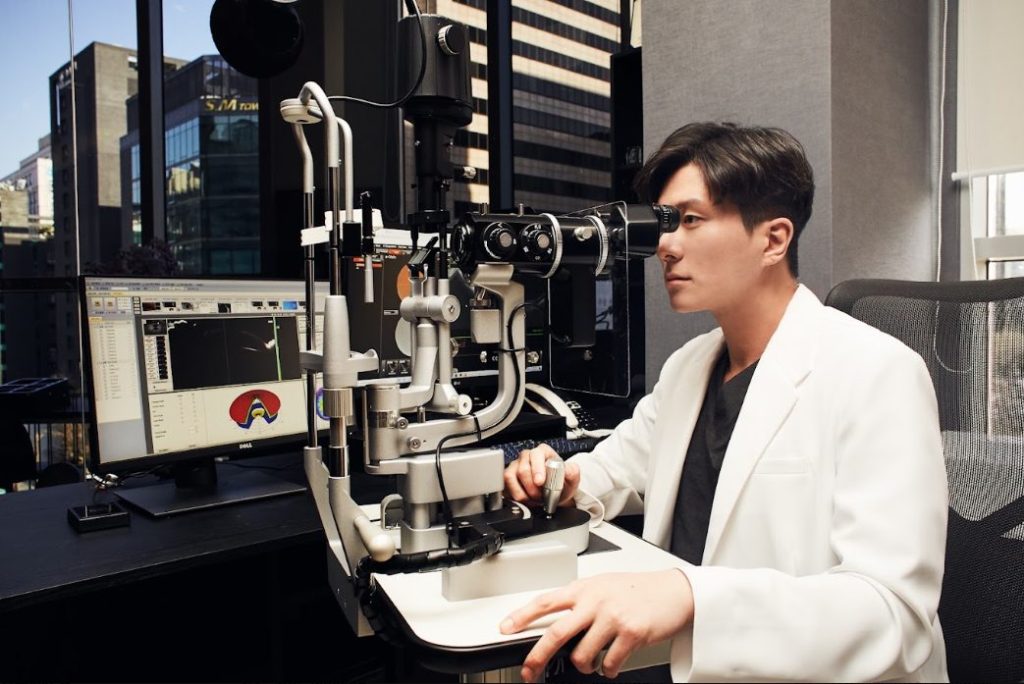
EVO ICL in Korea is vision correction that leaves the cornea untouched: a thin, custom-sized collamer lens from STAAR Surgical (USA) is placed behind the iris and in front of your natural lens to correct myopia and astigmatism. It is often considered for high myopia or thin corneas when LASIK, LASEK or SMILE-type surgery is not suitable — but it needs enough space inside the eye and enough corneal endothelial cells, and because the lens is ordered for your eye, surgery is usually not on the exam day.
Medically reviewed by Dr. Park JinHeung, Director, St. Mary’s Jin Eye Center (Ophthalmologist, PhD; Adjunct Professor, Seoul St. Mary’s Hospital) · Last updated 2026-10-26
This guide explains what EVO ICL is, which eyes suit it and which do not, the extra tests needed before surgery, what a US FDA three-year study found, how many days to plan in Seoul and the 2026 cost at St. Mary’s Jin Eye Center, about 5 minutes on foot from Gangnam Station Exit 5.
What is EVO ICL surgery?
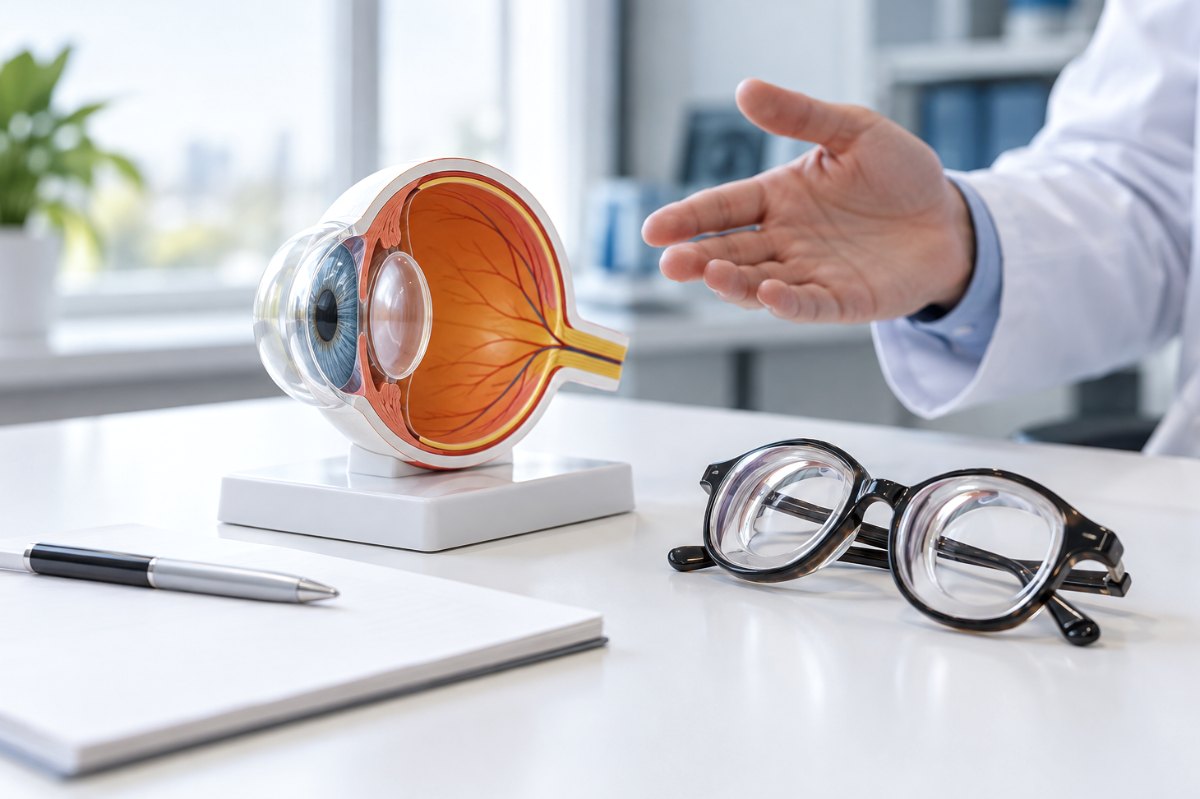
LASIK, LASEK and SMILE-type surgery reshape the cornea or remove tissue from it. EVO ICL does not remove corneal tissue; instead, a soft collamer lens works like glasses inside the eye. The lens is folded and inserted through a small incision at the edge of the cornea, and a toric ICL is used if you have astigmatism. If needed, the lens can be removed or exchanged, but because the surgery enters the eye, its risks are different from laser surgery.
The EVO lens has a tiny central hole that lets the fluid inside the eye (aqueous humour) flow through the lens. Older models needed a small laser opening in the iris for this; EVO is usually implanted without it. A 2018 review of central-port lenses reported asymptomatic anterior subcapsular opacity in 0.49% of eyes (11 studies, 617 eyes, mean 13 months), while citing 6.1% at 5 years for the earlier model without a port — follow-up periods and study designs differ, so they cannot be compared directly, and the author disclosed a consulting relationship with the manufacturer (Packer, Clin Ophthalmol 2018).
| EVO ICL | Corneal laser surgery (SILK, LASEK) | Cataract surgery | |
|---|---|---|---|
| How vision is corrected | A lens is added inside the eye; no corneal tissue removed | The cornea is reshaped or tissue removed from it | The cloudy natural lens is removed and replaced with an artificial lens |
| Natural lens | Kept | Kept | Removed |
| Reversible? | The lens can be removed or exchanged if needed | Removed corneal tissue cannot be restored | Not applicable |
| Key tests | Anterior chamber depth, corneal endothelial cells, eye dimensions for lens size | Corneal thickness and shape, Avellino gene test, dry eye | Lens power measurement, retina |
| Risks to manage | Raised eye pressure, cataract, endothelial cell loss, infection | Corneal haze or ectasia, dry eye | Posterior capsule opacification, infection and others |
A general comparison, not a ranking. The ophthalmologist chooses the method after reviewing all of your test results.
Who is a good candidate for EVO ICL?
Eyes with high myopia or a thin cornea, where removing corneal tissue would be a burden, with enough space inside the eye, enough endothelial cells and a prescription stable for at least a year, suit EVO ICL best. If the cornea is thick and myopia is not high, laser vision correction is compared as well.
A 2014 Cochrane review of 3 randomised trials (228 eyes) in myopia of −6.0 to −20.0 D found that fewer eyes lost best-corrected vision at one year after phakic lens surgery than after excimer laser, and contrast sensitivity and patient preference also favoured the phakic lens (Barsam & Allan, Cochrane 2014). Follow-up was one year and the lenses and lasers studied differ from today’s EVO lens and modern lasers, so the results cannot be applied directly.
| What we check | General criteria | Why it matters |
|---|---|---|
| Age and stable prescription | 18 or older with no change in the past year (Korean public health guidance); US approval: 21–60 years, change within 0.5 D over a year | If the prescription is still changing, myopia can return after surgery |
| Range of myopia and astigmatism | US approval: spherical equivalent from −3.0 to −20.0 D; toric lenses for myopic astigmatism with 1.0–4.0 D of cylinder | Decides the lens type and power |
| Anterior chamber depth | US approval: 3.0 mm or more (measured from the inner corneal surface) | Too little space can narrow the drainage angle |
| Corneal endothelial cells | Minimums by age and chamber depth (e.g. 3,875 cells/mm² at 21–25 years, 2,350 at 41–45 years, for a 3.0 mm chamber depth) | These cells keep the cornea clear and do not regenerate |
| Drainage angle and glaucoma | An adequately open angle; moderate or worse glaucoma excluded | The lens can affect the flow of fluid in the eye |
| General condition | Postponed during pregnancy or breastfeeding | The prescription can change temporarily |
US criteria are from the STAAR directions for use and the February 2026 age expansion. In Korea, the ophthalmologist decides after reviewing all results.
If your cornea suits laser surgery, compare our SILK guide and TransPRK guide for international patients; more on the lens itself is on our EVO ICL page.
Which extra tests are needed before EVO ICL?
In addition to the standard vision correction exam, we measure corneal endothelial cells, anterior chamber depth and the drainage angle, the inner eye dimensions that decide lens size, and examine the retina with dilated pupils. These values are used to calculate the lens size and power for the order. The manufacturer’s directions also call for endothelial cell imaging, chamber depth, corneal diameter, corneal thickness, cycloplegic refraction, eye pressure and a dilated retinal exam before surgery (STAAR EVO ICL directions for use).
| Test | What it shows | How the result is used |
|---|---|---|
| Corneal endothelial cell count | Density and shape of the cells on the inner cornea | If the count is below the required minimum, ICL may not be suitable; the count also serves as a baseline for follow-up |
| Anterior chamber depth and angle | Space between cornea and lens, and width of the drainage angle | If space is too narrow, other options are discussed |
| Inner eye diameter (corneal diameter and others) | The size of the space where the lens sits | Chooses lens size to set the vault (gap between ICL and natural lens) |
| Refraction (including cycloplegic) and corneal curvature | Exact myopia and astigmatism | Decides lens power and whether a toric lens is needed |
| Eye pressure and optic nerve | Glaucoma | Surgery is postponed if pressure is high or glaucoma has progressed |
| Dilated retinal exam | Retinal tears or thin areas | High myopia can weaken the retina; treatment first if needed |
General test list; the exact combination depends on your eyes.
Why does lens size matter, and what is the vault?
The vault is the gap between the back of the ICL and the front of your natural lens. The literature considers roughly 250–750 μm, about 0.5–1.5 times the corneal thickness, an appropriate range (EyeWiki, American Academy of Ophthalmology). Too small a gap brings the lens close to the natural lens and can raise cataract risk; too large a gap can push the iris forward, narrow the drainage angle and raise eye pressure. The range is a guide: a vault outside it does not by itself mean another operation — eye pressure, angle and lens condition are assessed together. That is why lens size is chosen from the eye’s dimensions and the vault is checked right after surgery and the next day.
High myopia often means a longer eye and a thinner retina; if a tear or weak area is found on the dilated exam, it may be treated with laser first.
What did research show about EVO ICL results and side effects?
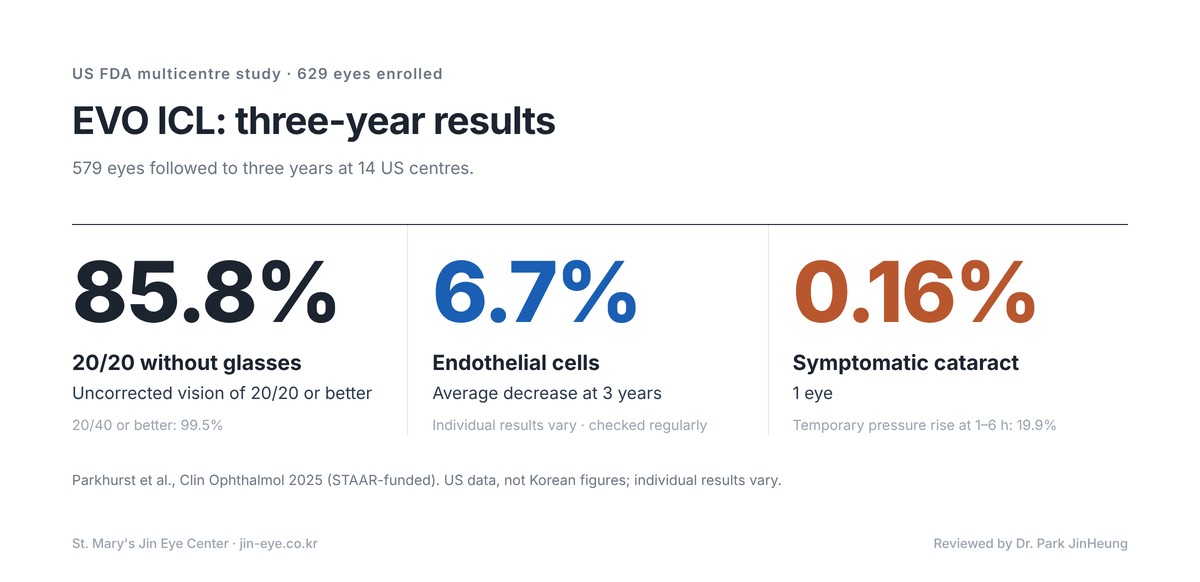
In a US FDA multicentre study, 85.8% of eyes saw 20/20 or better without glasses at three years, and symptomatic cataract occurred in 1 eye (0.16%). Endothelial cells in the 579 eyes followed to three years decreased by 6.7% on average (individual results vary), and a temporary rise in eye pressure right after surgery was common, so regular check-ups are essential.
The study enrolled 629 eyes (327 people) at 14 US centres and followed 579 eyes to three years: uncorrected vision of 20/20 or better in 85.8%, 20/40 or better in 99.5%, and 90.7% within ±0.5 D of the target. Two eyes (0.32%) lost two or more lines of best-corrected vision. The study was funded by the manufacturer (STAAR), some authors have financial ties to it, and these are US results, not Korean figures (Parkhurst et al., Clin Ophthalmol 2025).
| Item | Three-year result | What it means |
|---|---|---|
| Corneal endothelial cells | Average decrease of 3.0% at 1 year and 6.7% at 3 years (individual results vary); ≥10% loss in 20.5%, ≥30% in 0.5%, none below 1,500 cells/mm² | Lost cells do not recover, so they are checked as long as the lens is in the eye |
| Eye pressure right after surgery | Temporary rise at 1–6 hours in 19.9% (attributed to residual viscoelastic), steroid response 2.4% | Eye pressure is checked on surgery day and drops adjusted |
| Pupillary block, pigment dispersion | None | Interpreted as related to the central-port design |
| Cataract | Symptomatic anterior subcapsular cataract 1 eye (0.16%); asymptomatic anterior subcapsular opacity 2 eyes (0.32%); separately, 1 eye developed nuclear sclerotic cataract and 1 eye traumatic cataract | The natural lens is checked at follow-up |
| Further surgery | Lens exchange for high vault 2 eyes, toric repositioning 1 eye, lens removal for glare 1 eye | Lens size or position problems can be solved by exchange or adjustment |
| Retinal detachment | 3 eyes (0.48%, 2 people), treated with retinal detachment surgery | The relationship to ICL surgery is not established; high myopia itself increases retinal detachment risk, so knowing the warning signs matters |
Source: Parkhurst et al., Clin Ophthalmol 2025; six-month interim results in Packer, Clin Ophthalmol 2022. US studies, not Korean figures.
Beyond the study, glaucoma, cataract, endothelial cell loss and infection inside the eye (endophthalmitis) can occur, unlike after laser surgery. Glare or halos at night are possible, and a toric lens can rarely rotate and need repositioning. The manufacturer warns that marked long-term endothelial loss can cause corneal swelling, so endothelial cells should be checked regularly while the lens is in the eye.
- Severe eye pain, headache or nausea with sudden blur: eye pressure may have risen — contact the clinic that operated on you at once.
- Increasing redness and pain with falling vision: possible infection or inflammation — contact us at once, and follow the treating doctor’s instructions on your eye drops.
- Flashes of light, a sudden increase in floaters or a curtain-like shadow: possible retinal tear or detachment — contact us at once for same-day care.
- New or worsening glare or double vision: the lens position or leftover prescription may need checking — contact us to see whether an early visit is needed.
- Outside opening hours in Korea, go to a hospital emergency department with ophthalmology services; if you are already home, see a local ophthalmologist or eye emergency service the same day.
How many days do I need to stay for EVO ICL in Korea?
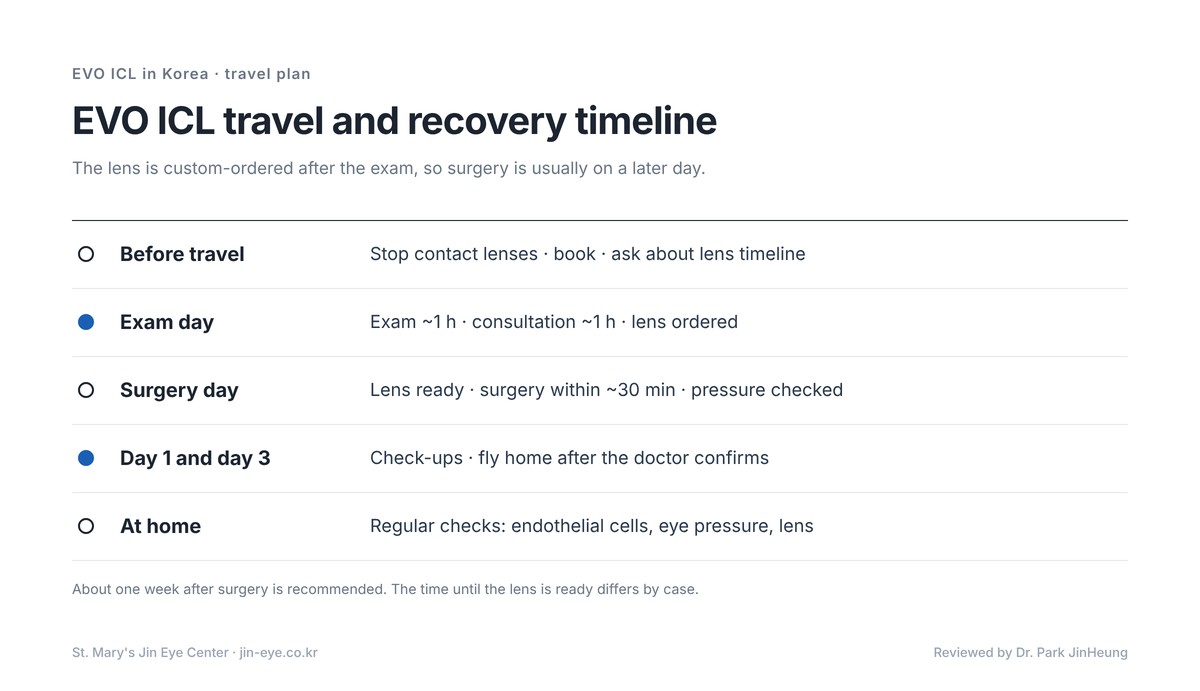
The total stay is longer than for laser surgery because the lens is custom-ordered after your exam. Plan for the exam day, the time until your lens is ready, the surgery day, and at least the check-up on day 3 after surgery; about one week after surgery is recommended. The time until the lens is ready varies, so ask us when you book — send your recent eye records in advance and we will tell you what to expect for your trip.
| Step | What happens | Time |
|---|---|---|
| Before travel | Stop contact lenses (soft 5 days, hard/RGP 2 weeks, ortho-k 4 weeks); book online, send recent eye records and ask about the expected lens timeline | — |
| Exam day | Detailed exam including endothelial cell count, chamber depth, eye dimensions and dilated retina; specialist consultation; lens size and power decided and the lens ordered | About 1 hour exam + about 1 hour consultation |
| Waiting for the lens | The custom lens is prepared; surgery is usually not on the exam day | Ask when booking |
| Surgery day | Dilating drops, eye-drop anesthesia, small incision at the corneal edge, lens inserted and positioned; eye pressure and lens position checked before you leave | Usually within 30 minutes (preparation and rest extra) |
| Day 1 after surgery | Check-up of eye pressure, vault and vision | Clinic visit |
| Day 3 and later | Check-up; most patients can fly home after the doctor confirms healing; about one week is recommended | Clinic visit |
| After returning home | Prescribed drops; regular checks of endothelial cells, eye pressure and the natural lens with a local ophthalmologist | As advised |
A typical schedule based on St. Mary’s Jin Eye Center’s care pathway; it changes with test results and your eyes. Do not drive yourself on surgery day.
For the first 1–2 days vision gradually settles, and many people return to light daily activities the next day (individual results vary). Avoid rubbing your eyes, saunas, swimming and strenuous exercise for the period you are told, and start driving only after the doctor has checked your progress. Visit planning help is on our international patients page.
How much does EVO ICL cost in Korea? (2026)
At St. Mary’s Jin Eye Center, EVO+ ICL costs ₩4,700,000 for both eyes (toric ₩5,700,000), and the detailed vision correction exam is ₩80,000. The final price is confirmed after the exam; ask us what is included when you book.
| Procedure (both eyes) | Price (KRW, 2026) |
|---|---|
| STAAR EVO+ Visian ICL (USA) | ₩4,700,000 |
| STAAR EVO+ Visian Toric ICL (astigmatism) | ₩5,700,000 |
| SILK — J&J ELITA | ₩3,500,000 |
| TransPRK — SCHWIND AMARIS 1050RS | ₩990,000 |
| Detailed vision correction exam | ₩80,000 |
All prices are for both eyes except the exam fee and are confirmed after the detailed exam.
Full price lists: St. Mary’s Jin Eye Center facts and 2026 prices · SILK, LASEK and ICL cost in Korea.
Frequently asked questions
From how many diopters can EVO ICL be done?
US approval covers a spherical equivalent from −3.0 D to −20.0 D, and toric lenses correct 1.0–4.0 D of astigmatism. In practice the decision is not based on the prescription alone: corneal thickness and shape, chamber depth and endothelial cell count are assessed and compared with laser vision correction.
Can I have EVO ICL surgery on the day of my exam?
Usually not. The lens is ordered to fit your eye size and prescription, so surgery is scheduled after the exam and consultation once the lens is ready. Stop contact lenses before the exam: soft 5 days, hard 2 weeks, ortho-k 4 weeks.
Why is a corneal endothelial cell test needed?
Endothelial cells keep the cornea clear and do not regenerate once lost. Because ICL surgery enters the eye, you need an age-appropriate minimum cell count, and the value is used as a baseline to check regularly while the lens is in the eye.
Can the ICL be removed later?
Yes, if needed it can be removed or exchanged for another size or power. In the US FDA study some eyes had a lens exchange for high vault or removal for glare. It is another operation inside the eye and carries its own risks.
Can I still have cataract surgery after EVO ICL?
Yes. If a cataract develops with age, the ICL is removed and cataract surgery is performed. ICL surgery itself can raise cataract risk, so the natural lens is checked at follow-up.
How many days should I plan in Seoul for EVO ICL?
Plan for the exam day, the time until your custom lens is ready, the surgery day and at least the day-3 check-up after surgery; about one week after surgery is recommended. Ask about the expected lens timeline when you book.
How much does EVO ICL cost in Korea?
At St. Mary’s Jin Eye Center, EVO+ ICL costs ₩4,700,000 for both eyes and the toric version ₩5,700,000 (2026); the detailed exam is ₩80,000. The final price is confirmed after the exam.
- 337 Gangnam-daero, Seocho-gu, Seoul (1F, 4F, 5F) — about 5 minutes on foot from Gangnam Station Exit 5
- Hours (KST): Mon–Fri 09:00–18:00 (lunch 13:00–14:00), Sat 09:00–15:00
- Phone +82-2-577-7782 · E-mail jin.eye.center@gmail.com
- Registered medical institution for international patients in Korea
- Clinic facts and prices: St. Mary’s Jin Eye Center — facts and 2026 prices
This article is general medical information and does not replace an individual diagnosis. Whether you can have ICL surgery, the lens type and your vision afterwards depend on your test results and eyes, and every operation can have side effects.