ECHO ICL vs EVO+ ICL: both are phakic posterior-chamber lenses placed behind the iris and in front of your natural lens, implanted with the same surgery. ECHO is the Korean supply name of Care Group’s IPCL V2.0 (hydrophilic acrylic, sizes in 0.25 mm steps); EVO+ is STAAR Surgical’s Visian EVO+ ICL (Collamer, four sizes), backed by more published data including US FDA trial results. Neither has been shown to be better overall; the lens is chosen from your examination.
Medically reviewed by Dr. Park JinHeung, Director, St. Mary’s Jin Eye Center (Ophthalmologist, PhD; Adjunct Professor, Seoul St. Mary’s Hospital) · Last updated 2026-11-23
International patients asking about ICL surgery in Korea now often see two names: ECHO and EVO+. Below, the ophthalmologists of St. Mary’s Jin Eye Center, an eye clinic in Gangnam, Seoul, explain how the two lenses differ, what the studies show, what can go wrong, what it costs and how we decide which lens fits your eye. Manufacturer marketing claims are not used as evidence in this article.
- Both lenses sit in the same place and are implanted the same way; both have a central hole so eye fluid can flow without a laser hole in the iris in most eyes.
- EVO+ has more published evidence, including US FDA trial data up to three years; ECHO (IPCL V2.0) has 6-month to 5-year studies, but fewer.
- ECHO comes in 13 lengths (0.25 mm steps); if the right size and power are in stock, surgery on the examination day may be possible.
- No study has shown one lens to be better overall; the choice depends on your measurements.
- Both carry risks such as raised eye pressure, cataract, corneal endothelial cell loss and lens exchange or removal, so regular check-ups are needed.
What are ECHO ICL and EVO+ ICL?
Both are implantable phakic lenses placed behind the iris and in front of your own lens to correct myopia and astigmatism (toric versions). ECHO is the Korean supply name of Care Group’s IPCL V2.0; EVO+ is STAAR Surgical’s Visian EVO+ ICL.
ICL surgery corrects vision by adding a lens inside the eye instead of reshaping the cornea, so it is usually considered for high myopia or corneas too thin for laser vision correction.
EVO+ is a version of STAAR’s EVO with a larger optic (the part you see through); the US FDA approved EVO and EVO+ together in 2022 (FDA SSED P030016/S035). The maker of IPCL V2.0 describes it as a revision of V1.0 with an added central hole and an optic of the same thickness at every power.
Neither lens is an upgraded version of the other: they are separate products with different makers, materials and designs. St. Mary’s Jin Eye Center offers both and chooses with you based on your measurements, power, schedule and budget. Our general guide to EVO ICL candidacy, tests and cost in Korea explains the basic tests.
How do ECHO and EVO+ ICL differ in design?
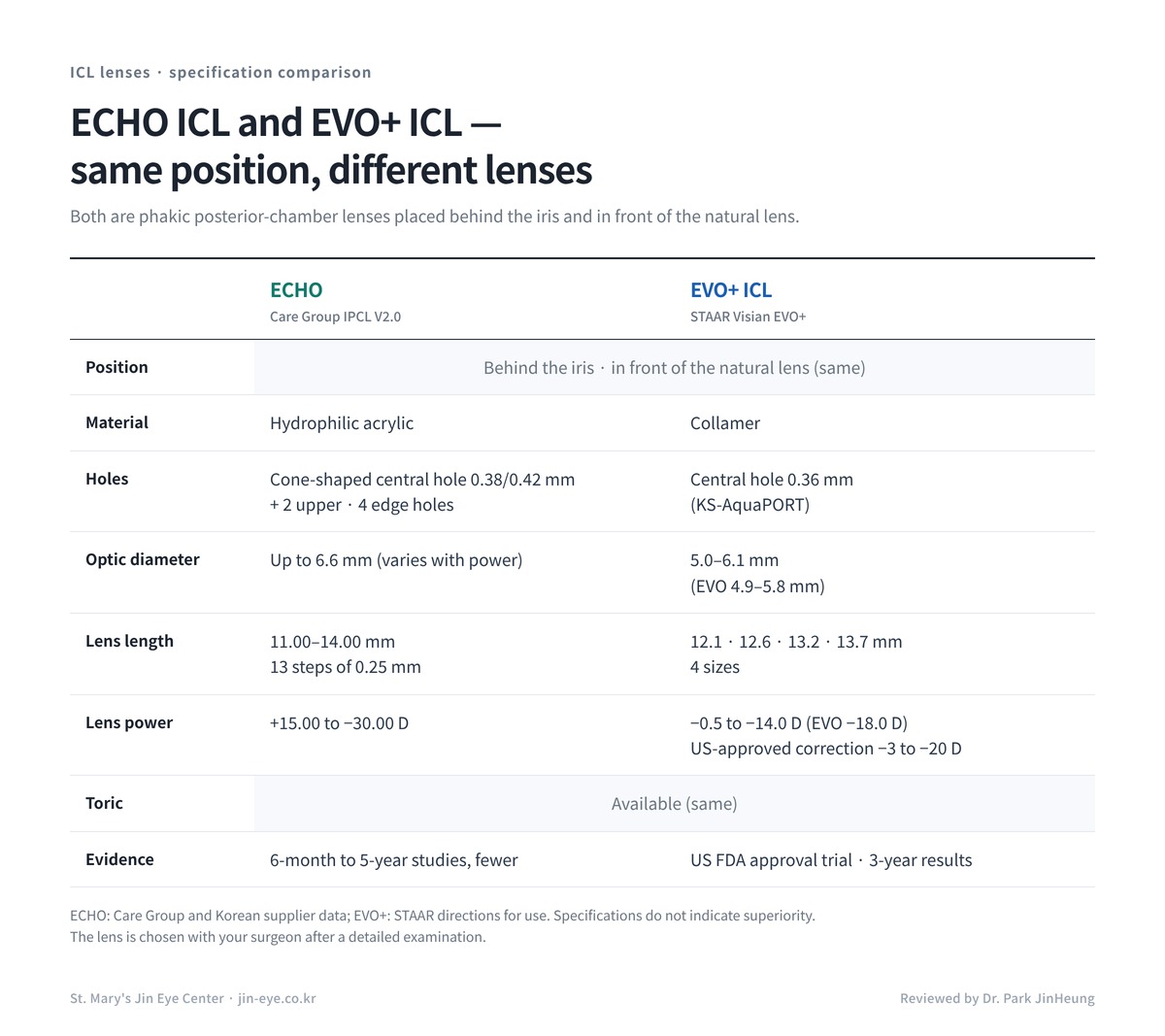
EVO+ is made of Collamer with a 0.36 mm central hole and comes in four lengths. ECHO is hydrophilic acrylic with a cone-shaped central hole (0.38 mm front, 0.42 mm back) plus six peripheral holes, and comes in lengths from 11.00 to 14.00 mm in 0.25 mm steps.
| Item | ECHO · Care Group IPCL V2.0 | EVO+ ICL · STAAR Visian EVO+ |
|---|---|---|
| Material | Hydrophilic acrylic (26% water) | Collamer (copolymer of HEMA with porcine collagen) |
| Holes | Cone-shaped central hole (0.38 mm front, 0.42 mm back), 2 upper and 4 edge holes | Central hole 0.36 mm (KS-AquaPORT) |
| Optic diameter | Varies with power, up to 6.6 mm | 5.0–6.1 mm depending on power (EVO 4.9–5.8 mm) |
| Central optic thickness | 0.08 mm at all powers (manufacturer data) | Varies with power |
| Lens length (size) | 11.00–14.00 mm, 13 steps of 0.25 mm | 12.1, 12.6, 13.2, 13.7 mm (4 sizes) |
| Lens power | +15.00 to −30.00 D (manufacturer data) | −0.5 to −14.0 D (EVO to −18.0 D); US-approved correction range −3.0 to −20.0 D at spectacle plane |
| Toric (astigmatism) | Available | Available |
| Supply | Stock range 11.75–13.00 mm and −3.00 to −15.00 D; other sizes made to order (about 3 weeks) | Ordered to your measurements |
ECHO: Care Group and Korean supplier data; EVO+: STAAR directions for use. Lens power is the power of the implanted lens itself, not your glasses prescription; the correctable range is calculated from your exam. Specifications do not indicate superiority.
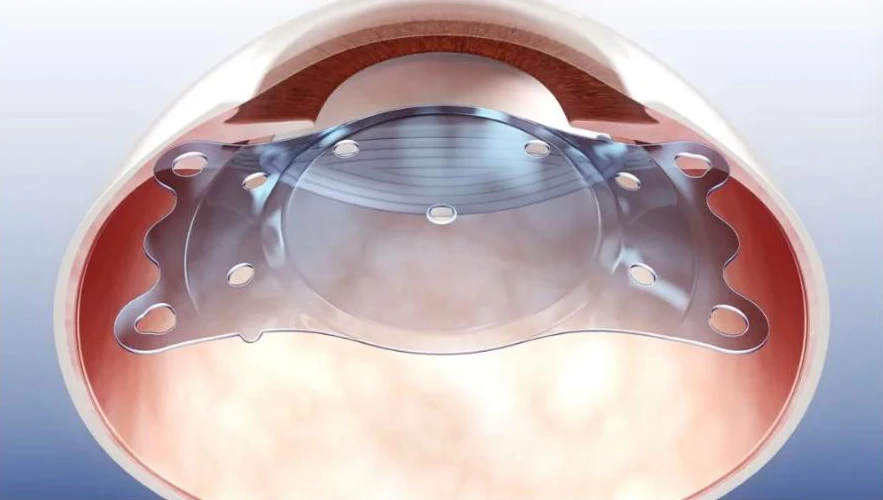
The maker of ECHO says its flexible haptics hold position even if the measured corneal width differs by up to about 0.5 mm. That is a manufacturer statement, not proof that a poorly sized lens is safe: with either lens, the wrong size can make the vault (the gap between the ICL and your natural lens) too low or too high.
Too low a vault can raise the risk of cataract; too high a vault can narrow the drainage angle and raise eye pressure (EyeWiki, AAO). That is why we size either lens from corneal width and anterior chamber depth and check vault and pressure right after surgery and the next day.
What do studies show for EVO+ ICL?
In the US FDA approval trial (EVO and EVO+ analysed together), 90.5% of eyes were within ±0.5 D of target at 6 months, and 80.1% saw 20/20 without glasses; three-year results have also been published. Small EVO+-only studies report fewer night halos with the larger optic, but they are small.
According to the FDA summary, at 6 months 90.5% of eyes were within ±0.5 D and 98.9% within ±1.0 D of target; among eyes that saw 20/20 with glasses before surgery, 80.1% saw 20/20 and 99.4% saw 20/40 or better without glasses (FDA SSED 2022).
In the same data, endothelial cells decreased by 2.3% on average. A rise in eye pressure was reported in 136 of 629 eyes (21.6%), 125 of them (19.9%) within 1–6 hours after surgery; a steroid pressure response occurred in 2.4%. These were mostly temporary rises right after surgery and do not mean a long-term glaucoma rate.
Additional surgery was needed in 9 of 629 eyes (about 1.4%, including lens exchange, removal, repositioning and retinal surgery); one eye had the lens removed for glare or halos and one eye developed nuclear cataract, and no laser iridotomy was needed. EVO and EVO+ were not analysed separately, and three-year data are reported by Parkhurst et al. (Clin Ophthalmol 2025).
In an early EVO+ report of 50 eyes from Spain, all eyes were within ±0.5 D at 1 week, mean vault was 611 µm and early halos improved by about one month (Aramberri, CRST Europe 2016); the author noted an optic area up to about 20% larger, while another study cited there found no difference in higher-order aberrations between EVO and EVO+. In 36 eyes followed for 6 months there were no complications, low-light contrast sensitivity and quality-of-life scores improved, and ring-shaped halos decreased over 3–6 months (Martínez-Plaza, Am J Ophthalmol 2021). Both studies are small and uncontrolled, so how much halos will decrease for you cannot be promised.
What do studies show for ECHO (IPCL V2.0)?
In 100 eyes followed for 6 months, endothelial cells decreased by 2.9% on average with no complications reported; a study comparing it with a central-hole ICL for up to 2 years found no statistically significant difference. A 5-year study exists, but long-term data are fewer than for the EVO family.
In 100 eyes with IPCL V2.0 followed for 6 months, endothelial cells decreased by 2.9% on average, mean vault was 541 µm, and no complications were reported during the study (Bianchi 2019).
A study of 111 IPCL V2.0 and 106 ICL V4c (the same central-hole design as EVO) implantations followed for up to 2 years found 76% and 83% of eyes seeing 20/20 without glasses at 3 months, and the authors concluded that outcomes did not differ statistically (Graefes Arch 2022). The comparison lens was V4c, not EVO+, so this is not a direct ECHO-vs-EVO+ comparison; the authors added that IPCL in particular needs longer follow-up. A conference report noted toric re-rotation in 5 of 58 IPCL eyes and 2 of 64 ICL eyes (EuroTimes 2021).
A 2024 single-centre retrospective study from Argentina of 140 eyes five years after IPCL implantation found 78.6% within the 250–750 µm vault range, anterior subcapsular cataract in 2 eyes whose vault was under 250 µm, and ciliary sulcus cysts in 50 eyes (35.7%), with no change in eye pressure or endothelial cell count (J Cataract Refract Surg 2024). As a single-centre retrospective study, it cannot settle long-term safety or rank lenses.
Supplier brochures include light-loss comparisons with other lenses and wording that endothelial cell loss need not be a concern; these are manufacturer tests and statements, not comparisons in human eyes, so we do not use them as evidence. Endothelial cells can decrease with any lens, so they are checked regularly while the lens is in the eye.
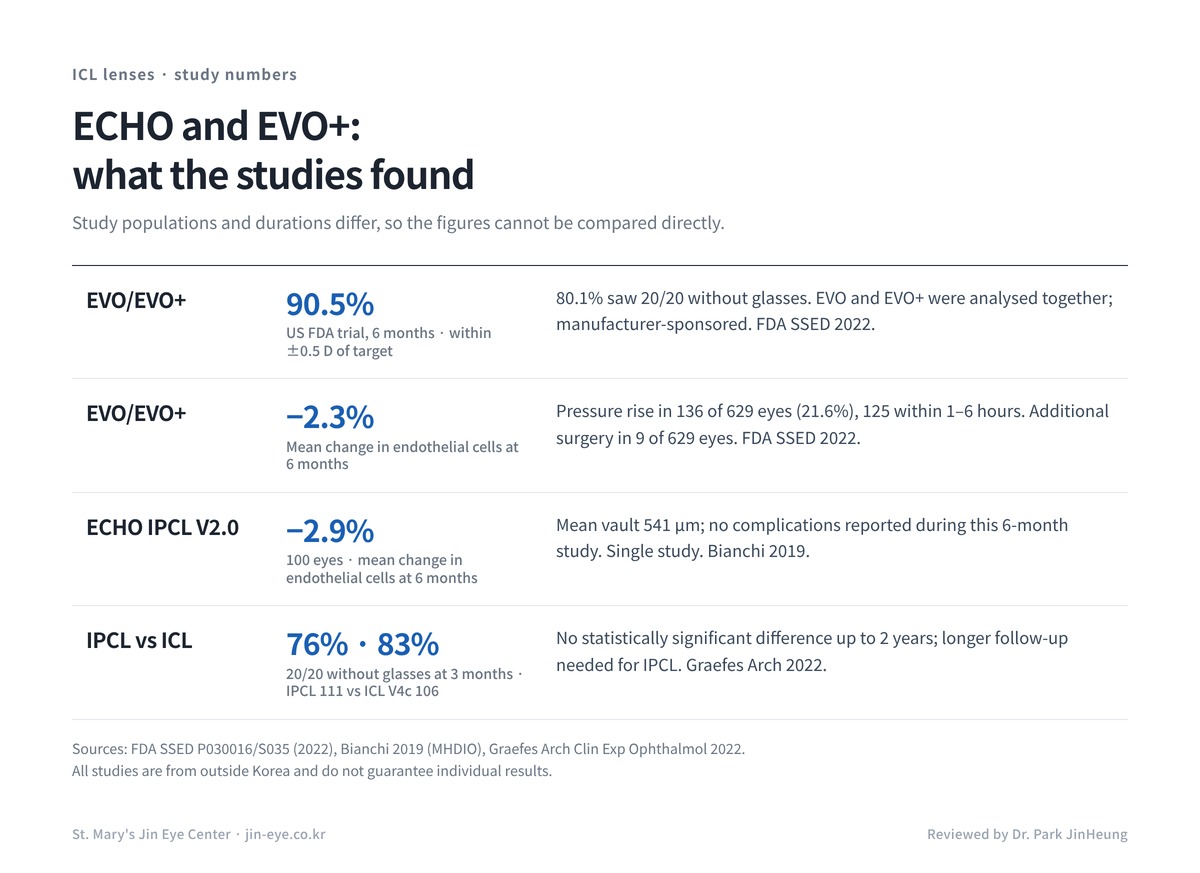
The US EVO/EVO+ trial was sponsored by the manufacturer (STAAR). All figures come from studies outside Korea and do not guarantee individual results.
Which lens is right for my eye — ECHO or EVO+?
Your measurements come before the lens name. We check anterior chamber depth, corneal width, endothelial cells, power and astigmatism and the retina, then decide with you whether both lenses or only one is suitable.
| If… | What we look at |
|---|---|
| You want the lens with more long-term data | EVO+ has more studies, including the US FDA trial and three-year results |
| Your eye falls between lens size steps | ECHO has 0.25 mm steps, EVO+ four sizes; finer steps are not proven to predict vault better or reduce complications, so chamber anatomy is assessed as well |
| Your myopia is very high | Whether correction is possible within each lens’s power range and approved range is calculated; outside them, other options are discussed |
| You want surgery on the examination day | Possible with ECHO if the right size and power are in stock; made-to-order lenses take about 3 weeks |
| Budget matters | ECHO costs less (see the price table below) |
| You also have astigmatism | Both have toric versions; rotation is checked after surgery |
General considerations; even with the same conditions, ICL surgery itself may not be recommended depending on your eyes.
At St. Mary’s Jin Eye Center, our initial screening criteria are an anterior chamber depth of at least 2.8 mm and a corneal width (white-to-white) of at least 11.4 mm in adults aged 18 or older with stable power; eligibility also depends on endothelial cell count and each lens’s approved indications, and other results may still lead us to advise against surgery. For reference, the US approval for EVO+ requires an anterior chamber depth of at least 3.0 mm and myopia of −3.0 to −20.0 D, and the age range was widened to 21–60 in February 2026 (STAAR 2026).
From the 40s, presbyopia begins and lens-based presbyopia options may be discussed instead; if laser vision correction is possible, it is compared as well.
How much do ECHO ICL and EVO+ ICL cost in Korea? (2026)
At St. Mary’s Jin Eye Center, ECHO ICL costs ₩3,800,000 for both eyes (toric ₩4,800,000) and EVO+ ICL ₩4,700,000 (toric ₩5,700,000). The examination is included when you have surgery; an examination-only visit is ₩80,000. The final price is confirmed after the exam.
| Procedure (both eyes) | Price (KRW, 2026) |
|---|---|
| ECHO ICL — Care Group IPCL V2.0 | ₩3,800,000 |
| ECHO toric ICL (astigmatism) | ₩4,800,000 |
| STAAR EVO+ Visian ICL (USA) | ₩4,700,000 |
| STAAR EVO+ Visian toric ICL (astigmatism) | ₩5,700,000 |
| Detailed vision-correction examination only (separate visit) | ₩80,000 |
Prices for international patients in Korean won. Ask what is included when you book. All clinic prices are on our facts and prices page.
How do ICL surgery and the stay in Korea work?
For both lenses, the lens type, size and power are decided after the examination and consultation; the folded lens is inserted through an incision of about 3 mm and positioned behind the iris. Eye pressure and lens position are checked before you go home, and check-ups follow from the next day.
| Step | What happens | Good to know |
|---|---|---|
| 1. Before the exam | Stop contact lenses for the period we tell you | The period depends on lens type and is given when you book |
| 2. Examination | Power, anterior chamber depth, corneal width, endothelial cells, eye pressure, dilated retina exam (about 1 hour) | In high myopia the retina is checked carefully |
| 3. Consultation | Suitability, lens type, size and power | We explain whether both lenses are possible |
| 4. Surgery | Dilating drops, numbing drops, incision of about 3 mm, lens insertion and positioning (the operation itself takes about 30 minutes; allow extra time for preparation and checks) | Both eyes are usually treated on the same day |
| 5. Before leaving and next day | Eye pressure and vault checked, eye drops prescribed | Drops for about 1 month; go home with a companion, do not drive |
| 6. Follow-up | Pressure, vault, natural lens and endothelial cells | Continues for as long as the lens is in the eye |
Based on our ICL care pathway; the schedule can change with your results.
Same-day surgery is possible only if you book ahead, arrive with contact lenses stopped, are confirmed suitable, and the right lens is available. EVO+ is ordered to your measurements, so surgery is usually scheduled once the lens arrives; ECHO sizes or powers outside the stock range are made to order (about 3 weeks).
We recommend staying in Korea for at least a few days after surgery to complete the first follow-up visits; the stay you need depends on your surgery schedule and recovery, so please confirm your treatment and travel dates with us before booking your return flight.
What are the risks of ECHO and EVO+ ICL, and which symptoms are urgent?
With either lens, raised eye pressure, cataract, endothelial cell loss, lens decentration or rotation, glare and halos and, rarely, infection can occur, and lens exchange or removal may be needed. Severe eye pain, headache or nausea, a sudden drop in vision or a curtain over your vision means contacting us immediately rather than waiting for the next check-up.
| Symptom | Possible cause | What to do |
|---|---|---|
| Severe eye pain, headache, nausea, sudden blur | Sudden rise in eye pressure | Contact the clinic immediately |
| Increasing redness and pain with falling vision | Infection (endophthalmitis) or inflammation | Contact us immediately for same-day care |
| Flashes, a sudden shower of floaters, a curtain over vision | Retinal tear or detachment | Contact us immediately for same-day care |
| New or worsening halos or double vision | Lens position or rotation, residual power | Contact us to see whether you need an earlier visit |
If you have urgent symptoms and cannot reach us, or it is outside opening hours, go straight to an emergency department with eye services. After returning home, if any warning symptom appears, see a local ophthalmologist urgently rather than waiting for our reply, and keep your scheduled follow-up care.
An ICL can be removed or exchanged if needed, but that is another operation inside the eye with its own risks. If you develop cataract later, the ICL can be removed and cataract surgery performed.
How does St. Mary’s Jin Eye Center choose the ICL lens?
We offer both ECHO and EVO+, and the same ophthalmologists review your results, choose the lens, operate and follow you up. We start from which lens fits your eye, schedule and budget, not from which lens is ‘best’.
St. Mary’s Jin Eye Center is led by ophthalmologists who trained at Seoul St. Mary’s Hospital, covering the retina and anterior segment, with more than 14,000 vision-correction procedures performed. Before ICL surgery in high myopia, the retina is examined as well. If your cornea is suitable for laser surgery, SILK and all-laser LASEK are compared too.
Frequently asked questions
Are ECHO ICL and EVO+ ICL the same surgery?
The lens position and the surgery are the same: both are phakic lenses placed behind the iris and in front of the natural lens through a small incision at the edge of the cornea. ECHO is Care Group’s IPCL V2.0 (hydrophilic acrylic) and EVO+ is STAAR’s Visian EVO+ (Collamer), so the maker, material and size steps differ.
Which is better, ECHO ICL or EVO+ ICL?
There is no evidence that either is better overall. EVO+ has more studies, including the US FDA trial and three-year results; ECHO (IPCL V2.0) offers sizes in 0.25 mm steps and, if the lens is in stock, surgery on the examination day. The lens is chosen with you after a detailed examination.
Does ECHO ICL need a laser hole in the iris?
Both ECHO and EVO+ have a central hole that lets eye fluid flow, so they are designed to be implanted without a preventive laser iridotomy in general. In the US FDA EVO/EVO+ trial, no laser iridotomy was needed. Whether any additional treatment is needed for your eye is decided by the surgeon.
Can I have ECHO ICL surgery on the day of the examination?
It may be possible if you book ahead and arrive with contact lenses stopped. You must be confirmed suitable, and the lens size and power you need must be within the stock range (11.75–13.00 mm, −3.00 to −15.00 D). Outside that range the lens is made to order, which takes about 3 weeks.
How is EVO+ ICL different from EVO ICL?
EVO+ has a larger optic of 5.0–6.1 mm compared with 4.9–5.8 mm for EVO. It is designed to reduce night halos in people with larger pupils; small studies report fewer halos, but results vary between individuals.
How much does ICL surgery cost in Korea?
At St. Mary’s Jin Eye Center, ECHO ICL is ₩3,800,000 for both eyes (toric ₩4,800,000) and EVO+ ICL is ₩4,700,000 (toric ₩5,700,000). The examination is included when you have surgery; an examination-only visit is ₩80,000. The final price is confirmed after the examination.
Where is St. Mary’s Jin Eye Center in Seoul?
We are at 337 Gangnam-daero, Seocho-gu, Seoul (1F, 4F, 5F), about 5 minutes on foot from Gangnam Station Exit 5. Opening hours are Monday to Friday 09:00–18:00 (lunch 13:00–14:00) and Saturday 09:00–15:00 (KST). Book online or call +82-2-577-7782.
- 337 Gangnam-daero, Seocho-gu, Seoul (1F, 4F, 5F) — about 5 minutes on foot from Gangnam Station Exit 5
- Hours (KST): Mon–Fri 09:00–18:00 (lunch 13:00–14:00), Sat 09:00–15:00
- Phone +82-2-577-7782 · E-mail jin.eye.center@gmail.com
- Registered medical institution for international patients in Korea
- Clinic facts and prices: St. Mary’s Jin Eye Center — facts and 2026 prices
References
- U.S. FDA. Summary of Safety and Effectiveness Data: Visian ICL with KS-AquaPORT (EVO/EVO+), P030016/S035. 2022. Source
- STAAR Surgical. EVO/EVO+ Visian ICL Directions for Use (eDFU-0009 Rev 03). Source
- Parkhurst G, et al. Three-year results from the US FDA prospective multicenter clinical study of the EVO/EVO+ Implantable Collamer Lens. Clin Ophthalmol 2025;19:3237-3248 (sponsored by STAAR Surgical). Source
- Aramberri J. First clinical outcomes with the EVO+ Visian ICL. CRST Europe 2016. Source
- Martínez-Plaza E, et al. EVO+ Implantable Collamer Lens: visual performance and quality of life. Am J Ophthalmol 2021;226:117-125. Source
- Bianchi GR. Initial results from a new model of posterior chamber implantable phakic contact lens: IPCL V2.0. Med Hypothesis Discov Innov Ophthalmol 2019;8(2):57-63. Source
- Initial clinical outcomes of two different phakic posterior chamber IOLs for the correction of myopia and myopic astigmatism. Graefes Arch Clin Exp Ophthalmol 2022;260(5):1763-1772. PMID 34741659. Source
- EuroTimes (ESCRS). Phakic IOL comparison. 2021. Source
- Implantable Phakic Contact Lens: vault evaluation five years after surgery. J Cataract Refract Surg 2024. PMID 38787622. Source
- STAAR Surgical press release. FDA expands U.S. age indication for EVO ICL. 17 February 2026. Source
- EyeWiki (American Academy of Ophthalmology). Implantable Collamer Lens. Source
This article is general medical information about implantable phakic lenses and does not replace an individual diagnosis or treatment. Suitability, lens type and visual results depend on your examination, and every operation can have side effects. Lens specifications are based on manufacturer and supplier data; study figures come from outside Korea. ECHO is the Korean supply name of Care Group’s IPCL V2.0. Written 23 November 2026.