





Written and medically reviewed by Dr. Park JinHeung, MD, PhD, ophthalmologist (retina) · St. Mary’s Jin Eye Center, Gangnam, Seoul · Last updated: October 2026
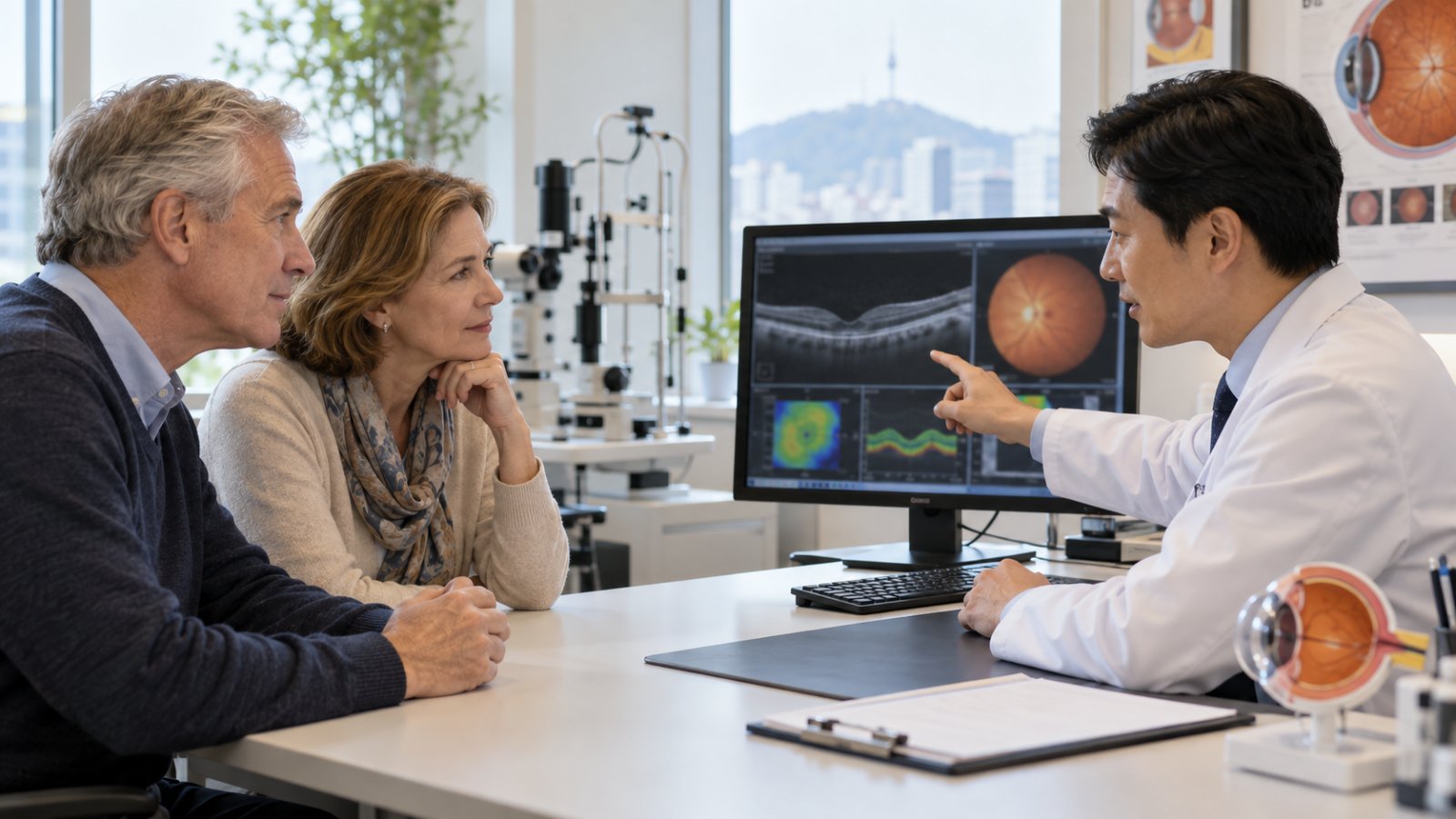
Many people who look into cataract surgery in Korea compare lens brands and prices first. Those matter, but the result of cataract surgery also depends on something that is easy to overlook: the health of the retina, the light-sensing layer at the back of the eye. This guide explains how cataract surgery works for international patients at our clinic, what is checked before surgery, how lenses are chosen, what it costs, and how long to plan to stay in Seoul.
Why the retina matters in cataract surgery
A cataract is a clouding of the eye’s natural lens. Surgery replaces the cloudy lens with a clear artificial lens (an intraocular lens, or IOL). A new lens can only deliver a sharp image if the retina, and especially its centre (the macula), can use that image.
Conditions that can limit vision after cataract surgery, or change which lens is suitable, include:
- Macular conditions such as age-related macular degeneration, an epiretinal membrane or macular swelling
- Diabetic retinopathy, which may need to be assessed and, if needed, treated before or around cataract surgery
- High myopia (strong short-sightedness), which is associated with a higher risk of retinal tears and detachment
- Glaucoma and other optic nerve conditions
A dense cataract can hide these problems on a routine check. That is why we assess retinal health before recommending a lens, using retinal imaging when possible (a dense cataract may limit the examination), and why some patients are advised that a premium multifocal lens is not the right choice for their eyes even when they would like one.
Your examination before surgery
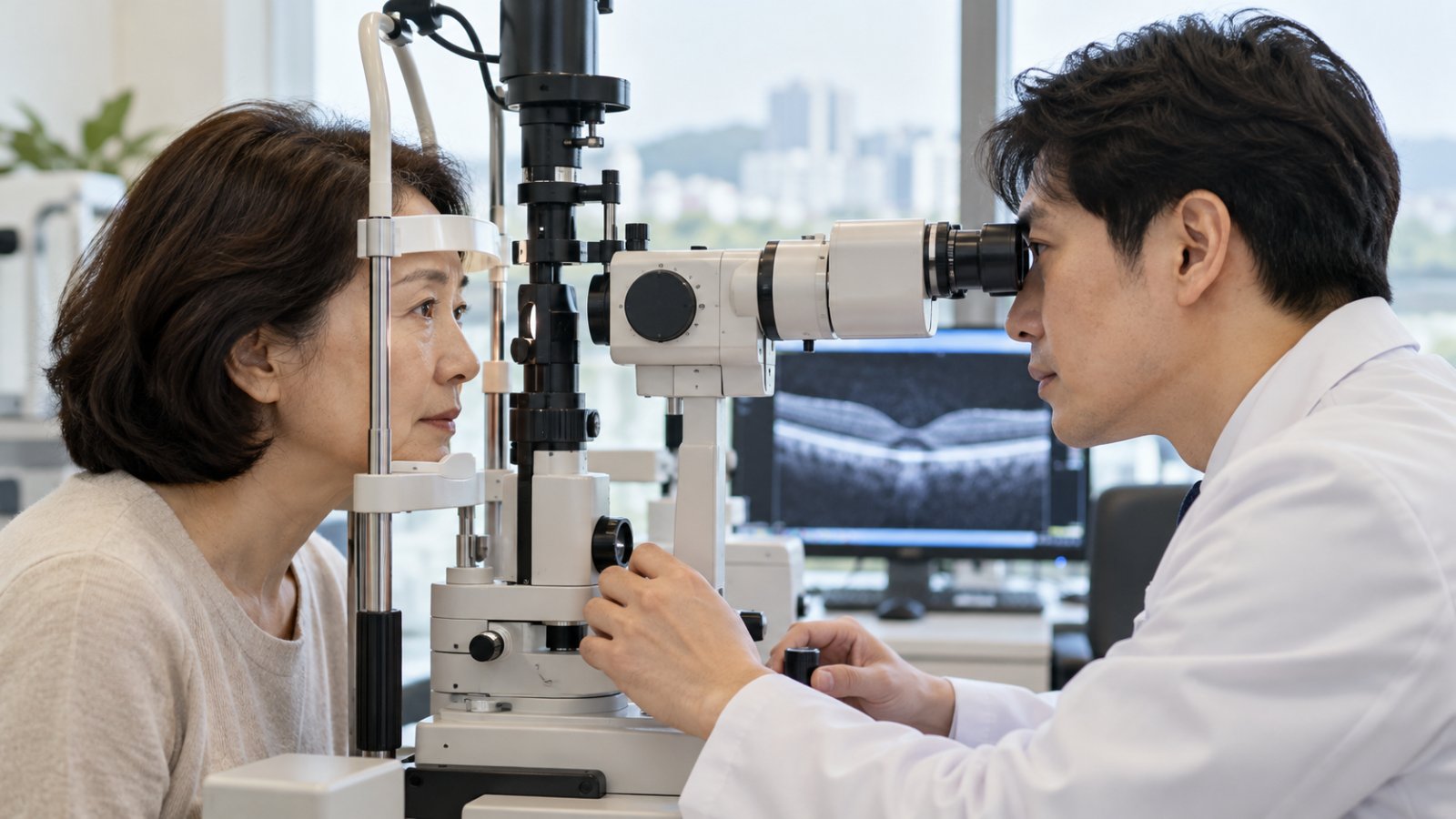
A comprehensive eye examination and one-to-one consultation with your surgeon usually takes around two hours in total. It typically includes:
- Visual acuity and refraction
- Eye pressure measurement
- Corneal measurements (curvature and thickness) and a count of corneal endothelial cells
- Optical biometry to calculate the lens power
- Dilated retinal examination and retinal imaging (OCT) of the macula
- A discussion of how you use your eyes — driving at night, reading, screen work, hobbies — to choose a lens
If you wear contact lenses, they change the shape of the cornea and can affect the lens calculation. Please stop wearing them before your examination: soft lenses 5 days before, hard (RGP) lenses 2 weeks before, and ortho-k lenses 4 weeks before.
Choosing a lens

We offer 14 intraocular lens options, which fall into four groups:
- Monofocal (for example Clareon): clear vision at one distance, usually far; glasses are typically needed for reading.
- Enhanced monofocal (Eyhance, Precizon Go): mainly for distance, with some added intermediate range.
- Extended depth of focus, EDOF (Vivity, Clareon Vivity, PureSee): designed to provide distance and intermediate vision. Reading glasses may still be needed, and halos or glare can occur.
- Trifocal / full-range (PanOptix, Clareon PanOptix, PanOptix PRO, FineVision, Synergy, Lisa TRI, ELANA, Odyssey): distance, intermediate and near. Some people notice halos or glare around lights at night, especially in the first months.
Toric versions correct astigmatism. Your surgeon recommends a lens based on your measurements, the health of your retina and your daily needs. No lens suits every eye, and no lens can guarantee that you will never need glasses.
What does cataract surgery cost?
For international patients, cataract surgery is self-pay. Our published prices (KRW) are:
- Monofocal lens (Clareon): from KRW 1,500,000 per eye
- Premium multifocal / EDOF lenses (selected PanOptix, Vivity, Odyssey and other models): KRW 3,000,000–5,000,000 per eye
- Clareon PanOptix PRO: KRW 6,500,000 per eye
- Toric lenses: availability and pricing are confirmed after your eye examination
- Comprehensive eye examination only: KRW 80,000 (included in the surgery fee if surgery is performed on the same day)
The final plan and price are confirmed only after your examination. Flights, accommodation and transportation are not included. See also our international patients page.
How long should you stay in Seoul?
For cataract surgery, we recommend planning about one week in Seoul. A typical schedule is:
- Day 1: comprehensive examination and consultation. If your eyes are suitable, the lens you need is available and the schedule allows, surgery may be possible the same day; otherwise we arrange another date.
- Surgery day: the procedure itself usually takes around 10 minutes per eye under local anaesthesia. After a period of observation at the clinic, most patients return to their accommodation the same day.
- The day after surgery: usually the first post-operative check.
- Before departure: follow-up appointments are arranged according to your recovery, including an examination before you leave. Your surgeon advises when you may fly; the timing depends on your recovery and any other eye conditions.
If both eyes need surgery, your surgeon will explain how the two operations are scheduled.
Risks you should know about
Cataract surgery is one of the most commonly performed operations in the world, but like any surgery it has risks. These include infection or inflammation inside the eye, raised eye pressure, swelling of the cornea or macula, retinal detachment, and posterior capsule opacification, which may develop months or years after surgery and can often be treated with YAG laser capsulotomy. With multifocal and EDOF lenses, some people notice halos, glare or reduced contrast at night. Your surgeon explains how these risks apply to your eyes before you decide.
After you return home
Use your prescribed eye drops as directed by your surgeon; the medications and how long you use them depend on your recovery. Before you leave Seoul, ask for a summary of your surgery, including the lens model and power, so that an ophthalmologist in your home country can continue your care. Please contact us, or see a local eye doctor promptly, if you notice increasing pain, worsening vision, a curtain or shadow in your vision, or a sudden increase in floaters or flashes.
Frequently asked questions
Do you speak English?
Yes. Consultations are available in English, and interpretation can be arranged for other languages if you ask before your visit.
Can I send my eye reports before I travel?
Yes. You can share recent eye examination reports and your glasses prescription with us for a preliminary estimate. A final recommendation is made only after we examine your eyes in person.
Where are you?
337 Gangnam-daero, Seocho-gu, Seoul — about a 5-minute walk from Gangnam Station Exit 5.
About our surgeon
Dr. Park JinHeung, MD, PhD, is a board-certified ophthalmologist at St. Mary’s Jin Eye Center and an Adjunct Professor in the Department of Ophthalmology, Seoul St. Mary’s Hospital, The Catholic University of Korea. He completed fellowship training in retinal diseases and surgery and performs cataract, retinal and vision correction surgery.
This article provides general information and is not a substitute for a medical examination. Suitability for surgery and the choice of lens are determined only after an in-person examination. Individual results vary.