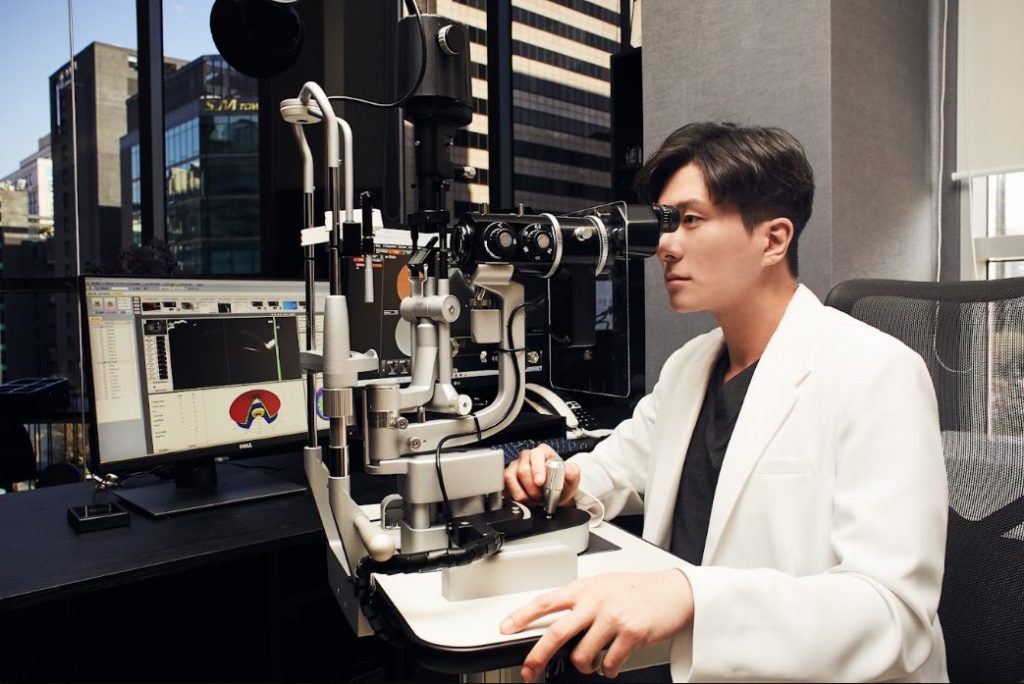
Plan about one week in Seoul for cataract surgery in Korea. At St. Mary’s Jin Eye Center the pre-surgery exam takes about 1 hour and the consultation about 1 hour, and surgery may be possible on the same day depending on your exam results. You can usually fly home after at least the day-3 check-up, if your surgeon confirms the eye is healing well. Monofocal cataract surgery starts from ₩1,500,000 per eye, and every price is confirmed after the exam.
Medically reviewed by Dr. Park JinHeung, Director, St. Mary’s Jin Eye Center (Ophthalmologist, PhD; Adjunct Professor, Seoul St. Mary’s Hospital) · Last updated 2026-10-09
If you live abroad and are considering cataract surgery in Korea, the first practical questions are usually about time and money: how many days to stay, what happens on each day, and how the price is set. This guide answers those questions with our clinic’s confirmed schedule and prices, and explains the medical reasons behind them using sources such as the U.S. National Eye Institute (NEI), the American Academy of Ophthalmology (AAO) and a Cochrane review.
How long should I stay in Korea for cataract surgery?
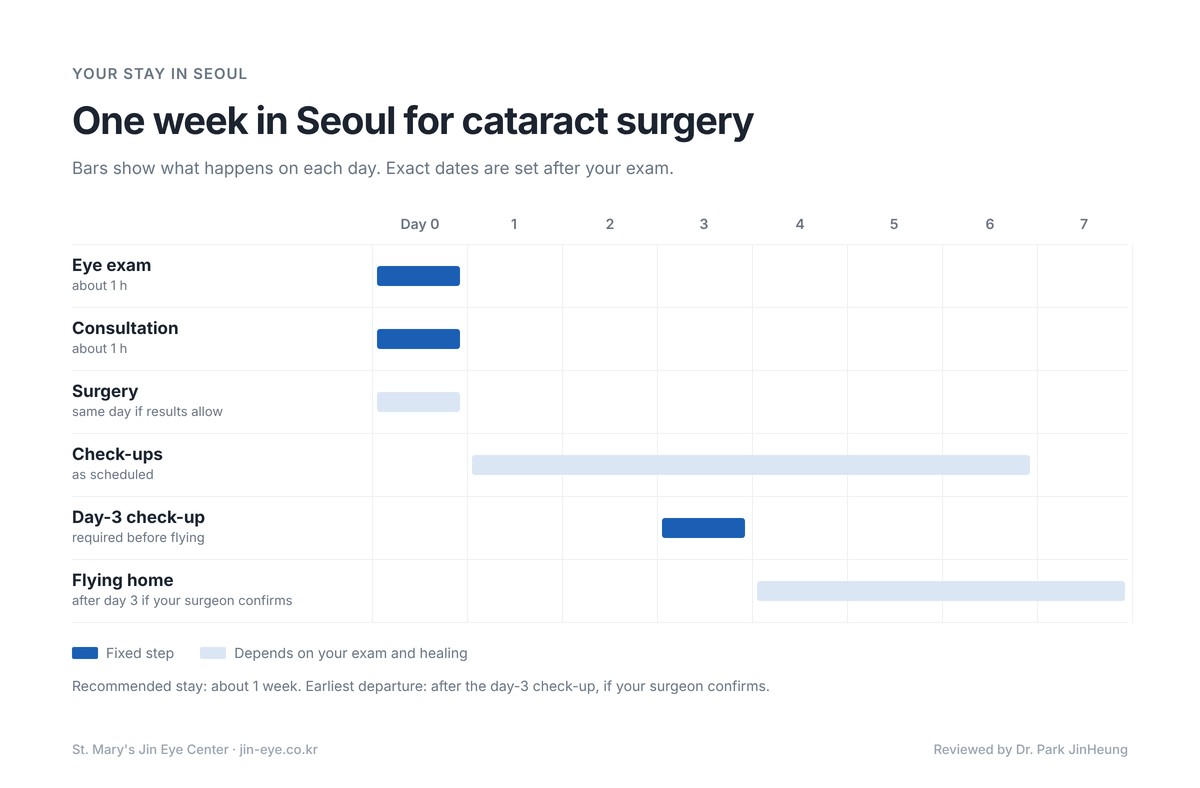
We recommend planning about one week in Seoul. The earliest you can usually leave is after your check-up on day 3 after surgery, and only if your surgeon confirms that the eye is healing as expected. The departure date is a medical decision made on the day, not a fixed promise, so a flight you can change is the safer choice. Being cleared to fly does not mean that recovery is complete, and follow-up care is still needed after you return home.
Why a week? According to the American Academy of Ophthalmology, altitude is not the main concern after cataract surgery; being far from your surgeon is. Ophthalmologists usually see patients the day after surgery and again around 5 to 8 days later, because rare but serious problems are most likely to show up in that window.
| Step | Time | What to know |
|---|---|---|
| Pre-surgery eye exam | About 1 hour | Measurements that decide the lens power, plus checks of the cornea and retina |
| Consultation and consent | About 1 hour | Lens choice, risks and your schedule are explained before you sign |
| Cataract surgery | Same day may be possible | Depends on your exam results; otherwise it is scheduled for another day |
| Check-ups after surgery | As scheduled by your surgeon | An early check may be scheduled soon after surgery if needed. A check-up on day 3 after surgery is required before you fly. Your surgeon sets the dates of any other check-ups |
| Flying home | After the day-3 check-up at the earliest | Only if your surgeon confirms healing. A 1-week stay is recommended |
Times are approximate. Your exact schedule is set after the exam.
Your vision may be blurred after the dilating drops used for the exam and after surgery. Do not drive, and plan safe transport back to your accommodation.
Can both eyes be done during one trip?
It depends on your eyes, and the surgeon decides after the exam. The National Eye Institute notes that when both eyes need surgery, each eye is operated on at a separate time, usually about a month apart.
When you contact us, tell us whether one or both eyes have been diagnosed with cataract and how many days you can stay. This lets us discuss a realistic plan with you before you book flights, including whether the second eye is better treated on a later visit.
How much does cataract surgery cost in Korea for international patients?
Our clinic publishes a starting price for standard (monofocal) cataract surgery and quotes premium lenses after the exam.
| Item | Price (KRW) | Notes |
|---|---|---|
| Eye exam (exam-only visit) | ₩80,000 | Comprehensive pre-surgery exam |
| Monofocal cataract surgery | From ₩1,500,000 per eye | Final price confirmed after the exam |
| Premium lenses (EDOF, multifocal, toric) | Quoted after the exam | Depends on which lens suits your eye |
Clinic fees only; travel and accommodation are not included. Ask us what your quote includes, for example the exam, eye drops and follow-up visits. All prices are confirmed after the comprehensive exam.
Premium lens prices depend on which of our 14 lens types fits your eye, so we quote them after the exam rather than publish a single number. For the full overview of lenses and fees, see our cataract surgery page for international patients.
Which lens should I choose: monofocal, EDOF or multifocal?
A 2016 Cochrane review of 20 trials (2,230 people enrolled) found that distance vision was probably not very different between multifocal and monofocal lenses (moderate-certainty evidence). People with multifocal lenses may have better near vision and need glasses less often, but haloes were reported about 3.6 times as often (moderate-certainty evidence) and glare somewhat more often (low-certainty evidence). The review describes the lenses studied at that time, not every newer lens model.
We use 14 lens types from Alcon, Johnson & Johnson and other makers, including Clareon PanOptix Pro (introduced in Korea in April 2026), TECNIS Odyssey, TECNIS PureSee, TECNIS Synergy, TECNIS Eyhance, Clareon PanOptix, AcrySof IQ Vivity, PanOptix, FINEVISION, Vivinex and AT ELANA. Surgery is performed with equipment such as the Alcon Centurion Vision System and the ZEISS OPMI Lumera microscope.
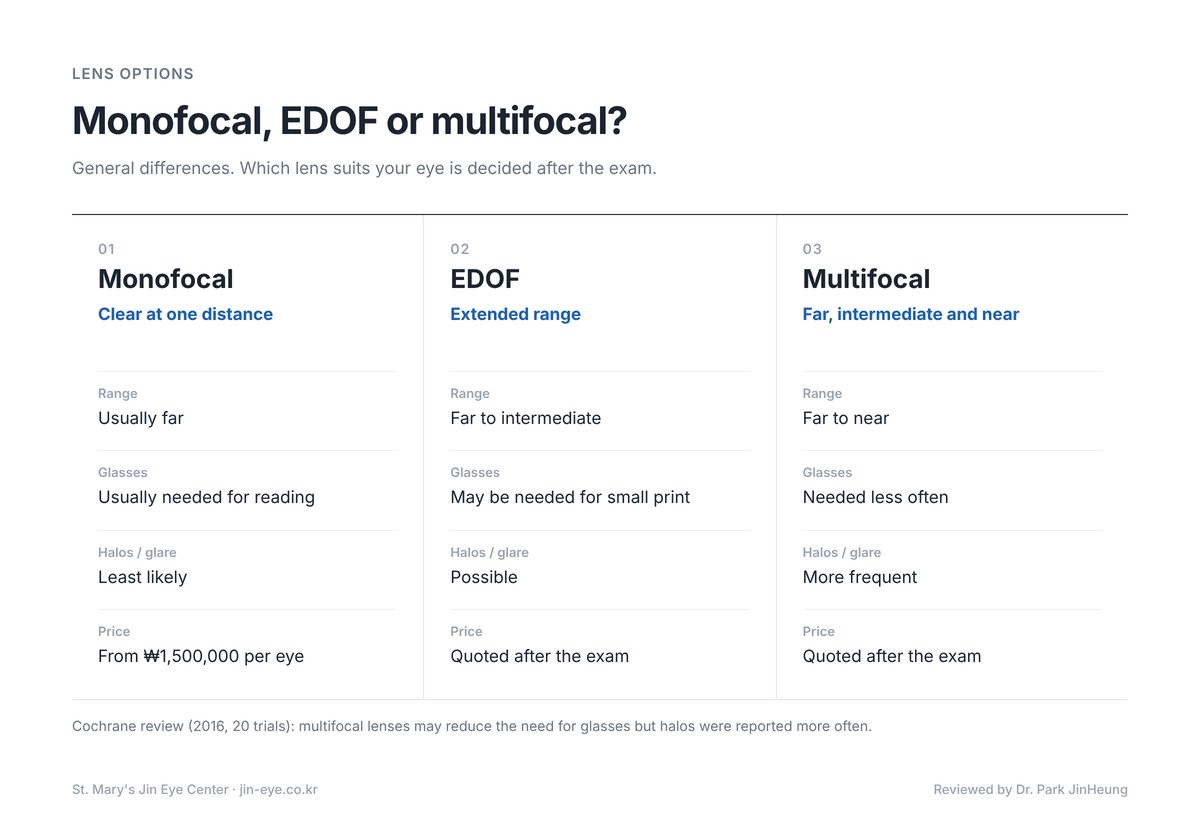
The right lens depends on the whole eye, not only the cataract. Some retinal or corneal conditions and dry eye can make a multifocal lens a poor fit. If you strongly wish to be free of glasses, your surgeon will explain the benefits and limits of multifocal lenses and assess whether your eye is suited to one.
What should I prepare before flying to Seoul?
Sending a few details in advance makes the first day in Seoul more efficient.
- Your current glasses or contact lens prescription and any recent eye exam reports you have
- Previous eye surgery or laser treatment, such as LASIK, which changes how the lens power is calculated
- General health conditions such as diabetes or high blood pressure
- A list of all your medicines, especially blood thinners and medicines for prostate or urinary problems. Do not stop any prescribed medicine on your own; check with your surgeon and the doctor who prescribed it whether any change is needed
- If you wear contact lenses: stop soft lenses 5 days, hard (RGP) lenses 2 weeks and orthokeratology lenses 4 weeks before the exam. These are standard minimum periods, and more time or repeat measurements may be needed
You can request a date through our online booking form or by email at jin.eye.center@gmail.com. Practical information for overseas visitors is on our international patients page.
What are the risks and limits of cataract surgery?
Cataract surgery is common, but it is still surgery. The NEI reports that about 9 out of 10 people see better afterwards, and lists possible risks that include:
- Swelling, bleeding or infection inside the eye
- Vision loss or double vision
- Unusual changes in eye pressure
- Retinal detachment
A common later problem is clouding of the back of the capsule that held your natural lens (posterior capsule opacification). It can appear weeks to years after surgery, and if it affects your vision a short laser procedure may be considered. Other eye diseases such as macular degeneration, glaucoma or diabetic retinopathy can limit how much vision improves. Some EDOF and multifocal lenses can cause halos or glare; how likely this is depends on the lens design, and some people still need glasses for certain tasks. Most people are completely healed about 8 weeks after surgery, so part of your recovery will happen after you return home.
If you notice a sudden drop in vision, increasing pain or redness, or new flashes, floaters or a curtain over your vision, see an eye doctor in person immediately. If you cannot see an eye doctor quickly, go to an emergency department. Do not wait for an email reply from us.
What happens after I return home?
Keep using your eye drops exactly as instructed and keep the follow-up visits your surgeon recommends with an eye doctor at home. Before you fly, book a follow-up visit with an eye doctor near your home, and ask us for your surgery report, the lens model and power, post-operative instructions and contact information.
Your final glasses prescription, if you need one, is usually decided after the eye has healed. If you have questions after returning home, you can contact us by email or phone.
Frequently asked questions
How long should I stay in Korea after cataract surgery?
We recommend about one week in Seoul. The earliest departure is usually after the check-up on day 3 after surgery, and only if your surgeon confirms that the eye is healing well. Being cleared to fly does not mean recovery is complete, so follow-up care is still needed at home.
Can I have cataract surgery on the same day as my eye exam?
It may be possible, depending on your exam results. The exam takes about 1 hour and the consultation about 1 hour. If same-day surgery is not suitable, it is scheduled for another day.
How much does cataract surgery cost in Korea for foreigners?
At St. Mary’s Jin Eye Center, monofocal cataract surgery starts from ₩1,500,000 per eye and an exam-only visit is ₩80,000. Premium lenses are quoted after the exam. All prices are confirmed after the comprehensive exam.
Can both eyes be operated on during one trip?
Your surgeon decides after the exam. The U.S. National Eye Institute notes that each eye is usually operated on at a separate time, about a month apart. Tell us how long you can stay so we can discuss a realistic plan before you book flights.
Do I need to stop wearing contact lenses before the exam?
Yes. Stop soft contact lenses 5 days, hard (RGP) lenses 2 weeks and orthokeratology lenses 4 weeks before the exam, because lenses can change the shape of the cornea and affect the measurements. These are standard minimum periods, and more time may be needed.
What should I do if I have a problem after I fly home?
If you notice a sudden drop in vision, increasing pain or redness, or new flashes, floaters or a curtain over your vision, see an eye doctor in person immediately. If you cannot see an eye doctor quickly, go to an emergency department. Do not wait for an email reply. Bring the details of your surgery and contact us as well.
- Address: 337 Gangnam-daero, Seocho-gu, Seoul (1st, 4th and 5th floors), about 5 minutes on foot from Gangnam Station Exit 5
- Hours: Mon–Fri 09:00–18:00 (lunch 13:00–14:00), Sat 09:00–15:00 (Korea time). Hours may differ on Korean public holidays, so please confirm your appointment before you travel
- Phone: +82-2-577-7782 · Email: jin.eye.center@gmail.com
- Doctors: Dr. Park JinHeung and Dr. Park Jae-hyun, ophthalmologists and former faculty of Seoul St. Mary’s Hospital, specializing in retina and anterior segment respectively
- Experience: 21,000+ presbyopia and cataract surgeries, 14,000+ vision correction surgeries and 70+ SCI papers (cumulative, all doctors)
- Registered medical institution for attracting foreign patients in Korea
This article provides general medical information and does not replace an individual diagnosis. Whether surgery is suitable, which lens is used and when you can travel are decided after an examination by an ophthalmologist. All surgery carries a risk of side effects.