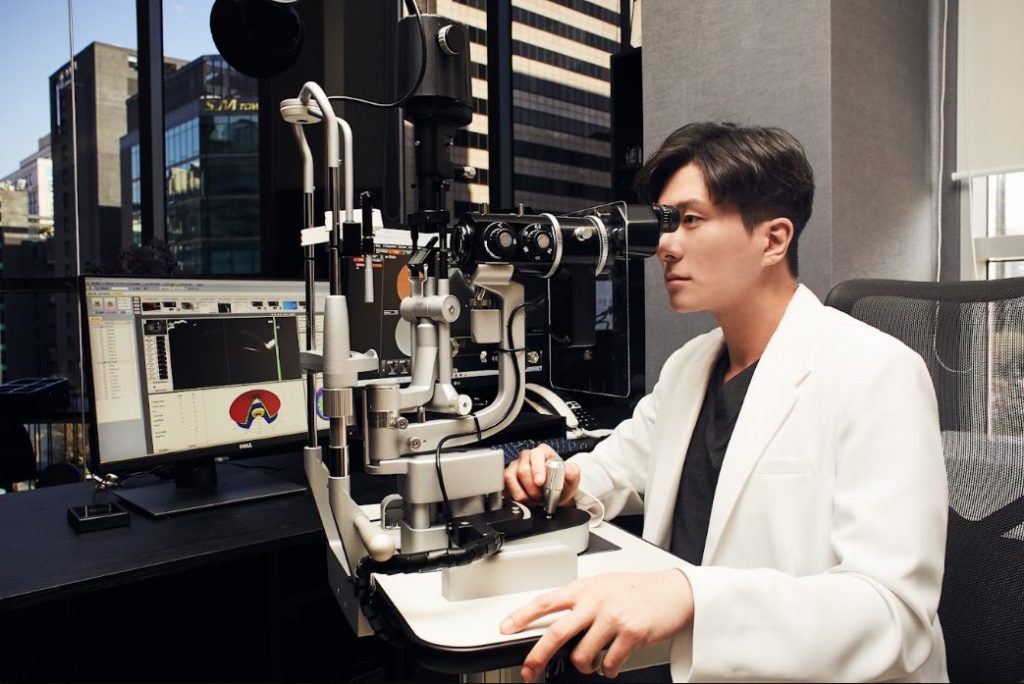





If you wear contact lenses, stop wearing them before your SMILE LASIK examination: 5 days for soft lenses, 2 weeks for hard (RGP) lenses and 4 weeks for ortho-K lenses at St. Mary’s Jin Eye Center in Seoul. Contact lenses before SMILE LASIK can temporarily change the shape of the cornea, and the surgery is planned from those measurements. Stopping in time is also what makes a same-day examination and surgery possible for patients travelling to Korea.
Medically reviewed by Dr. Park Jin-hyung, Director, St. Mary’s Jin Eye Center (Ophthalmologist, PhD; Adjunct Professor, Seoul St. Mary’s Hospital) · Last updated 25 September 2026
Why do you need to stop wearing contact lenses before SMILE LASIK?
A contact lens sits directly on the cornea. Over hours and days it can press on the corneal surface, change its curvature slightly and affect the tear film. The pre-operative examination for SMILE LASIK measures exactly these things: corneal shape (topography), corneal thickness, the amount and axis of astigmatism, and how healthy the tear film is.
If lenses are worn right up to the examination, the numbers may describe a temporarily changed cornea rather than your real one. Surgery planned on those numbers could be less accurate. The lens break is therefore not a formality; it protects the accuracy of the measurements that your surgeon uses to plan the treatment.
- Corneal curvature and astigmatism readings return to their natural values
- Corneal thickness can be measured accurately
- Dryness and tear-film quality can be assessed without the lens effect
How long should you stop each type of contact lens?
The harder and more shape-changing the lens, the longer the cornea needs to settle. These are the intervals we use for contact lenses before SMILE LASIK, LASEK and ICL at our clinic in Gangnam:
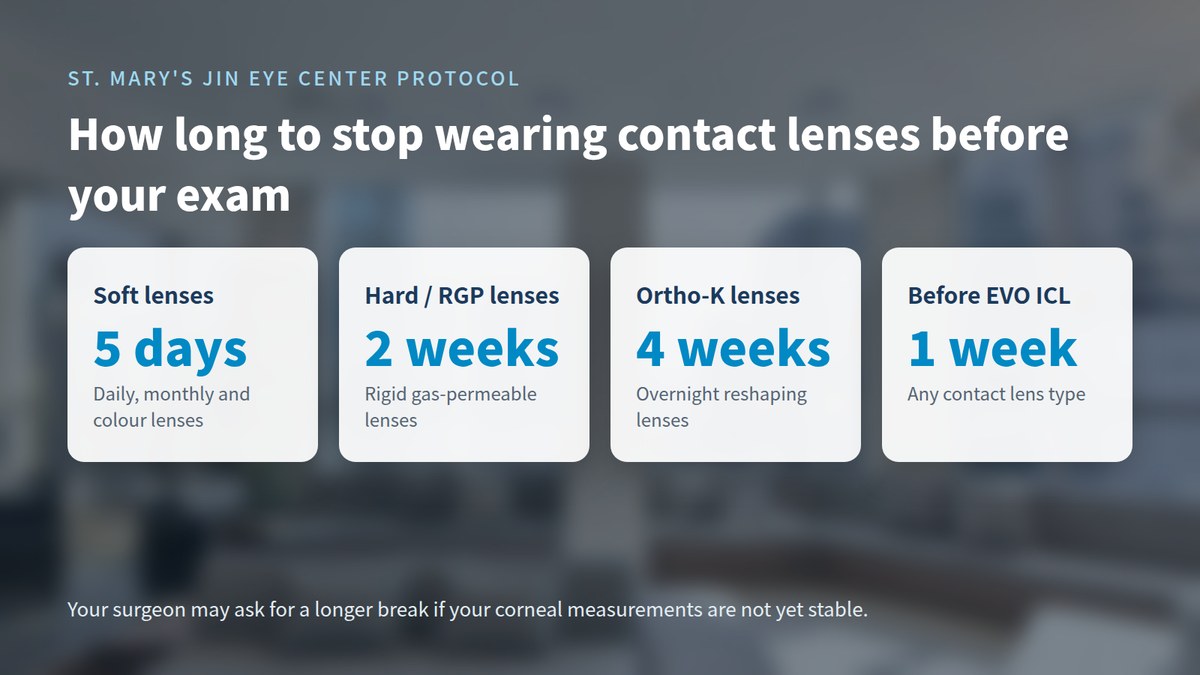
| Lens type | Stop before the examination | Why |
|---|---|---|
| Soft lenses (daily, monthly, coloured) | 5 days | Mild, short-lived effect on the corneal surface |
| Hard / RGP lenses | 2 weeks | Rigid lenses reshape the cornea more |
| Ortho-K (overnight) lenses | 4 weeks | Designed to flatten the cornea, so it needs the longest recovery |
| Any lens, before EVO ICL | 1 week | Accurate measurements are needed to size the implantable lens |
Recommended intervals differ between clinics and guidelines. If your measurements are not yet stable on the day, your surgeon may ask for a longer break before planning surgery.
Can you have SMILE LASIK after wearing contact lenses for many years?
Years of wearing contact lenses before SMILE LASIK is a common situation. In most cases, long-term lens wear does not rule out SMILE LASIK by itself. What matters is the condition of your cornea after the lens break: its thickness and shape, your prescription, and the health of the ocular surface. Many long-term lens wearers have some degree of dry eye, so the tear film is checked carefully during the examination.
The type of vision correction is decided by your surgeon after the examination. We perform 7th-generation SILK SMILE LASIK (ELITA, Johnson & Johnson Vision), LASEK sepenuhnya laser (Schwind Amaris Red) and EVO ICL. If the cornea is thin or the prescription is high, LASEK or EVO ICL may suit your eyes better.
Why does the lens break matter for same-day surgery in Seoul?
Because overseas patients stop their lenses at home before they fly, the examination and surgery are normally done on the same day for LASEK, SMILE LASIK and ICL. Booking in advance is required. A typical day looks like this:
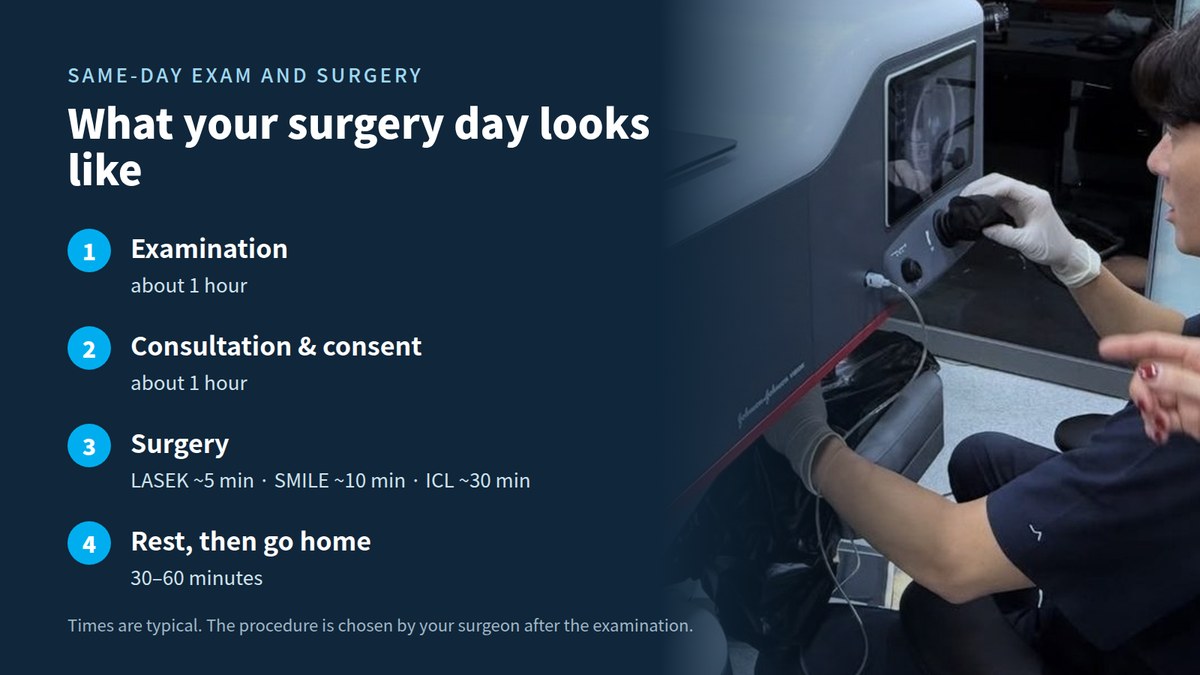
- Examination: about 1 hour
- Consultation and consent: about 1 hour
- Surgery: about 5 minutes for LASEK, 10 minutes for SMILE LASIK and 30 minutes for ICL
- Rest: 30 minutes to 1 hour before you go home
After surgery we recommend staying in Korea for about one week. If your schedule is tight, stay at least until the check-up on day 3 after surgery. Tell us your travel dates when you book so the plan fits your trip.
How should you prepare in the days before your examination?
Beyond stopping contact lenses before SMILE LASIK, a few simple steps help the examination go smoothly:
- Switch to glasses on the date that matches your lens type, and bring them with you.
- Note the brand, type and prescription of the contact lenses you wear.
- Tell the team if your eyes are red, itchy or infected; inflammation can affect the results.
- Bring a list of eye drops and medicines you use.
- Sleep well the night before; tired eyes can make some measurements less reliable.
For general background on laser vision correction, see the American Academy of Ophthalmology.
Pertanyaan yang sering diajukan
How long should I stop wearing soft contact lenses before SMILE LASIK?
At St. Mary’s Jin Eye Center, stop soft lenses, including daily, monthly and coloured lenses, 5 days before your examination. Wear glasses during that time.
How long should I stop hard (RGP) lenses or ortho-K lenses?
Stop hard or rigid gas-permeable lenses 2 weeks before the examination and ortho-K (overnight) lenses 4 weeks before. These lenses change the shape of the cornea more, so it needs longer to settle.
I am planning EVO ICL. Do I still need to stop contact lenses?
Yes. Stop any contact lenses 1 week before an EVO ICL examination so that the measurements used to size the lens are accurate.
I have worn contact lenses for more than ten years. Can I still have surgery?
Long-term lens wear does not rule surgery out by itself. The decision depends on the condition of your cornea and tear film after the lens break, which is measured during the examination.
Can I have the examination and surgery on the same day?
Yes. Because overseas patients arrive having already stopped their lenses, the examination and surgery are normally done on the same day for LASEK, SMILE LASIK and ICL. Booking in advance is required.
What should I bring to the examination?
Bring your glasses, the name and prescription of the contact lenses you wear, and a list of any eye drops or medicines you use. Tell the team if your eyes are red or irritated.
Visiting St. Mary’s Jin Eye Center
We are at 337 Gangnam-daero, Seocho-gu, Seoul, a 5-minute walk from Gangnam Station Exit 5. Hours: Monday to Friday 09:00–18:00 (lunch 13:00–14:00), Saturday 09:00–15:00, closed on Sundays and public holidays. St. Mary’s Jin Eye Center is registered as a medical institution for international patients.
- Information for international patients
- SMILE LASIK, LASEK and ICL costs in Korea
- Book an appointment · Tel +82-2-577-7782 · jin.eye.center@gmail.com
This article is general information and does not replace a medical examination. Suitability for surgery and the choice of procedure are decided by an ophthalmologist after a full pre-operative examination.